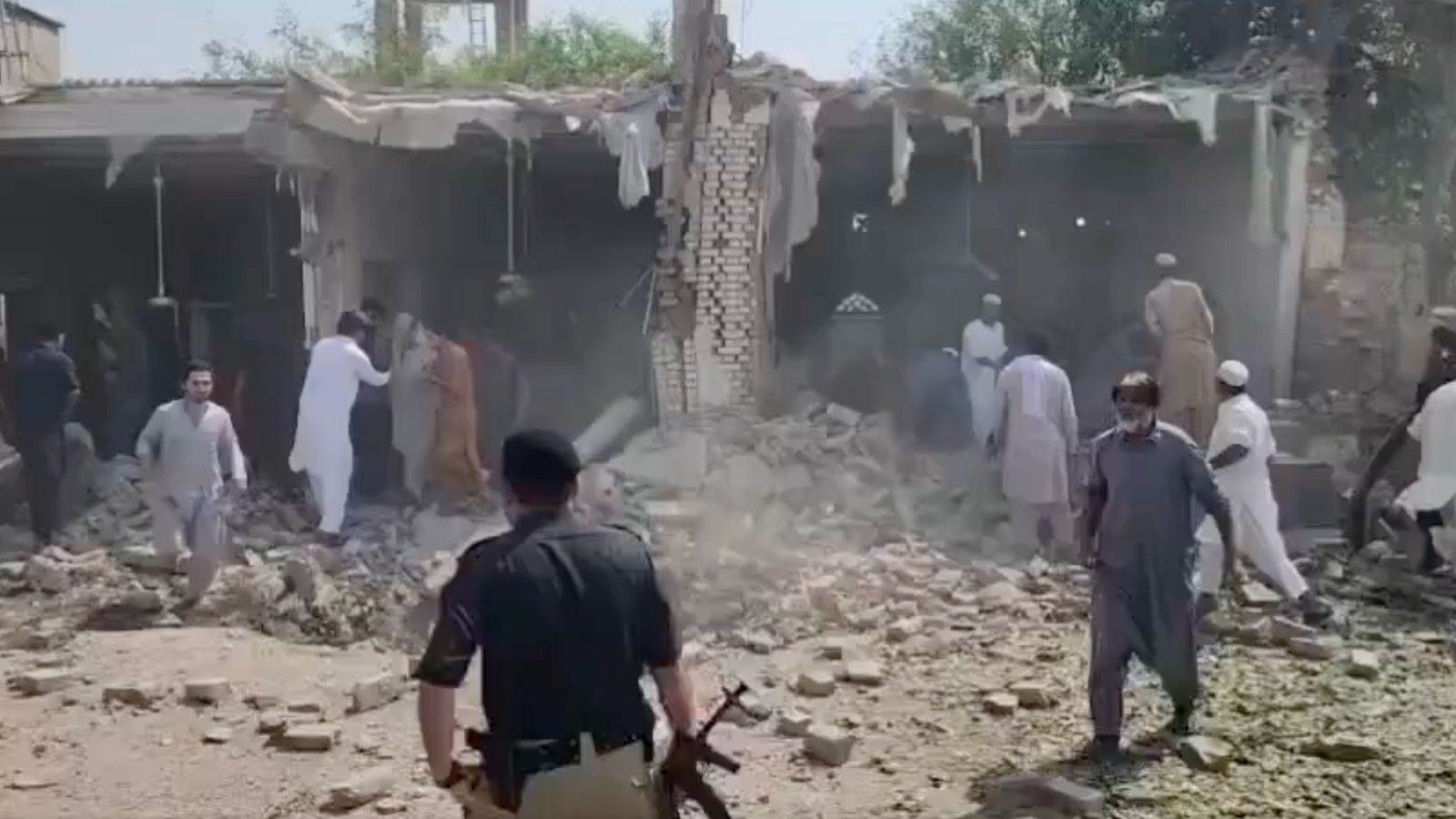
The suicide bombing at a packed mosque during Friday prayers in Pakistan represents a failure not merely of reactive policing, but of systemic risk architecture. When an adversary penetrates a perimeter where crowd density is maximized and defensive posture is static, the attack vector exploits predictable friction points in the target's operational design. Standard media reports frame such incidents through a lens of sporadic tragedy, focusing on casualty counts and emotional resonance. A rigorous security analyst must instead deconstruct the mechanics of the event: the target selection criteria, the physics of confined-space detonations, and the structural collapse of local intelligence matrices.
Targeting a place of worship during a congregational service is a calculated optimization of impact. From a tactical standpoint, Friday prayers concentrate human assets in a fixed spatial footprint for a predictable duration, eliminating the variable of mobility. The friction for the attacker is low because open-access religious sites prioritize communal inclusion over rigorous access control. When security protocols rely on visible, low-tier deterrence—such as unarmed guards or superficial bag checks—they create a false sense of institutional immunity while failing to mitigate asymmetric threats. The cost function for the attacker is heavily subsidized by this lack of active authentication rings. For another view, see: this related article.
The physical dynamics of an explosive device detonated inside an enclosed architectural structure compound the mortality rate exponentially. In an open-air environment, blast overpressure dissipates radially, reducing secondary fragmentation injuries. Enclosed masonry spaces, conversely, create a reverberation chamber effect. The initial shockwave reflects off structural walls, multiplying the overpressure spikes experienced by bodies within the radius. Furthermore, high-density human packing prevents rapid egress, causing secondary casualties through crush dynamics and structural failures of interior roofs or pillars. The lethality of the incident is therefore a direct product of environmental amplification rather than solely the chemical composition of the explosive charge.
Intelligence failures preceding such incidents typically stem from bureaucratic silos and the absence of predictive anomaly detection. Law enforcement agencies often operate reactively, mapping known threat networks rather than monitoring behavioral precursors or logistical anomalies in precursor acquisition. Intelligence-led policing requires continuous threat modeling, including Red Teaming exercises that simulate how an adversary would bypass existing checkpoints. When these frameworks are absent, defense mechanisms remain static while adaptive adversaries evolve their infiltration methods. Similar insight regarding this has been published by NBC News.
Addressing these vulnerabilities requires a shift from perimeter hardening to a layered defense-in-depth model. Hardening a facility cannot mean turning community spaces into militarized zones, which would defeat their social function. Instead, security architecture must integrate invisible layers: community-based awareness training, randomized dynamic checkpoints rather than stationary ones, and intelligence sharing protocols that connect local administrative nodes with regional counter-terrorism units. Without these systemic adjustments, high-density public spaces will remain structurally exposed to exploitation by actors who understand how to weaponize routine human behavior against institutional inertia.


