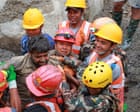
The extraction of two surviving workers from a buried hydropower tunnel nine days after catastrophic flooding along the Nepal-Tibet border presents a critical case study in prolonged subterranean endurance. Analyzing this event requires moving past standard disaster narratives to examine the physical mechanisms, systemic bottlenecks, and physiological variables that govern survival inside closed engineering infrastructure during high-energy flash flood events.
The Mechanics of Subsurface Air Pockets
When a wall of mud, boulders, and debris surges into a subterranean conduit, it does not always fill the cross-sectional area uniformly. The fluid dynamics of slurry flow inside a hard-rock tunnel create complex displacement patterns.
- Hydraulic Compression: As the debris front advances, air is compressed ahead of the slurry until it encounters structural geometry changes, such as expansion chambers, control rooms, or branching adits.
- Sealed Compartmentalization: Heavy steel doors, closed valves, and multi-level engineering designs trap residual atmospheric pressure, preventing immediate inundation.
- Thermal and Oxygen Equilibrium: Deep underground environments maintain relatively stable ambient rock temperatures, which mitigate hypothermic shock compared to surface exposure, while trapped air volumes dictate the absolute time ceiling for cellular respiration.
In the Trishuli 3A project, victims were recovered from a depth of 170 meters. At this depth, the surrounding geological mass provides structural shielding against surface crushing forces, but it simultaneously isolates the interior from immediate atmospheric replenishment. The survival window relies entirely on the initial volume-to-occupant ratio of oxygen and the containment of toxic off-gassing from construction materials or stagnant organic sludge.
The Physiology of Prolonged Confinement
Human survivability past the standard seventy-two-hour golden window in disaster zones is typically governed by access to hydration and the psychological mitigation of hypercapnia—the buildup of carbon dioxide in the blood.
- Metabolic Suppression: Trapped individuals instinctively or out of necessity reduce physical exertion, lowering metabolic oxygen demand.
- Acoustic Localization: Sound propagation through saturated rock and dense mud is heavily dampened, complicating rescue signaling. Survivors who conserve energy avoid futile screaming, reserving vocalization for confirmed acoustic contact from rescue teams.
- Psychological Anchors: Behavioral adaptation in extreme confinement dictates that cognitive focus—such as repetitive chanting or operational mental mapping—prevents panic-induced hyperventilation, which accelerates asphyxiation in closed-volume spaces.
The operational testimony from the site indicates that mechanical foreman Sanjay Shah remained in a control infrastructure zone, utilizing the immediate space to warn peers before egress routes failed. This deliberate structural positioning inside a reinforced operational core rather than a raw transit tunnel directly influenced his survival probability matrix.
Systemic Rescue Bottlenecks in Subterranean Disasters
Rescue operations executed across high-altitude, debris-choked regional infrastructure face acute logistical failure points.
- Access Obstrucions: Heavy machinery is frequently rendered useless when approach roads are sheared away by parallel riverine erosion, forcing reliance on manual excavation through tens of meters of compacted silt and boulders.
- Atmospheric Testing Lag: Entering a cleared portal without verifying internal gas composition risks immediate responder casualties due to pockets of hydrogen sulfide or carbon dioxide accumulation.
- Information Asymmetry: Surface incident commanders operate with near-zero visibility regarding internal void locations, relying heavily on historical blueprints that may have suffered structural shear displacement during the seismic or glacial trigger event.
Deploying specialized micro-tunnelling probes and seismic listening arrays remains the primary variable for cutting down search phases. In this specific event, localized acoustic tapping and faint vocal responses bridged the gap between wide-area recovery operations and precise point-extraction.
Strategic Engineering Implications for Underground Infrastructure
The frequency of glacial lake outburst floods and high-energy monsoonal surges along Himalayan river basins necessitates an immediate revision of subterranean asset design. Engineering protocols must transition from surface-level flood walls to internal compartmentalization strategies.
- Automated Isolation Valves: Installation of remotely triggered, high-pressure bulkheads designed to seal off lower-tier chambers upon sudden internal pressure spikes or electrical grid collapse.
- Independent Air Corridors: Implementation of drill-backed, armoured surface air vents that bypass primary water-conveyance tunnels to guarantee long-term atmospheric supply during sustained blockages.
- Subsurface Safe Havens: Hardened, stocked refuge chambers positioned above maximum expected hydraulic grade lines, equipped with independent rations, water filters, and emergency locator beacons.
Evaluate current subterranean facility designs against multi-axis debris flow models, prioritizing the retrofitting of rapid-seal bulkheads in active flood-zone corridors.
Two workers pulled alive from tunnel nine days after Nepal Tibet floods
This video provides visual documentation of the rescue operation and site conditions at the Trishuli 3A hydropower project following the disaster.
http://googleusercontent.com/youtube_content/1