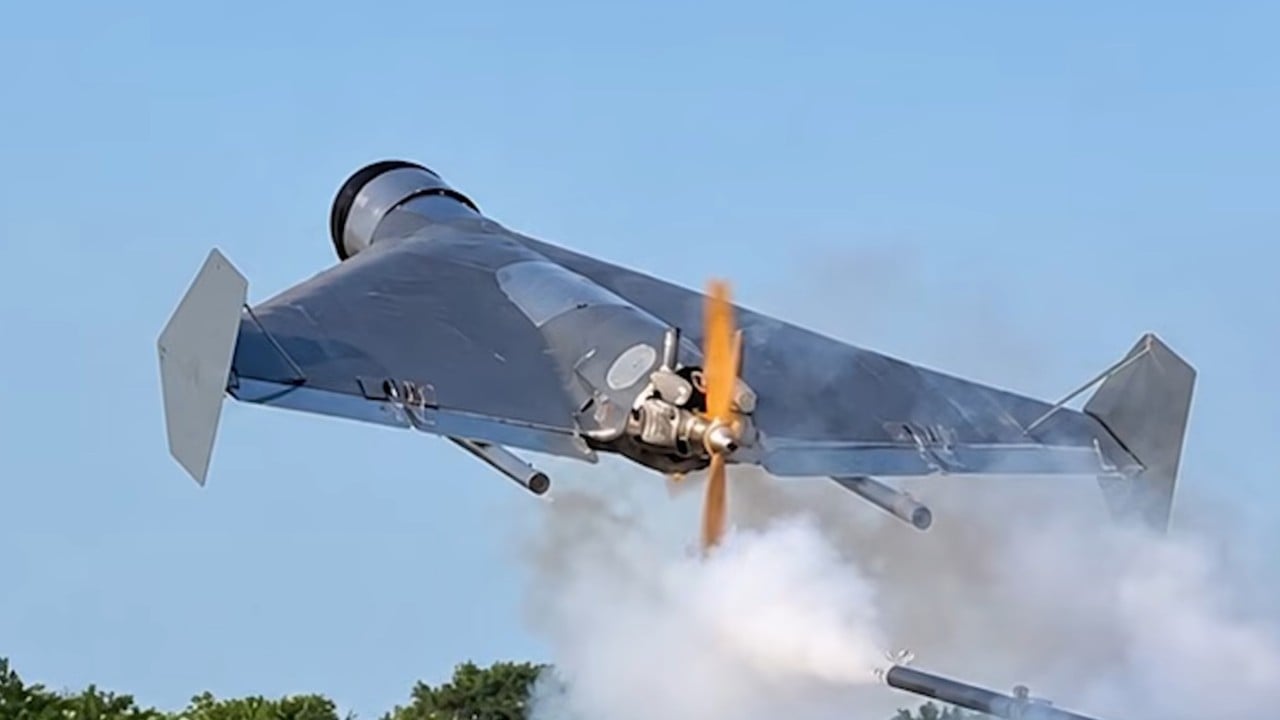
Low-cost attack drones do not automatically invert air defense economics across the Taiwan Strait; they only do so when production volume, target sets, and sensor-to-shooter timelines align against dense air and missile defenses. Popular commentary frequently treats expendable one-way attack drones—often compared to Iran's Shahed series or platforms like Taiwan's PD-136 and Chien Hsiang—as an inexpensive shortcut to exhausting People's Liberation Army air defenses. That framing misses the structural asymmetry of geography, industrial scale, and layered engagement doctrine.
A rigorous assessment requires separating what is established from what remains speculative. Known facts include the roughly 180-kilometer width of the Taiwan Strait, the existence of indigenous systems such as the Chien Hsiang anti-radiation loitering munition and newer long-range or Shahed-inspired concepts, the high unit cost of exquisite interceptors relative to expendable drones, and the People's Liberation Army's multi-tiered air defense and naval/air strike architecture. Educated hypotheses include how large a drone force Taiwan can field under wartime constraints, how effectively PLA sensors filter small slow-moving targets from clutter and decoys, and whether attriting interceptors translates into operational paralysis rather than tactical friction.
The Cost Function and Saturation Trap
The central premise behind "swamping" air defenses rests on the cost-exchange ratio between an expendable attacker and a high-value interceptor. If a defender fires a missile costing hundreds of thousands or millions of dollars at a drone costing a fraction of that amount, the defender faces fiscal and magazine exhaustion even when the intercept succeeds.
Yet cost asymmetry alone does not decide a campaign. Three operational variables govern whether a drone volley saturates a defender:
- Magazine depth and reload cadence: An air defense battery can be overwhelmed if incoming tracks exceed simultaneous engagement channels or deplete ready launchers before resupply arrives.
- Target value versus unit cost: Expending a costly missile to save a multimillion-dollar radar, command post, or amphibious ship makes rational sense; expending it to protect low-value terrain does not.
- Production elasticity: A low-cost drone only creates a numerical advantage if manufacturing lines can scale faster than attrition and survive strikes.
The second limitation of naive saturation arguments is that defenders rarely rely on a single interceptor tier. Modern air defense networks pair long-range surface-to-air missiles with medium-range systems, short-range air defense, electronic warfare, and gun or cannon systems. Using a high-end missile against a slow, low-altitude propeller drone is a failure of engagement allocation rather than an inherent law of physics. When a defender has cheaper guns, electronic attack, or overlapping sensors, the cost ratio narrows or reverses.
Consider a hypothetical coastal staging area protected by both long-range area-defense batteries and shorter-range point defenses. If fifty low-cost attack drones arrive sequentially over an hour, point defenses and electronic spoofing can absorb many of them without forcing long-range batteries to fire their highest-value rounds. Saturation occurs when hundreds of targets arrive concurrently across multiple axes, compressing decision times and forcing high-value interceptors into service because cheaper layers are saturated or out of range.
Why Geography and Range Reshape the Strait Equation
Commentaries that draw direct parallels between Middle Eastern or Eastern European drone use and the Taiwan Strait often overlook distance and over-water exposure. Crossing roughly 180 kilometers of open water removes terrain masking. Low-flying drones that hug hills or tree lines over land face fewer radar horizon obstacles over water, giving shipborne, airborne, and coastal early-warning sensors clearer line-of-sight detection.
Range and payload form a tight engineering trade-off for small unmanned aerial vehicles. Increasing fuel capacity for trans-strait transit or loitering reduces warhead mass or requires a larger airframe, which in turn increases radar cross-section and manufacturing cost. A smaller payload limits destructive effect against hardened targets, shifting the drone's value toward suppression, disruption, or soft targets such as fuel depots, radar emitters, airbase support equipment, and landing craft decks.
Platform specialization also matters. An anti-radiation loitering munition such as the Chien Hsiang hunts active radar emissions, forcing radar operators to choose between radiating to track threats or shutting down and going blind. A one-way attack drone with electro-optical or satellite-aided navigation follows preplanned waypoints or terminal seekers, which behaves differently against jamming and decoy emitters. Treating all "Iran-style" or loitering drones as interchangeable obscures these distinct kill chains.
Sensor-to-Shooter Chains and Counter-Drone Friction
Swamping an air defense system is fundamentally an information and queuing problem. Air and missile defense relies on a sensor-to-shooter chain that detects a target, classifies it, assigns a weapon, guides the interceptor or effector, and assesses damage. Low-cost drones attack that chain in three ways:
- Track saturation: Flooding radar displays with numerous slow, low-signature tracks strains tracking algorithms and operator bandwidth, especially when mixed with decoys or chaff.
- Emission exposure: Forcing defending radars to stay active to spot small drones increases their vulnerability to anti-radiation munitions or standoff strikes.
- Magazine drainage: Compelling defenders to fire expensive interceptors when cheaper counter-UAS options are unavailable or out of position.
Countering this requires looking at the other side of the ledger. The PLA fields layered air defenses, electronic warfare assets, and unmanned systems of its own, including long-range unmanned platforms and expendable decoys or converted aircraft. Moreover, mobile air defense units and point defenses can disperse and displace to complicate targeting, while electronic warfare can degrade unhardened navigation or datalink channels.
A common analytical error is assuming that every drone launched crosses the strait intact and reaches its intended target. In practice, attrition occurs along a funnel: pre-launch strikes on launchers or storage sites, transit attrition from air patrols, shipboard or coastal air defenses, and electronic interference, followed by terminal defenses near the aimpoint. Only the surviving fraction tests the final defensive ring.
Industrial Scaling Versus Wartime Survivability
A force of low-cost drones is only as credible as the industrial base behind it. Peacetime prototypes and small-batch production differ sharply from wartime surge output. Scaling unmanned systems depends on four bottlenecks:
- Propulsion and avionics supply chains: Engines, flight controllers, inertial measurement units, and secure navigation modules must be sourced without single points of failure.
- Distributed assembly: Centralized factories are prime strike targets; dispersed workshops or modular assembly require standardized parts and quality control.
- Testing and software integration: Autonomy, waypoint resilience, and electronic-warfare resistance require continuous iteration rather than static hardware builds.
- Sustainment and logistics: Batteries, fuel, launchers, and trained launch crews must move under contested conditions.
These constraints expose the limits of treating low-cost drones as a standalone strategic panacea. Drones cannot hold territory, replace hardened air defenses, or guarantee precision against heavily armored or deeply buried targets. Over-relying on one asymmetric tool invites counter-adaptation, such as cheaper interceptors, directed energy, net or kinetic point defenses, and hardened infrastructure.
Strategic Action for Force Planners
Defense planners evaluating low-cost attack drones for Taiwan should pair mass production of expendable strike and decoy systems with a dedicated, low-cost counter-drone tier and hardened launch/production dispersal rather than relying on high-end interceptors alone. Force design should treat low-cost drones as a compositional multiplier—sized to force expensive defensive responses, suppress radars, and strike soft or time-sensitive nodes—while funding affordable point-defense interceptors, electronic warfare, and distributed manufacturing so the cost and attrition math holds under sustained pressure.


