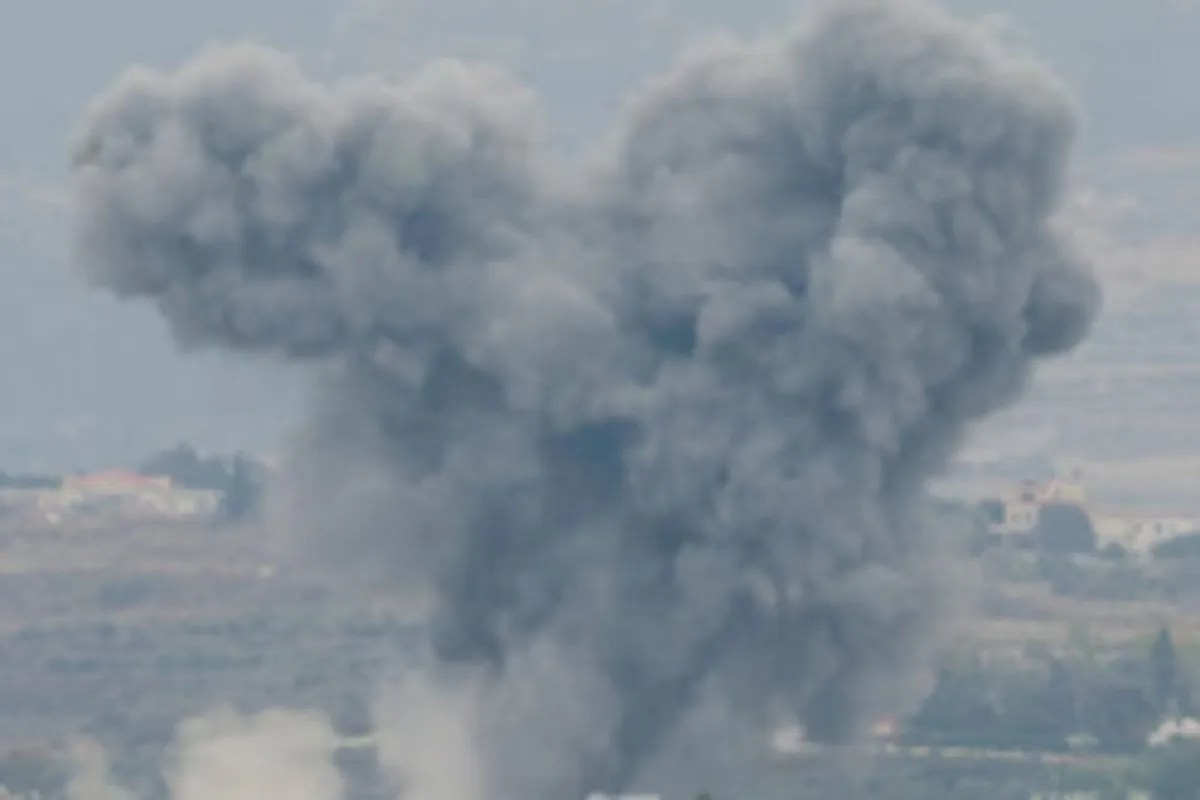
Headline reports announcing that four militants were killed in an Israeli strike strip away the strategic mechanics of post-ceasefire warfare. A bare body-count headline frames a tactical event as a self-contained victory or a simple act of retaliation, ignoring how kinetic strikes operate inside a fragile truce where large-scale combat has paused but political and military objectives remain unresolved.
Standard news coverage of targeted strikes typically relies on three thin conventions: sensationalizing the targets as "feared" or "notorious" figures, treating the strike as an isolated episode detached from broader negotiations, and relying on unverified or conflicting casualty tallies without separating military claims from local reports. That approach leaves readers unable to answer the practical questions that matter: Why do strikes continue after a ceasefire takes effect? What organizational function does eliminating mid-level or operational personnel serve? And what trade-offs govern this approach?
Understanding post-ceasefire strikes requires examining them through four analytical lenses: The Attrition-vs.-Disarmament Mechanism, The Three Tiers of Militant Value, The Escalation and Stalemate Cost Function, and Verification and Information Asymmetry.
The Attrition-vs.-Disarmament Mechanism
When a major ceasefire halts full-scale offensive operations—as occurred with the October 2025 truce in Gaza—the conflict often shifts from territorial maneuver to low-intensity enforcement and pressure. Under post-war frameworks tied to U.S.-backed mediation efforts, long-term stabilization depends on sequencing: halting large-scale hostilities, returning hostages or remains, funding reconstruction, and securing militant disarmament alongside Israeli troop withdrawals.
When disarmament stalls, kinetic strikes function as a coercive substitute for negotiated demilitarization. Rather than attempting to clear entire neighborhoods through mass ground assaults, military forces use intelligence-driven air or drone strikes against individuals or small cells accused of plotting attacks, maintaining command structures, or rebuilding combat capacity during the truce.
The cause-and-effect chain operates along a clear sequence:
- Disarmament impasse: Armed factions refuse to surrender weapons prior to full troop withdrawal, while military authorities decline full withdrawal until security threats are neutralized.
- Reconstruction bottleneck: International recovery and stabilization funding remains stalled or conditioned on demilitarization milestones.
- Selective kinetic enforcement: Military forces conduct targeted strikes against alleged planners, field commanders, or operatives linked to past or future attacks, framing the action as ceasefire enforcement rather than a return to all-out war.
- Political and operational friction: Factions accuse the military of violating the truce, civilian and non-combatant casualties fuel local anger, and trust in diplomatic sequencing erodes further.
In plain terms, a four-person strike in a ceasefire environment is rarely just a standalone incident. It is a symptom of an unfinished political settlement where enforcement by force is filling the gap left by stalled disarmament.
The Three Tiers of Militant Value
Sensationalist headlines treat every killed militant as an equivalent "mastermind" or "hardened terrorist," which obscures how armed networks actually function. In insurgent and militant organizations, eliminating four individuals has vastly different operational effects depending on where those personnel sit in the hierarchy and what skills they hold.
Tier 1: Strategic and Command Nodes
Senior political leaders, brigade or battalion commanders, and senior planners hold institutional memory, external coordination links, and authority over resource allocation. Removing leaders at this tier can disrupt strategic decision-making, at least temporarily, though surviving deputies often compete for succession or decentralize authority to avoid concentrated intelligence signatures.
Tier 2: Tactical Field Leaders and Specialists
Platoon commanders, unit leaders, snipers, tunnel or rocket specialists, and veterans of major assaults—such as operatives linked to specialized units or past cross-border attacks—carry tactical know-how and direct influence over small teams. Losing a field commander or specialist degrades local readiness and raises training costs for the group, especially when recruits are less experienced than veteran cadres.
Tier 3: Rank-and-File Fighters and Couriers
Entry-level gunmen, sentries, or logistics runners are numerous and easier to replace. Killing operatives at this tier imposes human loss on the organization and deters movement, but it rarely alters strategic capability on its own.
Consider a practical example of how this distinction plays out. If a strike hits a unit commander and a veteran operative who participated in a major prior attack while they are meeting to coordinate new operations, the group loses both leadership continuity and immediate operational momentum. Conversely, if a strike hits low-level personnel without disrupting command or weapons caches, the organization absorbs the loss through rapid replacement—even as the strike carries full political weight in public reporting.
The Escalation and Stalemate Cost Function
Every strike during a truce alters a complex cost function for both sides. A sound strategic assessment tracks four primary cost variables rather than counting fatalities alone:
- Operational disruption cost (for the armed group): Time lost reorganizing cells, heightened communications security that slows coordination, and morale strain among remaining fighters.
- Political and diplomatic cost (for the striking military): Friction with mediators, pushback from populations affected by ongoing strikes, and heightened scrutiny whenever civilians or non-combatants are caught in or near the target area.
- Retaliation and force-protection cost: Risk of attacks against troops holding positions or operating along perimeters, requiring sustained defensive readiness and intelligence overhead.
- Opportunity cost of stalled diplomacy: Every exchange of strikes and accusations reinforces mutual distrust, making concessions on troop redeployment, governance, and reconstruction harder to negotiate.
This is where sensational coverage misses the core paradox: tactical precision does not automatically produce strategic resolution. A military can locate and strike small groups of operatives repeatedly, yet still face a durable insurgency if political governance, border control, and disarmament remain unresolved. At the same time, refraining from strikes when intelligence indicates active attack planning carries its own severe risk to troops and civilians. Both restraint and enforcement impose real costs.
Verification and Information Asymmetry
A rigorous analysis must clearly separate established facts from contested claims and analytical inferences. In conflict zones—especially under ceasefire conditions where access for independent observers is restricted—information asymmetry is structural.
Known facts typically include:
- A kinetic strike occurred in a specific location or timeframe, and local sources or medical facilities reported a specific number of fatalities.
- The military issued a statement identifying targeted individuals by role or affiliation and stating the operational rationale, such as thwarting planned attacks or targeting participants in past operations.
- Broader truce terms, political disputes over compliance, and stalled reconstruction or disarmament milestones frame the environment in which the strike took place.
Contested claims and limits:
- Militaries generally assert that strikes targeted militants or attack planners, whereas local health authorities and residents frequently report civilian deaths or dispute the military characterization of the incident.
- Casualty tallies compiled by local health ministries often do not distinguish between combatants and civilians, while military statements rely on classified intelligence that is rarely released in full.
Educated hypotheses:
- Assessing how much a specific four-person strike degrades an armed group's future capability is an analytical judgment based on rank, role, and prior patterns of leadership attrition, not a directly measurable certainty.
Why do limitations matter here? Because targeted strikes have inherent ceiling effects. Decades of counterinsurgency and counterterrorism history show that targeted killings can degrade specific networks, disrupt plots, and keep pressure on leadership, yet rarely end a conflict on their own when underlying political grievances, external supply lines, or leadership regeneration mechanisms remain intact.
How to Audit Headlines Like This in Practice
Readers and analysts evaluating reports of targeted strikes can apply a disciplined four-step verification workflow before drawing conclusions:
- Check the ceasefire context: Determine whether the strike occurred during active large-scale combat or inside a formal truce or mediation framework, and note what political or diplomatic tracks are currently stalled.
- Classify the targets by tier: Look past adjectives like "feared" or "notorious" to see whether the report specifies command roles, specialist skills, involvement in prior attacks, or simply general affiliation.
- Separate attribution from independent corroboration: Compare the military's operational statement against local reports, named identifications, and any accounts of civilian casualties or collateral damage.
- Trace the second-order effect: Ask whether the strike changes the negotiation incentives around disarmament, troop positioning, or aid flows, or simply sustains a low-grade cycle of strike and accusation.
Strategic Forecast
As long as the core political dispute over governance, security guarantees, and disarmament remains unresolved, targeted strikes on small groups of operatives will continue to serve as an instrument of containment and pressure rather than a decisive off-ramp. Expect sporadic strikes against alleged field commanders, attack planners, and veteran operatives to persist alongside contested casualty reports and mutual accusations of truce violations. Sustainable de-escalation will not come from incremental strikes alone; it will require a verifiable enforcement and disarmament mechanism paired with credible political and reconstruction arrangements that reduce the incentive and capacity for armed mobilization.