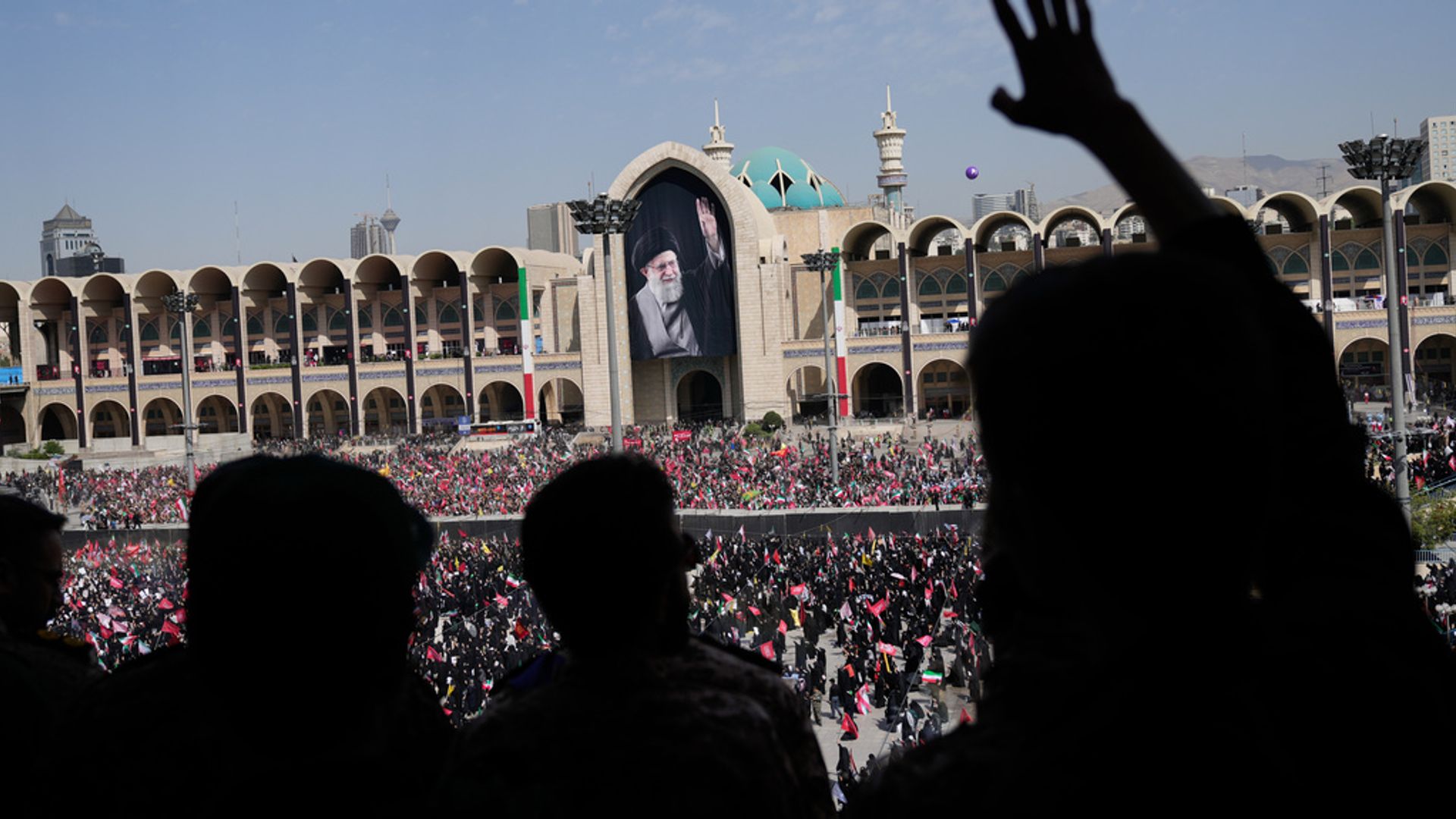
Speculation surrounding the sudden removal or death of Iran Supreme Leader Ali Khamenei frequently floods international media channels, often sparked by unverified reports of security breaches or failing health. The true crisis, however, does not lie in the sensationalized rumors of an assassination or a sudden public funeral. The real vulnerability rests within the fragile, opaque architecture designed to replace him. For decades, Western observers have focused on the public face of the clerical establishment, ignoring the quiet institutional coup mapping out the nation's future behind closed doors.
When the position of the Supreme Leader eventually falls vacant, the global community will not witness a simple religious transition. They will confront a heavily militarized corporate entity disguised as a government. The Islamic Revolutionary Guard Corps (IRGC) has spent twenty years positioning itself to dictate the next era of Iranian governance, turning the traditional clerical hierarchy into a political shield. Understanding this shift requires looking past the street demonstrations and examining the financial and military chokeholds that determine who actually holds authority in Tehran.
The Clerical Myth and the Corporate Guard
The constitutional mechanism for selecting a new leader appears straightforward on paper. The Assembly of Experts, a body of eighty-eight clerics, meets to deliberate, vote, and select a successor based on Islamic scholarship and piety. This public narrative serves to legitimize the theological state. The reality is far more transactional.
Over the past three decades, the IRGC has transformed from a voluntary ideological militia into an economic empire. It controls major construction firms, telecommunication networks, shipping lines, and energy infrastructure. The guards do not answer to the civilian president or the traditional judiciary. They answer directly to the office of the Supreme Leader, creating a symbiotic relationship where the cleric provides religious cover for economic dominance, and the military provides physical survival for the regime.
This economic entrenchment alters the entire logic of succession. The next leader cannot simply be a learned scholar of Islamic law. The individual must be someone who guarantees the continuity of the IRGC’s financial monopolies. A truly independent, highly respected religious authority could pose an existential threat to the military’s corporate interests by demanding a return to ascetic religious values or questioning corruption. Therefore, the selection process is heavily managed long before the Assembly of Experts ever casts a vote.
The Hidden Frontrunner and the Legacy Play
Discussion of Iranian succession inevitably centers on Mojtaba Khamenei, the second son of the current Supreme Leader. For years, his name has circulated in diplomatic circles as the quiet operator managing his father’s vast administrative apparatus. He possesses deep connections within the intelligence networks and commands significant respect among the senior leadership of the IRGC.
Yet, elevating a son to replace his father introduces a dangerous ideological contradiction for the Islamic Republic. The 1979 revolution was explicitly fought to overthrow a hereditary monarchy. Installing a dynastic succession undermines the foundational premise of the state, exposing the regime to accusations that it has merely replaced a secular shah with a clerical one.
The Candidate Dilemma
The regime faces a critical choice between structural legitimacy and factional survival. To navigate this, the security apparatus has systematically eliminated alternative power centers. High-ranking clerics who possessed the religious credentials to claim the office have either died under mysterious circumstances, been placed under house arrest, or found themselves politically marginalized by the state media.
- Traditional religious authorities are sidelined if they advocate for political moderation.
- The judiciary is utilized to disqualify candidates who show signs of independent economic policy.
- Media blackouts ensure that only figures aligned with the security state receive national prominence.
This deliberate narrowing of choices leaves the establishment highly vulnerable to internal friction. If the chosen successor lacks genuine religious authority, the regime loses its theological justification among devout citizens. If they choose a weak figurehead to satisfy the clerics, the security apparatus risks creating a power vacuum that rival factions within the military will attempt to exploit.
The Regional Explosion of a Power Vacuum
The consequences of an unstable transition extend far beyond the borders of Iran. The nation has spent the last two decades building an extensive network of regional proxy forces, stretching from the Mediterranean to the Arabian Peninsula. These groups rely heavily on personal networks, direct funding pipelines, and ideological allegiance to the person of the Supreme Leader.
A prolonged, contested succession crisis in Tehran threatens to sever these vital connections. Without clear direction from the center, local commanders of these proxy groups may begin acting independently, pursuing parochial agendas that conflict with broader state strategy. This decentralization increases the risk of miscalculation, potentially drawing regional adversaries into a wider conflict that neither side originally intended to provoke.
Furthermore, domestic instability routinely prompts the regime to project strength externally. When faced with internal challenges, the security apparatus historically escalates tensions abroad to rally nationalist sentiment and justify harsh crackdowns at home. The period immediately following a transition will likely see increased naval provocations in the Persian Gulf, cyber campaigns against foreign infrastructure, and a hardening of the state's nuclear stance.
The Failure of Domestic Opposition Movements
International analysts frequently predict that a succession crisis will serve as the catalyst for a popular revolution. They point to widespread economic dissatisfaction, systemic corruption, and frequent labor strikes as evidence that the public is ready to overthrow the regime. This perspective overlooks the sophisticated structure of internal repression that the state has perfected.
The security apparatus operates on a doctrine of fragmented control. They do not rely on a single police force; they utilize overlapping intelligence agencies, cyber monitoring units, and the Basij volunteer militia to monitor neighborhoods down to the block level. More importantly, the regime has successfully co-opted the middle class through economic dependency. With the state controlling the vast majority of the formal economy, public sector employees, factory workers, and merchants understand that open dissent means immediate economic ruin.
A transition of power will see these security networks enter a state of maximum alert. The internet will be throttled, major urban centers will see preemptive military deployments, and known activists will be detained preventively. The opposition lacks the centralized leadership, communications infrastructure, and armed capability required to challenge a military apparatus that views its own survival as a zero-sum game.
The Economic Mirage of Preemptive Sanctions
Western policy toward Iran has long relied on the mechanism of economic sanctions to force behavior modification or structural collapse. While these measures have severely degraded the standard of living for ordinary citizens and crippled civilian industries, they have had the opposite effect on the entities that will control the succession.
Sanctions have driven the Iranian economy underground, creating a massive black market for oil smuggling, currency manipulation, and illicit trade. The IRGC, by virtue of its control over borders, ports, and intelligence networks, completely dominates this shadow economy. The restrictions intended to weaken the regime have instead eliminated legitimate commercial competitors, leaving the military apparatus as the only entity capable of moving capital and securing essential goods.
When the transition occurs, the individuals taking power will be men who have grown exceptionally wealthy under the sanctions regime. They have no financial incentive to seek rapprochement with the West or reform the domestic economy. Their wealth depends entirely on maintaining the status quo of international isolation and state-directed distribution. Expecting a new leader to shift toward economic liberalization ignores the foundational financial incentives that placed them in office.
The survival of the Islamic Republic during its next transition depends entirely on whether the military leadership can maintain internal cohesion while presenting a unified front to a deeply dissatisfied public. The international community must stop waiting for a dramatic collapse born from a sudden event and begin preparing for a hardened, highly militarized state that uses the language of religion purely to defend its corporate survival.