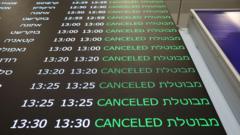
The screen in Terminal 3 is a digital altar to anxiety. It glows with a sterile, unforgiving font, flickering from green to red as names of cities vanish one by one. Tokyo. London. New York. Each disappearance is a small, controlled demolition of a thousand plans.
I remember standing in Heathrow during a winter storm years ago, watching a similar board. The air smelled of stale coffee and damp coats. Around me, hundreds of people were suspended in a strange, limbo-like state. We weren’t travelers anymore. We were hostages to a weather system that didn’t care about our anniversaries, our business mergers, or the sick relatives waiting on the other side of the Atlantic.
That is the hidden reality of the travel advisory: it is never just about wind speeds or volcanic ash or bureaucratic alerts. It is about the sudden, violent collision of our desire for mobility with the absolute indifference of the planet.
When a travel warning is issued—whether it’s due to sudden meteorological upheaval or shifting geopolitical tensions—the ripple effect is mathematical, yet the cost is entirely emotional. Airlines operate on a razor-thin margin of efficiency. Your plane isn’t just your plane. It is a puzzle piece. It arrived from somewhere else, it needs to be cleaned, refueled, and crewed, and then it must depart to make room for the next set of lives waiting to arrive.
Imagine a single bolt coming loose on a watch. The entire mechanism doesn't stop instantly, but it begins to stutter. Then it slows. Then, the silence.
The cancellation of a flight is a paradox. It is the most orderly form of chaos. You stand in a line that stretches for hundreds of yards, clutching a boarding pass that has become a useless scrap of paper. You are surrounded by people, yet you have never felt more isolated. The person next to you is crying silently, looking at a phone screen that says rebooking unavailable. You want to help, but you are barely holding your own composure together.
We act as if the sky is a highway we own, but every time a storm rolls in or a warning light blinks on a console in a control room, we are reminded that we are merely guests in an environment we do not control.
There is a cold logic to these cancellations. Airlines have algorithms that calculate the precise moment when the risk—of fuel consumption, of mechanical failure, of legal liability—outweighs the profit of the flight. When the warning is issued, those algorithms don't blink. They don't feel guilty. They just pull the plug.
And why should they? If a storm front with winds topping 70 miles per hour is carving a path through the runway trajectory, the physical reality is non-negotiable. It isn't a suggestion. It is a hard limit. Physics has a way of silencing even the most frustrated traveler.
But we ignore this. We internalize the delay as a personal affront. We think: Why me? I have a meeting. I have a wedding. I have a life.
The truth is more humbling.
Consider the logistical gravity. A commercial airliner is a massive, complex machine, and the infrastructure supporting it—from air traffic controllers to ground crews to baggage handlers—is equally complex. When an alert hits, the entire system enters a state of triage. It is not unlike a battlefield hospital. Who gets the priority? Who stays behind? The system is designed to favor the most efficient path to recovery, not the most equitable one. You are not a customer in those moments; you are a variable in an equation that is trying to balance itself.
I have watched airport staff age in real-time during these events. They become the physical embodiment of the conflict. They are the ones who must tell the grandmother that she will not make it to her grandson’s birth. They are the ones who stand behind the podium, sweating, as hundreds of people project their fears and frustrations onto them. They are the human friction in a machine that is trying to move too fast.
The real cost of these travel warnings is the erosion of trust. We live in an era where we expect the world to be a service provider. We press a button, we pay a fee, and we expect a result. When the world fails to deliver—when the wind blows or the border closes—we feel cheated. We feel like the contract has been violated.
Yet, perhaps the lesson is in the surrender.
When the flight is cancelled, you have two choices. You can rage against the machine, wasting your emotional energy on an agent who has no power to change the weather or the law. Or, you can find a corner of the terminal, sit on your suitcase, and accept the pause.
There is a strange, quiet dignity in sitting in an empty terminal at three in the morning. The harsh fluorescent lights hum. The janitors move silently, pushing their mops. You are a ghost in the machine. You have nowhere to be because the universe has decided you shouldn't be there.
There is no "next step" in these moments. There is no strategic pivot. There is only the long, slow wait for the board to change, for the wind to die down, or for the tension to break. We are so used to being in control that we forget how to be still.
The warnings will keep coming. The storms will gather. The airspace will close. And the planes will stay grounded, their engines cooling on the tarmac like iron monuments to our interrupted ambitions.
So, next time the notification pings on your phone—that dreaded Flight Cancelled—take a breath. Don’t look for someone to blame. Look at the people around you. They are all, like you, just trying to get home. We are all bound by the same sky, tethered to the same precarious schedules, waiting for the moment when the world opens up again and allows us to cross the divide.
Until then, all we have is the waiting. And that, in its own way, is the most human thing of all.