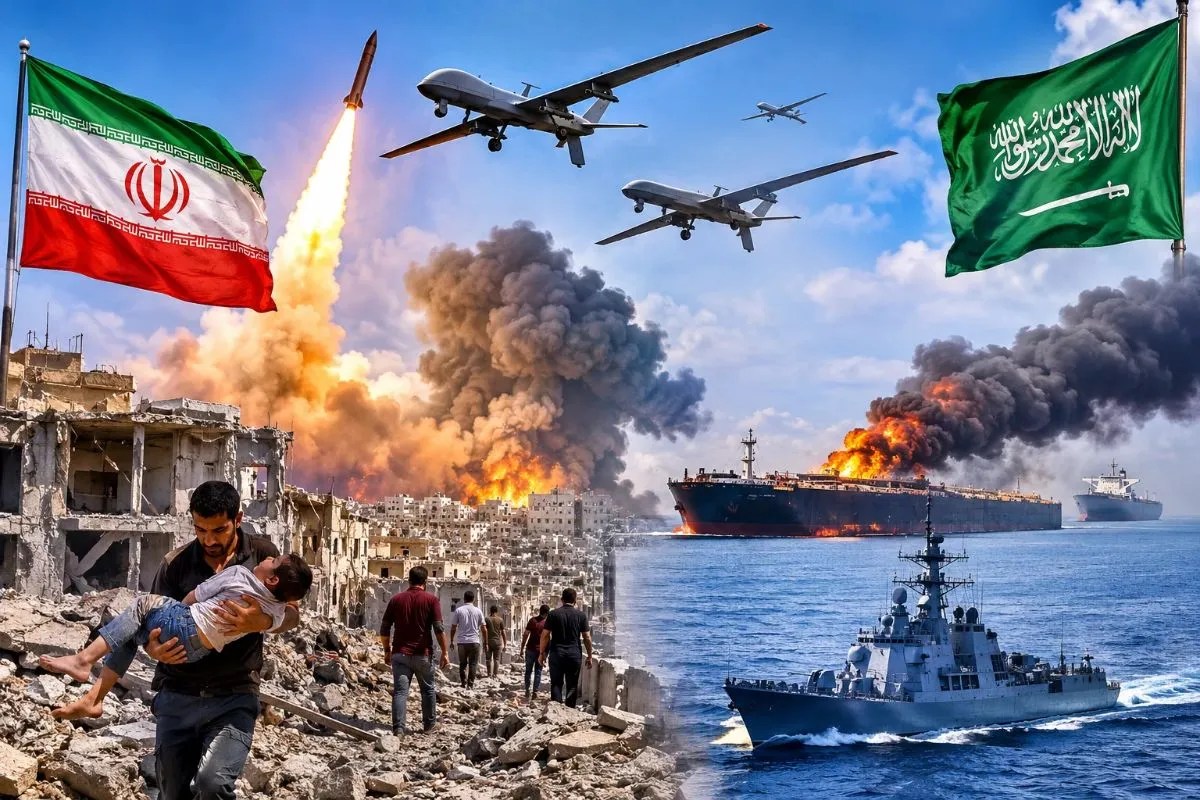
Sirens. That is the first thing people remember when a quiet evening turns brittle.
Not the slow, theatrical wail of an old movie siren, nor a distant warning meant for someone else across town. A modern alert—the kind that slices through air-conditioned stillness, hums through glass windows, and makes a coffee mug tremble on a kitchen counter—feels personal. It feels like the sky itself just cleared its throat and spoke your name. You might also find this related article interesting: Throwing More Billions at the FAA Won't Stop the Next US Ground Stop.
In the Persian Gulf, where salt hangs heavy in the night air and tankers trace slow, luminous lines across dark water, the threshold between normal life and emergency can be measured in seconds. When headlines report that a Saudi-led coalition intercepted three Houthi drones and a threat alert sounded in Bahrain, most readers outside the region see a tidy arithmetic: three unmanned aircraft down, a siren triggered, another flare-up in a long, exhausting regional conflict. Clean. Distant. Almost abstract.
Three. Such a small number. A single hand can hold it. Yet in modern asymmetric warfare, small numbers carry disproportionate weight because they are designed to test reflexes, stretch defenses, and fracture peace of mind long before—or even without—a single warhead lands on a target. As reported in recent reports by NPR, the effects are widespread.
I have stood on coastal promenades in the Gulf at dusk when the horizon turns the color of bruised plums and the humidity clings to your shirt like a second skin. You watch families strolling along the water, children chasing stray sea breezes, fishermen mending nets near small boats, and delivery riders weaving through traffic with hot meals strapped to their backs. Everything looks ordinary, anchored, permanent. Then a phone buzzes with an urgent warning, or a faint, high-pitched alarm echoes off concrete facades, and suddenly the air feels thinner. You realize how much of daily peace is an agreement between human beings and fragile machines watching the sky.
To be completely honest, following Middle Eastern security news for years can leave you feeling numb, confused, or strangely skeptical. Every week brings another claim, another interception, another warning. Part of me—and perhaps part of you reading this—wonders how much of the noise is tactical posturing, how much is verified operational reality, and what any of it actually means for people trying to pay rent, sleep through the night, and keep a small business open. Uncertainty is exhausting. When events unfold across borders, coalitions, and contested skies, plain truth is rarely handed to you on a silver platter.
Let us stick strictly to what is verifiable and grounded in the core facts before us: a Saudi-led coalition reported shooting down three Houthi drones, and a threat alert was issued in Bahrain. Because I do not have a full operational briefing dossier from that specific incident in front of me, I will not invent tactical coordinates, radar frequencies, or unverified casualty figures. Instead, I want to examine what those two concrete developments—three intercepted drones and an alert sounding in Bahrain—actually signify on the ground, in the air, and inside ordinary homes.
Where a narrative is hypothetical or metaphorical, I will say so openly. Truth does not need decoration to hit hard; it needs clarity.
The Cost of Three Small Machines in a Wide Sky
Think of an unmanned aerial vehicle not as a roaring jet fighter from a childhood poster, but as a flying errand boy built for trouble.
In recent years, Houthi forces in Yemen have relied heavily on drones—ranging from long-range one-way attack systems to surveillance craft—as low-cost instruments of reach and pressure. Compared to multi-million-dollar aircraft or complex ballistic missiles, drones are relatively inexpensive to assemble, easier to conceal before launch, and capable of traveling long distances over water and desert to probe air defenses.
Now picture the math of defense. (This next illustration is a conceptual analogy rather than a report on a specific engagement.) Imagine you are guarding a sprawling glass greenhouse during a hailstorm, and someone starts tossing stones from behind a wall a hundred miles away. Even if you catch every stone before it hits the glass, you still have to spot it in time, track its path, launch an interceptor, and accept that a single missed throw could shatter a pane. A drone costs a fraction of what it takes to detect, track, and shoot it down. Over time, that imbalance is less about a single duel in the clouds and more about endurance, fatigue, and psychological strain.
When a Saudi-led coalition downs three Houthi drones, that is not a minor footnote. It represents radar sweeps, command-and-control decisions, air-defense crews standing watch in heat and glare, and debris that could fall anywhere once struck out of the sky. Even a neutralized drone is still heavy metal and unspent fuel tumbling toward land or sea.
Why does a threat alert in Bahrain matter right alongside those interceptions?
Geography. The Gulf is tight. Bahrain is an island kingdom connected to Saudi Arabia by the King Fahd Causeway, sitting close to vital shipping lanes, energy infrastructure, and regional military hubs. Threat alerts in places like Bahrain are rarely issued for theatrics alone; they are designed to compress reaction time when aerial threats are detected in the broader theater or moving along vectors that could endanger civilian or strategic areas.
Consider what happens next: a siren sounds, or an emergency notification lights up thousands of screens at once.
Let us step into a hypothetical scene to feel what that moment looks like from the inside. Let us call her Layla—a fictional Bahraini pharmacist working a late shift near Manama, with a younger brother at home studying for exams. Layla is not a soldier or a diplomat. Her world revolves around prescription labels, inventory deliveries, and checking her phone between customers. When a threat alert goes out, her first instinct is not geopolitical analysis. Her first instinct is checking whether her brother got the message, whether the roads are calm, and whether the warning means "stay indoors for twenty minutes" or "something serious is unfolding right now."
Even if nothing strikes near her neighborhood, the adrenaline arrives right on schedule. Heart rate climbs. Hands tighten on the counter. Customers glance at one another with a tight, unspoken question behind their eyes: Is this just a precaution, or is today the day?
Multiply Layla by hundreds of thousands of residents, expatriate workers, nurses, hotel staff, and parents across the Gulf. That is the invisible stake behind every headline about drone interceptions and threat alerts.
Why Geography Turns Distant Skirmishes Into Local Anxiety
People who have never lived near a contested maritime corridor sometimes assume borders act like thick brick walls. They do not. Airspace and sea lanes are porous. A launch site hundreds of miles away can still cast a shadow over a port city before sundown.
Historically, conflict in and around Yemen and the wider Gulf has demonstrated a clear behavioral pattern: when direct frontlines harden or diplomatic channels stall, asymmetric tools like drones and missiles become the preferred way to signal resolve, impose costs, or test an adversary's perimeter without committing massive ground armies. It is a strategy of attrition and pressure. Every alert reminds neighboring states and their populations that calm in the Gulf is actively policed, never automatic.
Yet there is a paradox here that deserves honest scrutiny.
When alerts sound periodically, societies face two opposite hazards at once. On one side is panic—traffic bottlenecks, rushed decisions, sleepless nights. On the other side is alert fatigue—the quiet danger of hearing warnings often enough that people start shrugging, delaying shelter, or treating real hazards like background static. Neither extreme helps anyone. Real resilience sits in the sober middle: paying attention without losing your mind.
Some readers might ask a very practical question right here: If three drones were shot down, doesn't that prove the defenses worked?
Yes—in the immediate tactical sense, an interception means a threat was stopped before completing its mission. That matters. Nobody wants unchallenged aerial hardware drifting toward cities, ports, or oil facilities. At the same time, treating every interception as a complete resolution misses the deeper dynamic. Shooting down three drones today answers today's move; it does not automatically erase the workshop that built them, the launch crew that sent them aloft, or the strategic motives behind the next salvo.
Another question naturally follows: Why does Bahrain get a threat alert when the interception involves a Saudi-led coalition and Houthi drones?
Because regional air and missile defense is interconnected across closely linked neighbors, and aerial threats in the Gulf region can involve multiple trajectories, decoys, or shifting flight paths. When authorities issue a threat alert in Bahrain, it reflects a posture of caution—giving people time to take protective measures rather than waiting until the last possible second. Details are often sparse in the first minutes of such alerts, which makes the silence between official updates feel much longer than the clock actually says.
The Human Ledger Behind Every Headline
I have spent enough time talking to people in stressful regions to know that fear rarely sounds like screaming in the streets. More often, it sounds like a quiet change in routine.
It sounds like a father telling his kids to sleep in the inner hallway "just tonight, just to be comfortable." It sounds like a delivery driver deciding whether to finish one more route before dark. It sounds like a small shop owner watching foot traffic dip whenever regional tensions flare, wondering how a conflict hundreds of miles away is already pinching next month's bills.
Look at how quickly abstract geopolitics becomes domestic arithmetic.
In the Gulf, economies are deeply tied to confidence, movement, trade, and aviation. Even brief alerts or heightened security postures ripple outward. Flights adjust. Shipping insurers watch risk premiums. Families check news feeds every ten minutes instead of twice a day. None of that requires a direct hit to leave a mark. The mere possibility of escalation carries a tax on everyday life.
And what about the people operating the systems on all sides? Young men and women staring at glowing displays in warm control rooms, tracking blips that look like tiny dots on glass, knowing that a fraction of a second or a software glitch separates routine duty from disaster. Warfare today often strips away face-to-face contact and replaces it with screens, algorithms, and distance—yet the human nerves holding the controls are just as fragile as they have always been.
I want to pause and admit something here: when I read reports of drone interceptions and regional alerts, I sometimes feel a sharp tension between wanting clear answers and recognizing how much happens behind closed doors. Official statements are cautious by nature. They reveal what commanders choose to share and hold back what they must protect. Accepting that gap without filling it with wild rumors is one of the hardest disciplines in modern news consumption.
If you are reading this from afar, here is a grounded way to separate signal from noise whenever you see headlines like this:
- Check the scale and specifics. Three intercepted drones is a concrete operational claim, distinct from a mass swarm or a confirmed impact, though any aerial threat warrants serious attention.
- Watch the distinction between an alert and an attack. A threat alert in Bahrain signals heightened danger or precautionary warning; treat it seriously without jumping ahead of verified facts on damage or casualties.
- Follow the regional ripple effects. Look beyond the immediate clash to shipping, aviation, diplomatic statements, and civilian advisories, which often show whether tension is peaking or settling.
Notice how simple those habits are. They do not make you an expert analyst overnight, nor do they turn you into a spectator rooting for drama. They simply keep your feet on the ground when the headlines turn loud.
What Lingers After the All-Clear
Eventually, sirens stop. Phones quiet down. Traffic resumes its steady murmur along coastal highways, and people go back to making tea, answering messages, and planning for next week.
To the outside eye, normal life snaps right back into place—like a rubber band released after being pulled taut.
Yet anyone who has lived through that stretch knows the band is never quite the same after being stretched enough times. Something subtle shifts in the background of awareness. You notice the hum of an aircraft overhead a little sooner. You glance at the sky before locking your car door. You value an uninterrupted night of sleep with a sharper, almost fierce gratitude.
Three drones intercepted in the Gulf. A threat alert sounding in Bahrain. On paper, it takes less than a minute to read. In lived reality, it is another reminder of how thin the membrane is between ordinary Tuesday evening and sudden emergency—and how much quiet courage it takes for everyday people to keep living normal lives underneath an uncertain sky.
Out over the dark Gulf water, beneath stars that do not care about borders or coalitions, the tide keeps coming in—slow, indifferent, and relentless—long after the last siren fades.