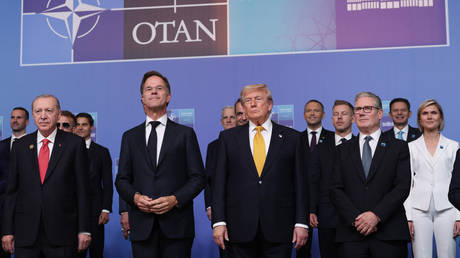
The modern North Atlantic Treaty Organization operates not on institutional sentimentality, but on a stark calculations of structural dependency. The recent diplomatic friction at the 2026 NATO summit in Ankara—where NATO Secretary-General Mark Rutte declined to publicly rebuke U.S. President Donald Trump over renewed demands for control of Greenland and threats to sever trade with Spain—exposes the profound tension between European sovereign integrity and the hard math of transatlantic security.
To analyze Rutte’s strategic silence through the lens of personal "self-respect" or diplomatic weakness is a category error. It misunderstands the structural asymmetry of the alliance. The institutional survival of NATO relies on managing an American executive that views collective defense through a strictly commercial and transactional framework. In similar developments, read about: The Architecture of Democratic Insulation: Analyzing the Restoration of Bangladesh Caretaker Government Framework.
The Three Pillars of Transatlantic Transactionalism
The institutional relationship between European member states and the United States has transitioned into a highly calculated market exchange. This operational reality is defined by three specific dynamics:
1. The Asymmetric Security Insurance Premium
The United States remains the primary underwriter of European deterrence. While European allies have pledged significant capital to defense—evidenced by the €70 billion military support package for Ukraine and a $170 billion EU-backed defense loan system—the foundational capabilities of high-end deterrence remain American. Strategic airlift, air-to-air refueling, satellite reconnaissance, and the nuclear umbrella cannot be replicated by European states in the short or medium term. Rutte’s calculated non-confrontation is a pragmatic recognition that the cost of offending the primary insurer far outweighs the short-term rhetorical benefit of defending Danish sovereignty over Greenland on a press conference stage. Reuters has also covered this important topic in extensive detail.
2. Strategic Flattery as a Risk-Mitigation Mechanism
The management of U.S. participation in NATO has become a core bureaucratic competency for the Secretary-General. Rutte’s strategy mirrors that of his predecessor, Jens Stoltenberg, relying on empirical proof of European spending to satisfy U.S. demands. By presenting charts demonstrating that European defense procurement creates tens of thousands of American jobs and accounts for a $300 billion backlog in U.S. defense orders, the NATO leadership shifts the narrative from European dependency to mutual economic benefit. Silence during Trump’s provocative statements on Greenland is a tactical concession required to preserve this broader economic alignment.
3. The Fragmentation of Peripheral Alliances
The targeting of specific allies, such as Spain, reveals a deliberate strategy of vertical isolation. Spain’s exemption to limit military expenditure to 2.1% of GDP—compared to the broader 5% target sought by Washington by 2035—makes it structurally vulnerable to bilateral pressure. When the U.S. executive threatens to halt trade or isolate a non-compliant member, the Secretary-General’s role is not to engage in a public defense of that specific state, but to preserve the integrity of the core alliance architecture. Rutte’s pivot to praising Trump’s success in driving spending parity illustrates the prioritization of systemic stability over individual member protection.
The Strategic Geography of the High North
The U.S. demand for control or increased military presence in Greenland is driven by structural changes in Arctic geography, rather than eccentric real estate ambition. The melting of Arctic ice sheets has transformed the High North into a contested theater of resource extraction and maritime transit, creating a severe collective action problem for the alliance.
                  [ Arctic Security Axis ]
                             │
            ┌────────────────┴────────────────┐
            ▼                                 ▼
   [ Commercial Routes ]             [ Power Projection ]
   • Northern Sea Route access       • Deep-water sub monitoring
   • Reduced transit times           • Early-warning radar arrays
   • Resource extraction fields      • Hypersonic missile tracking
The Arctic possesses an estimated 13% of the world's undiscovered oil and 30% of its undiscovered natural gas. Control over Greenland provides uncontested monitoring capability over the GIUK (Greenland-Iceland-United Kingdom) gap, a critical naval chokepoint. Furthermore, the expansion of Russian and Chinese maritime presence in the region has forced a reassessment of NATO's northern flank.
Denmark’s Prime Minister, Mette Frederiksen, has maintained that Greenland is sovereign, non-negotiable territory. Yet, Denmark's historical inability to single-handedly patrol and secure the vast Arctic coastline creates an operational vacuum. The U.S. military already maintains an extensive footprint via Pituffik Space Base (formerly Thule Air Base), which houses vital components of the American early-warning radar network. The push for greater control is an attempt to formalize and expand this security perimeter, bypassing the multi-layered decision-making apparatus of the North Atlantic Council.
Quantifying the Burden-Sharing Formula
The primary friction point within the alliance remains the structural imbalance in defense expenditures. The historical baseline of 2% of GDP on defense has been exposed as insufficient by the ongoing war in Ukraine. The current U.S. administration’s insistence on a 5% target represents a fundamental restructuring of European fiscal priorities.
| Country Grouping | Current Average GDP Allocation | Proposed 2035 Target | Primary Capability Gap |
|---|---|---|---|
| United States | ~3.5% | 5.0% | Global logistics overextension |
| Frontline States (Poland, Baltics) | 3.0% - 4.0% | 5.0% | Strategic depth and long-range air defense |
| Western Europe (Germany, France, UK) | 2.0% - 2.5% | 5.0% | Ammunition stockpiles and readiness rates |
| Southern Flank (Spain, Italy) | 1.5% - 2.1% | 5.0% | Maritime surveillance and anti-submarine warfare |
Achieving a 5% GDP defense spending target across Europe requires a massive reallocation of public capital, likely forcing reductions in social spending or significant increases in national debt. For a country like Spain, moving from its current expenditure to 5% would require nearly tripling its military budget within a decade.
Rutte’s positioning acknowledges this math. By choosing not to fight rhetorical battles over Greenland or trade threats, he keeps the focus on the actual capital commitments European nations are making. The announcement of tens of billions of dollars in new contracts at the Ankara summit—including multinational acquisitions of Airbus refueling aircraft and Triton surveillance drones—serves as tangible proof to Washington that Europe is funding its own defense infrastructure.
The Strategic Cost of Institutional Defiance
The core risk of a more confrontational approach by the NATO Secretary-General is the absolute collapse of the American security guarantee. The alliance functions entirely on the credibility of Article 5. If an American president openly states that the U.S. will not defend non-compliant or argumentative allies, the deterrence value of the treaty drops to zero.
The secondary limitation of public pushback is the alienation of bilateral partners who hold significant leverage within the alliance. The hosting of the 2026 summit in Ankara by Turkish President Recep Tayyip Erdogan highlights the decentralized nature of modern NATO authority. Turkey’s independent foreign policy, coupled with its potential reintegration into the F-35 fighter jet program following the lifting of U.S. sanctions, demonstrates that Washington is highly capable of cutting transactional, state-by-state deals that ignore broader institutional norms.
If Rutte were to adopt the role of a traditional diplomat defending the sovereign sensibilities of Denmark or Spain, he would break the fragile personal alignment he has constructed with the U.S. executive. In the calculus of international relations, an undignified silence that preserves the operational commitment of the world's largest military superpower is a highly rational choice.
The Decoupling Framework
The long-term trajectory of the alliance points toward a structural decoupling of European and American security priorities. While Europe remains focused on the immediate, conventional land threat posed by Russia on its eastern border, the United States is increasingly reorienting its strategic capital toward the Indo-Pacific theater to counter Chinese expansion.
This creates an inescapable bottleneck. Europe must rapidly build the capacity to sustain a high-intensity conventional conflict without relying on American logistics, intelligence, and ammunition stockpiles. The establishment of the €170 billion EU defense loan program is an initial step toward building this autonomous capacity, but the transition will take decades.
Until Europe achieves strategic autonomy, its security leaders have no choice but to absorb rhetorical volatility from Washington. The preservation of the alliance requires a leadership style that treats geopolitical outbursts not as existential insults to sovereignty, but as variables to be managed within a broader transactional equation.
The optimal strategy for European leaders moving forward is clear: accelerate independent procurement programs, fulfill the 5% GDP spending targets as rapidly as fiscal realities allow, and tolerate the transactional demands of the United States. Any alternative strategy that prioritizes diplomatic posturing over capability accumulation risks inviting the very abandonment Europe is trying to prevent.