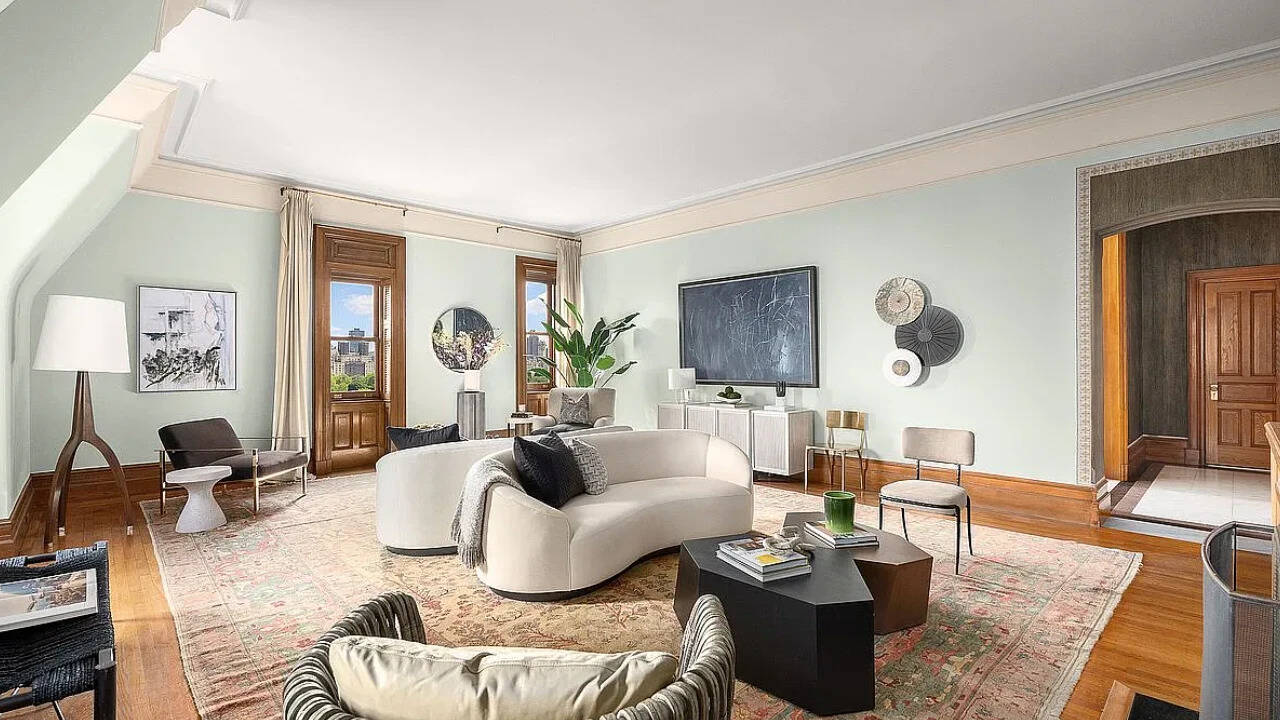
Jane Rosenthal and Craig Hatkoff, the co-founders of the Tribeca Film Festival, finally unloaded their sprawling apartment at the Dakota on Manhattan's Upper West Side, closing a chapter that required multiple price reductions to get across the finish line. Listed initially at a number that reflected peak luxury optimism, the residence ultimately traded after significant discounting—a stark reminder that even the most storied addresses in New York City are not immune to the cold arithmetic of high interest rates, soaring maintenance fees, and shifting buyer preferences.
The headline is simple enough. Famous New Yorkers sell a famous apartment for less than they hoped. Yet if you look past the celebrity gloss of the Dakota and the Tribeca Film Festival, this transaction exposes a structural fault line running right through the heart of Manhattan's historic co-op market. For decades, pre-war trophy apartments along Central Park West operated in their own economic stratosphere, insulated from the mundane realities that govern normal housing. Those days are over.
The Anatomy of a Luxury Price Cut
When a property sits on the market and requires repeated price slashes, the public tends to assume the sellers were simply greedy. That is rarely the whole story in upper-echelon Manhattan real estate. Pricing a one-of-a-kind residence in a building completed in 1884 is closer to valuing a piece of fine art than appraising a suburban colonial. There are no true comparables.
Rosenthal and Hatkoff originally brought their spread to market with expectations anchored in a different era—a period when ultra-low borrowing costs and an influx of global wealth pushed trophy prices to historic highs. By the time the deal actually closed, the market had undergone a violent recalibration. Buyers with eight figures to spend suddenly had options. They could park their cash in short-term Treasury bills yielding five percent risk-free, or they could buy a brand-new glass tower residence on Billionaires' Row with floor-to-ceiling windows, private elevators, and zero board approval headaches.
A price cut in this tier is not merely a discount. It is an admission that the psychological premium attached to old-world prestige has shrunk. Sellers who refuse to acknowledge this reality end up watching their listings rot on StreetEasy for years, accumulating the dreaded "stale" label that forces even steeper concessions down the road.
The Co-op Penalty in a Condo World
To understand why an apartment owned by cultural heavyweights had to be marked down, you have to understand the war between New York's two dominant forms of ownership: the co-op and the condominium.
The Dakota is the ultimate co-op. Built by Edward Clark, the head of the Singer Sewing Machine Company, it practically invented luxury apartment living in America. When you buy at the Dakota, you do not actually buy real estate. You buy shares in a corporation that owns the building, which grants you a proprietary lease to live in your unit. And before you can buy those shares, you must survive one of the most notorious co-op boards in the world.
This board has famously rejected everyone from Madonna and Cher to Billy Joel and Alex Rodriguez. They demand exhaustive financial disclosures, personal references, and face-to-face interviews. They impose strict rules on financing, often requiring buyers to pay all cash, and they fiercely restrict renovations, subletting, and pied-à-terre usage.
Compare that friction to the modern luxury condo market.
- No Board Approvals: If you have the money, you get the keys. A limited liability company or a family trust can close in weeks without explaining its tax returns to a committee of neighbors.
- Modern Infrastructure: New developments along Central Park South and Hudson Yards offer central air conditioning, private wellness centers, subterranean parking, and acoustic insulation that a 19th-century masonry fortress simply cannot match without millions of dollars in gut-renovation work.
- Liquidity: Condos are global currency. Co-ops are a local club with a velvet rope.
Because co-op boards limit the pool of eligible buyers—excluding foreign nationals who do not hold U.S. assets, LLCs, and buyers who rely on complex leverage—co-ops naturally trade at a steep discount to comparable condos. When the broader luxury market tightens, that discount widens into a chasm.
The Hidden Anchor of Monthly Maintenance
Sticker price is only half the battle at 1 West 72nd Street. The real killer for many historic co-ops is the monthly maintenance fee, and the Dakota is no exception.
In a co-op, monthly maintenance covers both the building's operating expenses and its underlying real estate taxes. Because the Dakota is a landmarked structure nearly a century and a half old, keeping it standing requires constant, enormously expensive capital work. Facade inspections under New York City's Local Law 11, slate roof repairs, copper flashing replacements, and antique plumbing upgrades do not come cheap. Add in the salaries for a full staff of doormen, elevator operators, and porters, and the monthly carrying costs routinely climb into the tens of thousands of dollars.
For a buyer, a $15,000 or $20,000 monthly maintenance bill is dead money. Unlike mortgage interest—which at least builds equity over time—maintenance vanishes every thirty days. When a seller asks top dollar for an apartment that also carries a massive monthly nut, savvy buyers do the math. They capitalize that monthly expense into the purchase price and demand a lower number to offset the ongoing bleed.
The Renovation Reality Check
There is another factor that quietly forces price reductions in legacy buildings: the cost of construction in New York City.
Many grand apartments owned by long-term residents reflect the tastes of twenty or thirty years ago. Even when impeccably maintained, a residence with formal dining rooms, dark wood paneling, and segmented kitchens often clashes with how wealthy families actually live today. Modern buyers want open-plan entertaining spaces, chef's kitchens, and spa-grade primary baths.
Executing a gut renovation inside the Dakota is an exercise in extreme patience and bottomless capital.
- Strict Alteration Agreements: The board limits construction to specific summer months or tight weekday windows to avoid disturbing neighbors.
- Landmark Preservation: Any change that affects the exterior or historic fabric requires sign-off from the city's Landmarks Preservation Commission.
- Supply Chain and Labor: High-end Manhattan contractors routinely charge upwards of $1,000 to $1,500 per square foot for top-tier finishes, and timelines routinely stretch past two years.
If a buyer has to spend $5 million and wait thirty months just to move in, they will not pay peak pricing for the raw shell. They push that renovation risk directly back onto the seller in the form of a price cut.
The Cultural Weight of the Dakota
None of this means the Dakota has lost its mythic pull. Few buildings on earth carry its specific gravity.
When it rose on the corner of 72nd Street and Central Park West in the 1880s, the neighborhood was so undeveloped that critics joked it might as well have been built in the Dakota Territory—hence the name. Its steep gables, deep courtyard, and yellow brick facade quickly became a magnet for Manhattan's creative and financial aristocracy. Leonard Bernstein lived there. Lauren Bacall held court there for decades. Boris Karloff, Judy Garland, and Rudolf Nureyev all called it home. And of course, John Lennon lived in the building and was tragically murdered outside its arched entrance in December 1980, cementing the address forever in global consciousness.
Rosenthal and Hatkoff fit neatly into that lineage. After the September 11 attacks devastated Lower Manhattan, the pair co-founded the Tribeca Film Festival alongside Robert De Niro to revitalize the neighborhood's economy and spirit. Their Dakota home was not merely a crash pad; it was a salon, a gathering point for filmmakers, politicians, and philanthropists who shaped New York's civic life over the past quarter-century.
Yet nostalgia does not clear escrow. A new generation of tech founders, hedge fund managers, and private equity partners respects the history, certainly, but they rarely feel compelled to overpay for it. For them, status is measured in privacy, views, and turnkey convenience rather than proximity to the ghosts of Broadway and Hollywood.
What This Sale Signals for Trophy Real Estate
The closing of the Rosenthal-Hatkoff apartment offers a clear blueprint for anyone watching the high end of the New York housing market.
First, price discovery is back. During the pandemic boom, panic buying distorted values across every borough. Now, transactions only happen when sellers meet buyers where the market actually lives, not where it lived three years ago. Taking a haircut is no longer a sign of distress; it is the price of admission for getting a deal done.
Second, the wealth gap between neighborhoods continues to shift. While the Upper West Side remains deeply desirable for families seeking proximity to Central Park and top private schools, it faces fierce competition from downtown enclaves like Tribeca, SoHo, and the West Village. Ironically, the very neighborhood Rosenthal and Hatkoff helped resurrect after 2001 has spent the last decade siphoning wealthy buyers away from uptown's historic co-ops. Many buyers who once would have defaulted to Central Park West now prefer a full-floor loft in Tribeca where they can walk out their front door into a neighborhood buzz that feels contemporary rather than museum-like.
Finally, patience is a double-edged sword. In a rising market, holding out for your number makes you look like a genius. In a flat or correcting market, every month on the market costs money—not just in lost opportunity, but in actual carrying costs paid out of pocket while the apartment sits empty or staged.
Rosenthal and Hatkoff understood when to bend. By adjusting their expectations to match the current reality of Manhattan real estate, they achieved what dozens of stubborn trophy-home sellers across the city still cannot: they actually closed.