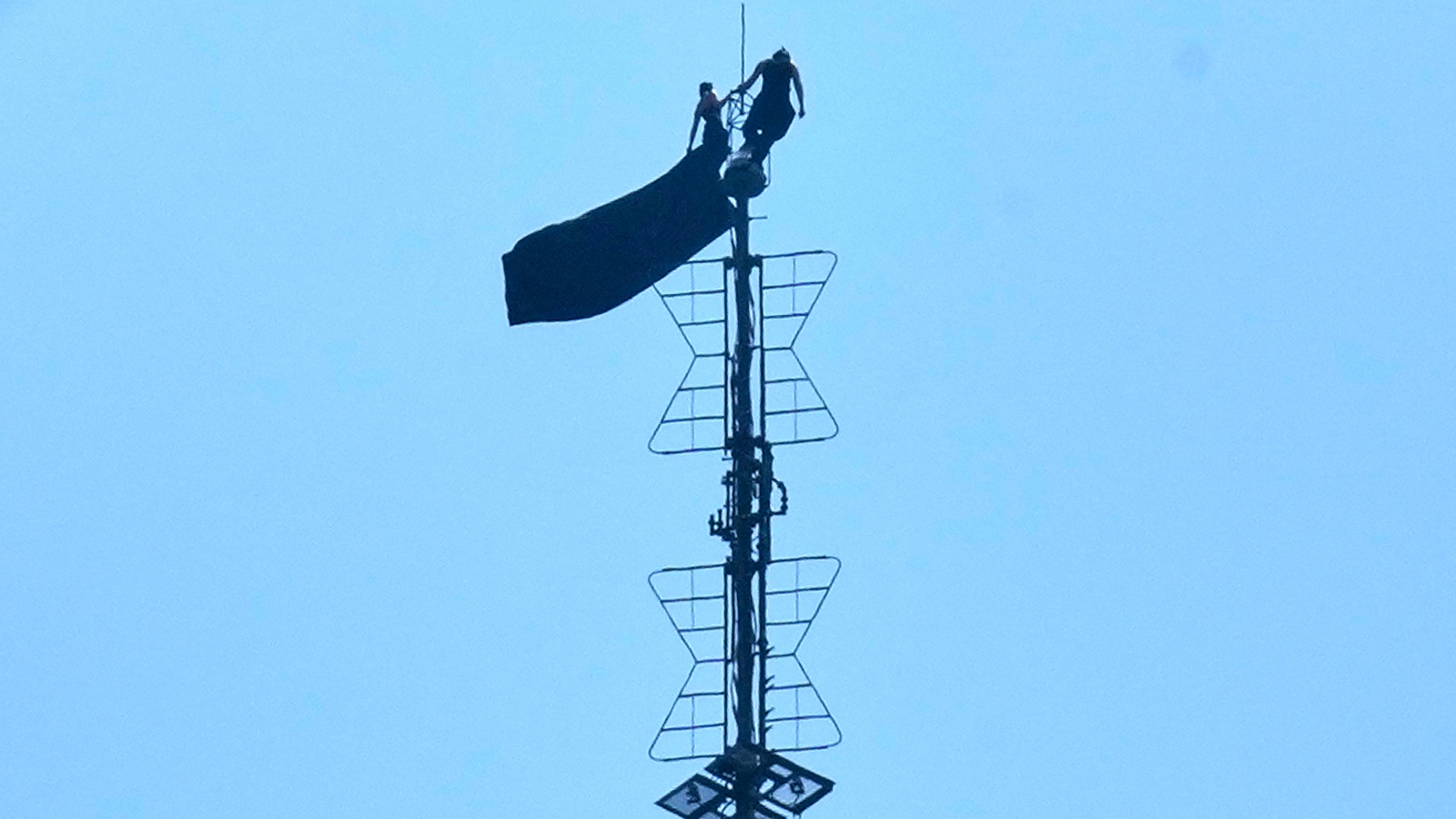
On July 1, 2026, two black-clad figures bypassed multi-layered security cordons at the Empire State Building to scale its 1,454-foot antenna spire. They did not use safety harnesses. They did not have authorization. For nearly an hour, the pair occupied the absolute pinnacle of Manhattan’s skyline, unfurling a massive political banner before transitioning into a high-altitude marriage proposal witnessed by thousands on the streets below. By 1:00 p.m., the New York Police Department’s Emergency Services Unit had both individuals in handcuffs.
While the public treated the incident as a daring romantic spectacle, the event exposes a systemic vulnerability in urban infrastructure that security officials have quietly feared for decades. This was not a harmless prank. It was a calculated breach of a Tier 1 security asset that highlights how easily commercial anti-trespass systems can be defeated by determined actors seeking global attention. For an alternative perspective, check out: this related article.
The Illusion of Skyscraper Security
Modern high-rises rely heavily on electronic access control. Turnstiles, biometric scanners, and closed-circuit television networks are designed to funnel thousands of daily workers and tourists into tightly monitored corridors. Yet, this entire apparatus operates on the assumption that intruders will attempt to blend into corporate crowds or use forged credentials. It struggles to account for individuals who look for structural gaps where human oversight fails.
Witnesses on the 86th-floor observation deck reported seeing the two individuals simply push open a set of mesh access gates. There was a security guard present in the vicinity. The guard did not stop them in time. Once an intruder breaches the perimeter of the public viewing area, the physical architecture of a skyscraper becomes an escalator for agile climbers. The structural latticework of transmission towers offers natural handholds and footholds that make ascending relatively straightforward for experienced athletes. Similar insight regarding this has been published by The Guardian.
The immediate reaction from the building's management was predictable damage control. A spokesperson emphasized that guests were never in danger and used the opportunity to promote the observation deck as a commercial venue for legitimate proposals. This corporate deflection masks a uncomfortable truth. If two civilians carrying a heavy fabric banner can reach a live broadcast antenna without detection, the underlying threat matrix used by private security firms requires immediate overhaul.
The High Frequency Radiation Threat
The climb was physically dangerous beyond the obvious risk of a fatal fall. The spire of the Empire State Building is not just a decorative architectural feature. It is a highly active telecommunications hub transmitting massive amounts of radiofrequency radiation for local television and radio stations. Engineering experts have noted that working on these towers normally requires rigorous specialized safety training and turning down transmitter power levels to prevent severe internal tissue heating.
Unprotected exposure to these fields can cause rapid thermal damage to human organs. The climbers spent significant time directly adjacent to active arrays while wearing nothing but sleeveless black outfits. This detail demonstrates a total disregard for invisible environmental hazards, driven by the intense pursuit of viral documentation. The immediate physical risk was secondary to the creation of digital content.
The Economy of Extreme Attention
The identity of the climbers quickly became an open secret within the urban exploration community. Indicators pointed directly to prominent Russian daredevils who have spent years documenting unauthorized climbs on international landmarks. Their activities are not spontaneous acts of rebellion. They are highly calculated business ventures supported by streaming revenue, documentary deals, and digital brand sponsorships.
Social media networks provide the financial infrastructure that makes these high-risk operations viable. A single dramatic photograph taken from a skyscraper spire can generate millions of impressions, which translates into direct monetization through algorithmic ad-sharing and subscription platforms. The legal penalties associated with misdemeanor trespass or reckless endangerment are viewed merely as a minor cost of doing business. The financial returns of the content far outweigh the standard court fines.
This symbiotic relationship between tech platforms and extreme trespassers complicates municipal enforcement. Police departments find themselves trapped in a cycle of reactive policing. They must deploy expensive emergency resources, close major city streets, and launch helicopters to monitor individuals who are actively using the state’s response to increase the dramatic tension of their live streams.
Municipal Resource Strain and Legal Gaps
The NYPD deployment on July 1 was massive. The department sent drones, a helicopter, and specialized rescue trucks to Fifth Avenue and 34th Street, forcing immediate street closures during a busy mid-week afternoon. This disruption carries a real economic price tag for the city. It diverts elite rescue personnel away from genuine life-or-death emergencies to manage a staged media event.
The legal framework for addressing these stunts remains remarkably weak. In many jurisdictions, scaling a building is prosecuted under basic criminal trespass statutes, which often carry penalties equivalent to minor shoplifting or vandalism. Prosecutors face a difficult path when attempting to secure felony charges unless they can prove significant property damage or a specific intent to cause harm.
Some city councils have attempted to introduce specialized legislation specifically targeting "rooftopping" by creating steeper fines and mandatory jail time for scaling structures over a certain height. These measures have largely failed to deter international actors. For someone flying into New York specifically to execute a high-profile climb, the threat of a few nights in a local jail is an acceptable risk that only adds to their counter-culture mystique.
Redefining Asset Protection
Private security firms must transition away from relying on passive monitoring systems. Cameras that simply record an intrusion without triggering an active physical intervention are useless against fast-moving climbers. True security requires heavy physical barriers that cannot be opened with simple force, combined with real-time pressure sensors that alert law enforcement the exact second an unauthorized perimeter is violated.
The responsibility also extends to the corporate entities that profit from the aftermath. Tech platforms must face stricter regulatory scrutiny regarding the monetization of content that depicts explicit, illegal acts that endanger public safety. If the financial incentive is removed, the frequency of these high-altitude stunts will drop precipitously.
New York infrastructure cannot remain a playground for international influencers looking to stage dramatic life milestones at the expense of public order. Property owners must accept that their landmarks are permanent targets, requiring active, hard-edged defense rather than corporate public relations statements. Real security is achieved through unyielding structural barriers, not polite signs and distracted guards.