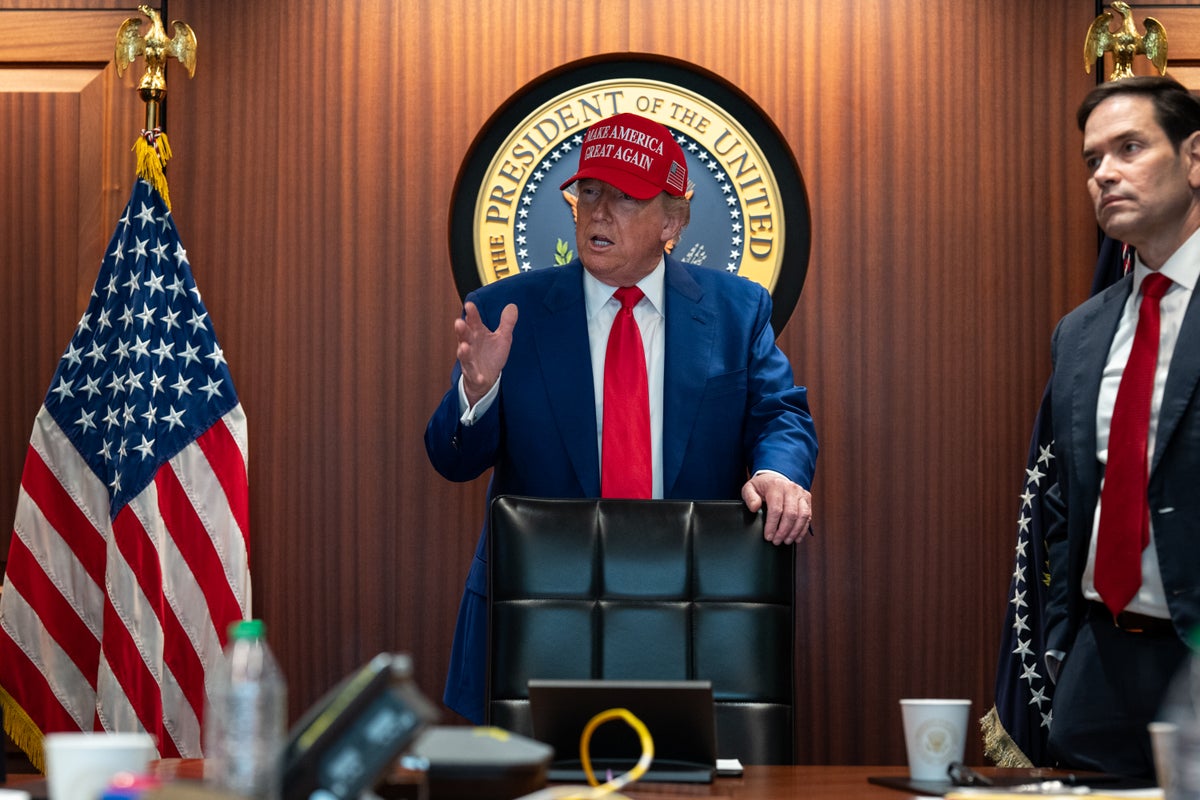
The headlines are vibrating with a desperate, familiar energy. They want you to believe that a President being "kept out of the room" during a sensitive military operation is a sign of total institutional collapse. They paint a picture of aides whispering in hallways, terrified of a leader’s temper, acting as a shadow government to prevent a global catastrophe.
It is a convenient narrative. It’s also a fundamentally flawed understanding of how high-stakes decision-making actually works. If you enjoyed this post, you should look at: this related article.
If you are a CEO, a military commander, or an executive who hasn’t realized that being "out of the room" is often the highest form of operational efficiency, you are failing your team. The "screaming" is a distraction. The "aides" are doing their jobs. The story isn't about a rogue president; it’s about the brutal, necessary separation between strategic intent and tactical execution.
The Cult of the All-Seeing Leader
Corporate culture and political punditry suffer from the same delusion: the belief that a leader must be a fly on every wall. We’ve been conditioned to think that the person at the top should be in the Situation Room, leaning over a grainy satellite feed, micro-managing the exact moment a pilot ejects or a server migration begins. For another perspective on this development, see the latest coverage from The New York Times.
This is the "War Room" fetish. It’s a toxic management style that prizes visibility over results.
In the case of the downed pilots in Iran, the media frames the exclusion of the President as a coup. In reality, it is the only way a complex organization can survive a volatile personality—or even a stable one. When the person with the ultimate power to fire, pivot, or nuke enters a room filled with tactical experts, the experts stop being experts. They become performers. They start weighing their advice against the leader's mood rather than the objective data on the screen.
I have seen boards of directors do this to CEOs, and I have seen CEOs do this to their engineering leads. The moment the "Big Boss" walks in, the IQ of the room drops by forty points. Everyone looks for the signal. They stop looking for the solution.
The Screaming is a Feature Not a Bug
The report claims the President spent hours shouting at aides before the operation. Let’s address the elephant: noise.
In any high-pressure environment, the "top" is rarely a place of calm, Zen-like reflection. It is a pressure cooker. The mistake observers make is thinking that the emotional state of the leader must be mirrored by the operational team.
A truly resilient organization creates a firewall.
On one side, you have the political or strategic level—emotional, volatile, responding to the 24-hour news cycle and the demands of the base. On the other side, you have the tactical level—cold, calculated, focused on wind speeds and fuel levels.
If the aides "kept him out," they didn't do it to protect the world from him; they did it to protect the mission from the noise of the strategy. Effective managers don't need their boss to be happy or even rational in the moment. They need the boss to stay in the zone where their volatility can’t break the gears of the machine.
If you can’t run your company while your lead investor is having a meltdown in a different building, your company is fragile. The fact that the operation to find the pilots proceeded effectively while the "strategic head" was occupied elsewhere is a testament to the strength of the U.S. military’s decentralized command, not a proof of its subversion.
Tactical Autonomy vs. Strategic Tantrums
The "lazy consensus" says that a leader should always be the most informed person in the room. This is a lie told by people who have never managed anything more complex than a lunch order.
Information density is a trap.
There is a concept in military science called Mission Command. It dictates that subordinates should be given a clear "Commander's Intent" and then left the hell alone to achieve it. The intent in this scenario was simple: Recover the pilots. Prevent escalation.
Once that intent is set, the President’s presence in the room adds zero value. In fact, it adds negative value. Every question asked by a high-ranking official who doesn't understand the minutiae of SAR (Search and Rescue) operations is a distraction that costs seconds. And in Iran, seconds are the difference between a rescue and a hostage crisis.
The aides who "kept him out" weren't acting as mutineers. They were acting as high-level buffer caches. They absorbed the kinetic energy of the President's frustration so the people actually doing the work could maintain their flow state.
The Myth of the "Adult in the Room"
We love the "Adult in the Room" trope. It suggests that a few wise men (Mattis, Kelly, etc.) were the only things standing between us and the abyss. This narrative is self-serving for the aides and insulting to the systems we have built.
The truth is more uncomfortable: the system is designed to function despite the person at the top.
If the U.S. government required a perfectly calm, perfectly briefed, perfectly rational President to execute a standard recovery mission, the country would have collapsed in the 1800s. We build systems that account for human error, human ego, and human rage.
When we see reports of this nature, we shouldn't be asking "How could they keep him out?" We should be asking "Why don't more organizations have the guts to exclude their leaders when they become a liability to the timeline?"
Stop Asking for Consensus
If you are looking at this story and feeling a sense of dread about "unelected officials" making calls, you are asking the wrong question.
The right question is: Was the objective met?
If the pilots were found and the situation didn't spiral into World War III, the management structure worked perfectly. The "screaming" was contained. The "operation" was insulated.
We have become obsessed with the process of leadership—the meetings, the briefings, the optics of the situation room—rather than the output. We want our leaders to look like they are in charge, even if their involvement makes the outcome worse.
I’ve worked with founders who would throw chairs during product launches. The successful ones had a layer of VPs who knew exactly when to bar the door. The unsuccessful ones had teams that let the founder in, listened to their panicked pivots, and watched the company burn because they wanted to be "respectful" of the hierarchy.
The Brutal Reality of Middle Management
The aides in this report are the ultimate middle managers. Their job wasn't to be "loyal" in the way a dog is loyal. Their job was to be loyal to the office and the outcome.
True loyalty often looks like disobedience.
If you see your boss heading toward a cliff, and you let them walk over it because "they are the boss," you aren't a loyal employee. You're a collaborator in a disaster. The people who kept the door shut were the only ones in the building who understood the assignment.
They didn't "undermine" the presidency. They saved it from itself.
The Cost of the "Open Door"
What would the alternative have looked like?
Imagine a room where a frustrated, high-energy leader is pacing, demanding updates every thirty seconds, questioning the flight path of every helicopter, and suggesting "alternative" ways to negotiate with Tehran mid-flight.
The pilots would likely be dead or in a cage.
The "screaming" described in the report is a signal that the leader was at his limit. Acknowledging that limit and creating a perimeter around it is not a constitutional crisis. It is basic risk management.
We need to stop pretending that being a "leader" means being a superhero. It means being a component in a much larger machine. Sometimes, that component needs to be disconnected from the drive shaft so the rest of the engine doesn't seize up.
Stop Reading the Drama, Start Reading the Architecture
The media sells the drama of the "screaming" because it gets clicks. It plays into the "chaos" narrative. But the real story—the one that should fascinate anyone interested in power and efficiency—is the architecture of the exclusion.
How do you build a team so disciplined that they can ignore the person who can fire them?
How do you create a culture where the mission is more important than the ego of the man at the top?
That isn't a report of a failing presidency. It is a blueprint for organizational survival in an age of volatility.
If your leadership style requires you to be in every room to feel "in control," you aren't leading. You're just anxious. And if your team doesn't have the stones to keep you out of the room when you're the biggest threat to the mission, you don't have a team. You have a fan club.
The pilots were found because the people who knew how to find them were allowed to work in silence. Everything else is just noise for the pundits to chew on.
Build a firewall. Lock the door. Get the job done.