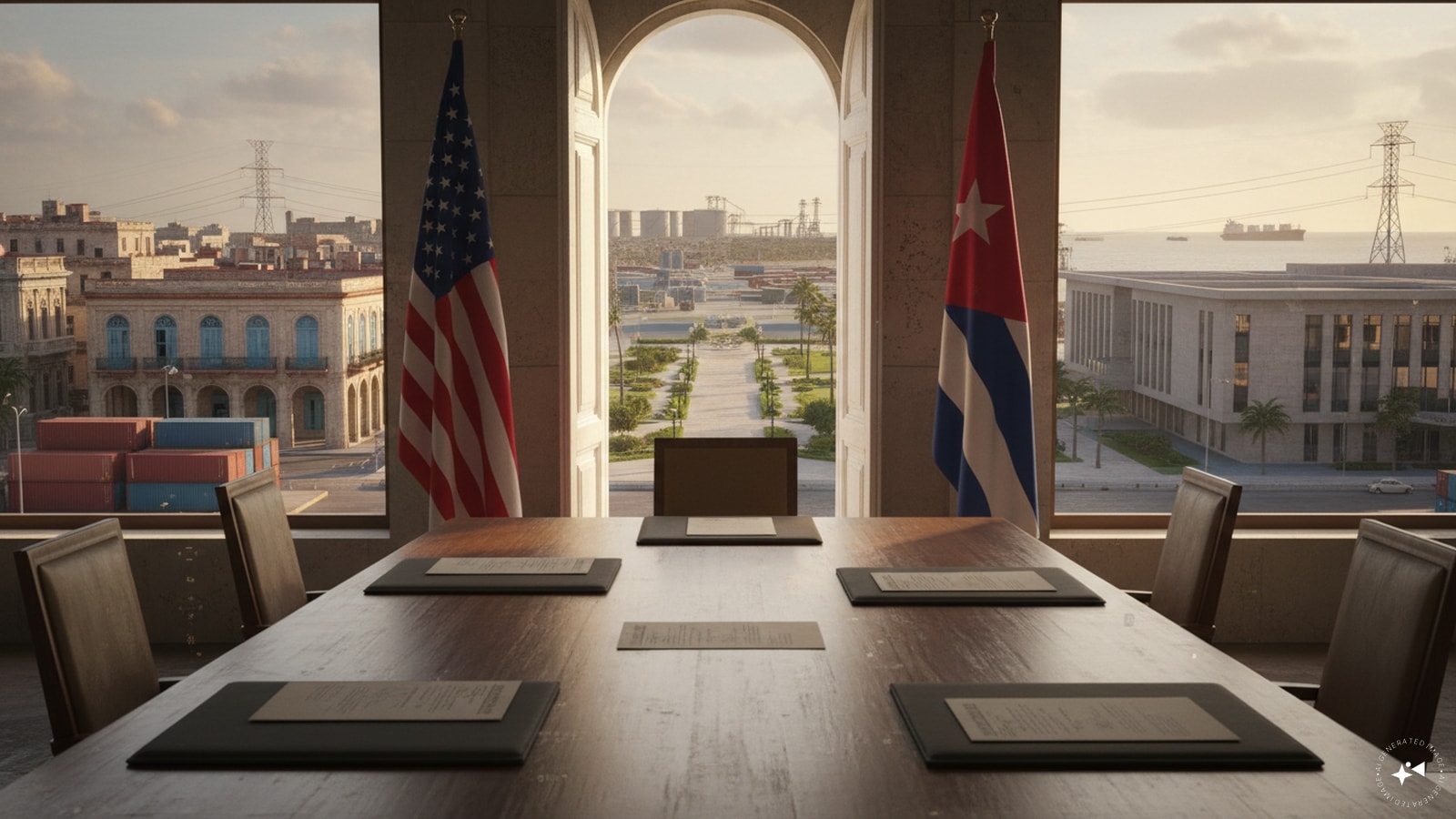
Donald Trump predicts the United States and Cuba will eventually strike a bilateral deal because Washington holds overwhelming economic cards while Havana faces an existential domestic collapse. The prediction relies less on traditional diplomatic goodwill and more on transactional coercion. By tightening sanctions during his first term, rolling back Obama-era normalization, and keeping Cuba on the State Sponsors of Terrorism list, the Trump playbook engineered maximum economic pressure. Now, with Cuba's electrical grid failing, inflation spiraling out of control, and hundreds of thousands of citizens fleeing the island, Trump is calculating that the Cuban government will soon have no choice but to negotiate on American terms.
To understand why this prediction carries weight right now, you have to strip away sixty years of Cold War nostalgia and look at the cold math of Caribbean geopolitics. Most surface-level political coverage treats US-Cuba relations as an ideological stalemate frozen in 1962. That view is outdated. The Cuban leadership in Havana is no longer fighting to export revolution across Latin America; it is fighting simply to keep the lights on in Vedado and prevent another mass uprising like the historic protests of July 2021.
The Architecture of Transactional Diplomacy
Trump does not view foreign policy through the lens of institutional norms or multilateral treaties. He views it as a distressed asset acquisition. In his worldview, you apply relentless financial pressure until the counterparty runs out of liquidity, and then you dictate the terms of the restructuring.
During his first administration, his team systematically dismantled the openings created by Barack Obama. They restricted travel, capped remittances, slapped sanctions on shipping companies moving Venezuelan oil to the island, and activated Title III of the Helms-Burton Act, allowing Americans to sue foreign companies operating on property confiscated after the 1959 revolution. That last move was a masterstroke of economic warfare. It immediately froze European and Canadian investment in Cuban tourism and mining, starving the regime of hard currency.
Then came the final blow in January 2021, when the outgoing administration redesignated Cuba as a State Sponsor of Terrorism. That designation acts like a financial nuclear bomb. It effectively cuts a nation off from the global banking system because international banks refuse to risk massive US Treasury fines just to process routine Cuban transactions. Even when the Biden administration eased minor travel and remittance rules, it left the core sanctions architecture intact, keeping the economic vise tightly clamped.
When Trump says the two nations will make a deal, he is signaling that the pressure campaign has reached its intended crescendo. He believes Havana is finally desperate enough to trade major political or strategic concessions in exchange for relief from the embargo and removal from the terrorism list.
Havana Is Running Out of Rope
Walk through the streets of Havana today, and the ideological slogans painted on crumbling concrete walls feel like relics from a dead civilization. The reality on the ground is an acute humanitarian and economic emergency.
Cuba's economy has contracted sharply over the last several years, crippled by the dual shocks of tightened US sanctions and the lingering collapse of its tourism sector. The island's Soviet-era thermoelectric power plants are breaking down faster than engineers can patch them together, leading to rolling blackouts that routinely last twelve to eighteen hours a day. Food shortages are chronic. Basic antibiotics and medical supplies are virtually nonexistent in public clinics, shattering the regime's long-standing propaganda boast of providing world-class universal healthcare.
The demographic bleed is even worse. Since 2021, roughly one million Cubans—nearly ten percent of the entire population—have abandoned the island, primarily migrating north toward the US border. Those leaving are not dissidents; they are doctors, teachers, engineers, and young laborers. A country cannot sustain an economy when its productive workforce is packing its bags en masse.
The Collapse of Foreign Lifelines
Historically, Havana survived American pressure by latching onto wealthy ideological patrons. First, it was the Soviet Union, which subsidized the Cuban economy to the tune of billions of dollars a year until Moscow imploded in 1991. Later, Hugo Chávez stepped in, flooding Cuba with cheap Venezuelan oil in exchange for Cuban doctors and intelligence operatives.
Those lifelines are frayed beyond repair.
- Venezuela is mired in its own economic dysfunction and can barely spare the crude oil needed to keep Cuban generators humming.
- Russia, bogged down in a costly war of attrition in Ukraine, offers diplomatic rhetoric and occasional symbolic naval visits, but Vladimir Putin is not writing blank checks to bail out the Cuban central bank.
- China has grown deeply frustrated with Havana's chronic failure to repay its debts and its stubborn refusal to implement genuine market reforms, leading Beijing to scale back new credit lines.
Without a foreign sugar daddy to subsidize its inefficiencies, the government led by President Miguel Díaz-Canel is trapped. It cannot print its way out of the crisis without triggering hyperinflation, and it cannot crush dissent forever without risking a total breakdown of civil order.
What a Washington-Havana Deal Actually Looks Like
If Trump and the Cuban leadership actually sit down at the negotiating table, forget about grand speeches regarding human rights or immediate multi-party democracy. A deal brokered by a Trump White House would be brutally pragmatic, focusing on immediate, tangible wins that play well to domestic American audiences while leaving the underlying political structure of Cuba largely up to the Cubans to sort out—at least initially.
First on the table would be migration control. Border security and deportation logistics are massive political priorities in Washington. A deal would almost certainly require Havana to accept regular, large-scale deportation flights of Cuban nationals who entered the United States illegally, as well as stricter maritime interdiction cooperation to stop rafters in the Florida Straits.
Second would be geopolitical containment. Washington wants absolute assurances that Cuba will not serve as an intelligence or military listening post for China or Russia. Reports of Chinese signals intelligence facilities operating on the island have alarmed defense officials in the Pentagon. Rolling back Beijing's electronic footprint ninety miles off the coast of Florida would be a massive strategic victory for any US president.
Third is property restitution and debt settlement. Roughly six billion dollars in certified US corporate and individual claims remain unresolved from the 1959 nationalizations. A framework allowing American companies to invest in Cuban infrastructure, agriculture, or telecommunications—while paying into a settlement fund for those historic claims—fits squarely into a transactional business model.
In exchange, Washington could offer a phased rollback of sanctions. Removing Cuba from the State Sponsors of Terrorism list would immediately restore its access to international credit. Lifting restrictions on American agricultural exports, telecom investments, and commercial flights would inject billions of dollars of liquidity into the island's starving economy within months.
The Domestic Minefield in South Florida
Talking about a deal is easy. Surviving the political fallout in Miami is another story entirely.
For decades, US policy toward Cuba has been dictated less by the State Department and more by the electoral math of Florida. While Florida has shifted reliably red in recent election cycles, the Cuban-American political establishment in Miami-Dade County remains fiercely influential in Republican politics.
Figures like Senator Marco Rubio and Representative Mario Díaz-Balart have built their careers on an uncompromising stance against the Castro regime and its successors. To them, any concession that enriches the Cuban state—particularly GAESA, the sprawling military-run conglomerate that controls Cuba's hotels, ports, remittances, and retail stores—is an act of betrayal. They argue, with considerable evidence, that lifting sanctions without verifiable democratic reforms simply gives the military brass the cash they need to buy more riot gear and stay in power for another twenty years.
Trump will have to navigate this ideological tripwire carefully. He enjoys immense loyalty among Cuban-American voters who view him as a strongman willing to confront socialist regimes in Havana, Caracas, and Managua. If he cuts a deal that looks like appeasement, he risks alienating a core constituency and triggering a revolt among hawkish Republicans in Congress.
To sell a deal in Little Havana, Trump would have to frame it not as a compromise, but as a total surrender by the communists. He would need visible, undeniable concessions—such as the release of hundreds of political prisoners detained after the July 2021 protests, or the formal dismantling of specific state security apparatuses—to prove that Washington extracted blood for every dollar of sanctions relief.
Why Havana Might Still Walk Away
The fatal flaw in any transactional foreign policy is assuming the other side values economic survival above all else. The Cuban Communist Party has demonstrated for over six decades that it values absolute political control far more than the material well-being of its citizens.
For the aging generals running GAESA and the bureaucrats in the Central Committee, genuine economic liberalization is a mortal threat. History shows that when authoritarian regimes lose their monopoly over capital, they eventually lose their monopoly over politics. If Cuban citizens can earn independent wealth through private enterprise and foreign investment without relying on state ration cards, the regime loses its primary mechanism of social control.
Consider a hypothetical scenario where Washington offers to lift the embargo tomorrow in exchange for free, internationally monitored municipal elections and unrestricted internet access. The leadership in Havana would reject it instantly. They know that in a genuinely free election, they would be voted out of office within weeks, and their senior officials would likely face prosecution for decades of human rights abuses and corruption.
This creates a fundamental asymmetry at the negotiating table. Washington wants stability, migration control, and business opportunities. Havana wants survival without relinquishing power. Bridging that gap requires a level of trust that simply does not exist between two capitals that have spent sixty-five years trying to destroy each other.
Furthermore, hardliners within the Cuban military still harbor deep paranoia about American intentions. They view every diplomatic overture from Washington—whether Obama's cultural exchanges or Trump's transactional deal-making—as a Trojan horse designed to subvert the revolution from within. When push comes to shove, the bunker mentality in Havana has a long track record of overriding economic rationality.
The Clock Is Ticking on the Straits
Despite the entrenched obstacles, the status quo is rapidly becoming unsustainable for both sides. Washington cannot afford a complete state collapse ninety miles off its southern coast, which would trigger an unprecedented refugee crisis in the Florida Straits and create a power vacuum that cartel networks or hostile foreign powers would eagerly exploit. Meanwhile, Havana cannot govern a country in permanent darkness with a shrinking, furious population.
Trump's prediction is a calculated bet on leverage. He is wagering that the sheer weight of economic reality will eventually crush ideological stubbornness, forcing the heirs of Fidel Castro to sign a deal simply to save themselves from a violent reckoning at home. Whether Havana blinks first, or chooses to go down with the ship, will define the final chapter of the Cold War in the Western Hemisphere.


