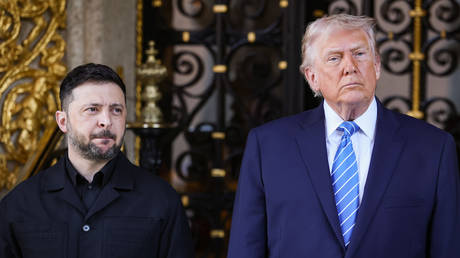
When Donald Trump suggests that Ukraine will end up with "a little bit different shape" following a negotiated settlement with Russia, he is using casual, real-estate-inflected language to describe a profound geopolitical rupture—the formal or de facto partition of a sovereign European nation. Beneath the offhand phrasing lies a clear strategic calculation. Rather than pursuing the Biden-era goal of restoring Ukraine’s internationally recognized 1991 borders, a Trump-brokered framework prioritizes a rapid cessation of hostilities by freezing the current front lines, effectively ceding control of roughly one-fifth of Ukrainian territory to Moscow in exchange for an end to active combat and a reduction in American financial commitments.
To understand why this phrase carries such weight in Washington, Brussels, and Kyiv, one must strip away the political theater and look at the mechanics of modern territorial conflict. Maps do not change easily, and when they do, the consequences echo for generations. Don't forget to check out our previous coverage on this related article.
The Architecture of a Frozen Conflict
In diplomatic shorthand, a "different shape" is a euphemism for territorial concession. Since Russia’s full-scale invasion in February 2022—building on its 2014 annexation of Crimea and incursion into the Donbas—Russian forces have occupied significant swathes of eastern and southern Ukraine. This includes most of Luhansk and Donetsk, alongside substantial portions of Zaporizhzhia and Kherson.
A settlement built around the current line of contact does not merely alter lines on a cartographer's desk. It fundamentally reshapes Ukraine’s economic viability, demographic balance, and defensive posture. To read more about the history here, BBC News offers an informative breakdown.
Consider the geography of the occupied zones. Russia currently controls the land bridge connecting its mainland to the Crimean peninsula, turning the Sea of Azov into a Russian-dominated internal lake. It holds Europe’s largest nuclear power plant at Zaporizhzhia, vast lithium and rare-earth mineral deposits in the east, and some of the most fertile agricultural land on the continent. Losing these assets—even under a "temporary" armistice rather than formal legal recognition—leaves the remaining Ukrainian state structurally weakened and heavily dependent on Western economic life support.
The Korean Peninsula Model
Advocates of a rapid settlement frequently point to the 1953 Korean Armistice Agreement as a viable template. In that scenario, fighting stops along a heavily fortified demilitarized zone, neither side formally abandons its territorial claims, and a fragile peace holds through deterrence.
Yet the comparison breaks down under scrutiny. South Korea survived and prospered after 1953 because the United States signed a mutual defense treaty with Seoul and stationed tens of thousands of American troops permanently on the peninsula. Trump and his inner circle have repeatedly signaled deep skepticism toward extending similar Article 5-style NATO security guarantees to Kyiv, or deploying U.S. forces to police a Ukrainian buffer zone. Without a credible, ironclad deterrent backed by American military power, a frozen line in Ukraine looks less like the Korean peninsula and more like the failed Minsk agreements of 2014 and 2015—a temporary pause that allows Moscow to rearm, reconstitute its battered divisions, and strike again at a moment of its choosing.
The Transactional Logic in Washington
To grasp the "why" behind Trump’s rhetoric, you have to understand how he views foreign policy. For decades, the bipartisan consensus in Washington held that the preservation of the post-World War II international order—specifically the principle that borders cannot be changed by force—was a core American national security interest.
Trump rejects that premise as an expensive abstraction. His worldview is strictly transactional, rooted in balance sheets, immediate leverage, and burden-sharing. From his perspective, the war in Ukraine is primarily a European security problem that has drained tens of billions of dollars from the U.S. Treasury while distracting Washington from its primary strategic competitor, China.
Leverage as a Blunt Instrument
How would an administration operating on this logic actually force two entrenched adversaries to the negotiating table? The mechanism relies on asymmetric pressure applied to both sides simultaneously.
- Pressuring Kyiv: The United States remains Ukraine’s single most critical supplier of high-end air defense interceptors, artillery ammunition, and real-time battlefield intelligence. Threatening to turn off that spigot gives Washington immense coercive leverage over President Volodymyr Zelenskyy. Without American aid, European allies lack the industrial capacity to fill the void in the short term, leaving Ukrainian forces vulnerable to catastrophic defensive collapses.
- Pressuring Moscow: Conversely, getting Vladimir Putin to stop advancing requires a credible threat of escalation. Trump has suggested that if Moscow refuses a deal, Washington could flood Ukraine with more weaponry than ever before, while simultaneously using American energy dominance to drive down global oil prices—starving the Kremlin’s war machine of the petrodollars it needs to survive.
It is a high-stakes gamble. The assumption is that both leaders are rational actors who will bend when confronted with extreme financial and military pressure. History, however, suggests that autocrats fighting wars they frame as existential rarely behave like real-estate developers looking to cut their losses on a bad property.
What Moscow Actually Wants
A critical flaw in the "quick deal" thesis is the assumption that Vladimir Putin is satisfied with the territory he currently holds. While a "different shape" for Ukraine might satisfy Trump’s desire to declare victory and end U.S. spending, it does not necessarily align with the Kremlin’s core objectives.
Since the outset of the war, Moscow’s demands have extended far beyond the four annexed regions. Putin’s ultimate goal has consistently been the political subjugation of Ukraine—ensuring that whatever remains of the country is neutral, demilitarized, and firmly outside the Western orbit.
If a peace deal leaves a smaller, fiercely anti-Russian Ukraine intact, armed by European nations, and economically integrated with the European Union, Moscow will view that outcome as a strategic defeat. The Kremlin has restructured its entire economy onto a war footing, absorbing staggering casualties and severe Western sanctions precisely to prevent a sovereign, Western-aligned Ukraine from existing on its border. Expecting Putin to accept a simple territorial compromise without demanding strict limits on Ukraine’s future military capabilities and foreign alliances ignores the ideological core of his regime.
The European Dilemma and the Precedent Problem
For European leaders in Paris, Berlin, and Warsaw, the prospect of a U.S.-brokered territorial concession triggers acute strategic anxiety. Europe has spent the past several years slowly waking up from a post-Cold War slumber, attempting to rebuild its atrophied defense industrial base while managing an energy transition away from Russian gas.
If Washington forces Kyiv into a settlement that validates Russia’s territorial conquest, the consequences will ripple far beyond Eastern Europe.
- The Erosion of Deterrence: The foundational rule of European security since 1945 has been the inviolability of borders. Legitimizing land grabs by force signals to every revanchist power on the globe that military aggression ultimately pays dividends if you are willing to outlast Western political attention spans.
- The Burden Shift: Trump’s vision of a post-war settlement explicitly places the financial and military burden of reconstruction and peacekeeping on European shoulders. European capitals would be expected to fund the rebuilding of a devastated country while simultaneously deterring a rejuvenated Russian military—all without the automatic backstop of American leadership.
- Nuclear Proliferation: Perhaps the most dangerous, yet least discussed, consequence involves nuclear weapons. In 1994, Ukraine gave up the world’s third-largest nuclear arsenal under the Budapest Memorandum in exchange for security assurances from the United States, the United Kingdom, and Russia. If those assurances prove worthless and Ukraine is carved up anyway, non-nuclear states worldwide—from East Asia to the Middle East—will draw a sobering conclusion. Conventional alliances cannot be trusted; only an independent nuclear deterrent guarantees national survival.
The Domestic Reality in Kyiv
Inside Ukraine, the political and social reality is far more complex than Western soundbites suggest. Years of relentless attrition, rolling blackouts from targeted strikes on the energy grid, and tens of thousands of dead and maimed soldiers have exhausted the population. Public polling within Ukraine shows a gradual, painful shift: while the vast majority still opposes formally ceding land to Russia, a growing minority is open to discussions about ending the war through diplomacy to save lives.
Yet Volodymyr Zelenskyy faces an impossible political trap. Under the Ukrainian constitution, the president does not have the unilateral authority to cede national territory; any change to the country's borders requires a nationwide referendum. Signing a deal that hands over sovereign land would not only trigger massive domestic backlash and potential political instability, but it would also be viewed by millions of Ukrainians—particularly frontline veterans—as a betrayal of those who died defending it.
To survive politically, any Ukrainian leader would need to frame a territorial loss not as a permanent surrender, but as a temporary tactical pause—much like West Germany during the Cold War, which never recognized the permanent division of the German nation even as it integrated into NATO and the European economic community.
The Illusion of a Clean Exit
The appeal of Trump’s rhetoric lies in its simplicity. Voters tired of endless foreign entanglements and rising domestic costs naturally gravitate toward a leader promising a swift, decisive resolution to a brutal conflict thousands of miles away. Calling the outcome "a little bit different shape" softens the harsh reality of what is actually being proposed.
In practice, redrawing borders under duress never produces a clean exit. A truncated Ukraine, stripped of its industrial heartland and coastal access, deprived of NATO membership, and left staring across a heavily mined frontier at an emboldened Russia, is not a recipe for lasting stability. It is an architecture designed for future friction. The guns might fall silent for a season, the television cameras might move on to the next crisis, and the balance sheets in Washington might temporarily improve—until the underlying unresolved grievances ignite a far deadlier war down the road.