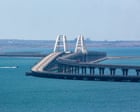
Concrete smells like wet chalk and cold iron right before it cracks.
Anyone who has stood near an industrial waterfront in November knows that heavy, metallic dampness that settles into your coat and refuses to leave. Across the Kerch Strait, where the Sea of Azov bleeds into the Black Sea, that smell carries a very specific weight. For years, nineteen kilometers of steel trusses and reinforced concrete stood there as a physical argument that geography could be bullied into submission.
The headlines always reduce it to geometry and tonnage. A span dropped. A rail line charred. Traffic halted in both directions. News alerts treat the Kerch Bridge like a chessboard square that changes color with a tap of a finger, stripping away the salt spray, the grinding anxiety of midnight checkpoints, and the terrifying fragility of an artery forced to carry the weight of an empire’s pride.
When Ukraine strikes that crossing, the world checks satellite photos. People on the ground check their fuel gauges.
The Weight of an Artificial Spine
To understand why a single explosion over dark water reverberates thousands of miles away, forget military maps for a moment and picture a long, narrow pier extending out into an unforgiving sea. Imagine building your house at the very end of that pier, knowing that every drop of fresh water, every crate of medicine, every gallon of heating oil, and every bullet required to guard your front door must travel down that single wooden walkway.
That is occupied Crimea.
Before 2014, the peninsula breathed through the mainland to its north. Water flowed down the North Crimean Canal. Trains rolled seamlessly from Kyiv and Kharkiv down to Simferopol and Sevastopol. When Russia seized the peninsula, it severed those natural roots and spent roughly four billion dollars hammering an artificial spine into the seabed between the Taman Peninsula and Kerch. Opened to vehicle traffic in 2018 and rail in 2019, the Crimean Bridge became the ultimate symbol of permanence—a boast poured in cement.
Consider a hypothetical logistics officer named Major Alexei Volkov, stationed at a rail depot near Dzhankoi in northern Crimea. Let us be clear that Volkov is a composite figure, drawn from the documented realities of Russian supply chains, yet his sleepless nights mirror a mathematical certainty. Every morning, Volkov stares at a ledger that does not care about political speeches. A mechanized brigade consumes hundreds of tons of fuel, ammunition, and rations every single day. Moving that volume by sea requires specialized roll-on, roll-off ferries that are slow, vulnerable to winter gales, and easy targets in open water. Moving it overland along the northern coast of the Sea of Azov means driving trucks through occupied Zaporizhzhia and Donetsk—corridors within reach of Ukrainian artillery and partisan sabotage.
Volkov needs the bridge. He needs those twin parallel spans—one for four lanes of asphalt, one for two tracks of heavy rail—to hum without interruption. When a strike buckles the roadway or melts the steel beneath a fuel train, Volkov’s neat columns of numbers turn into chaos overnight.
Anatomy of a Chokepoint
It is easy, sitting in a quiet room far from the Black Sea, to feel confused by the conflicting reports that always follow an attack on the Kerch Strait. One side claims the structure is barely scratched; the other declares a strategic triumph. Both sides release grainy thermal footage that looks like ink spilled on gray paper. I remember watching the first major blast footage in October 2022, squinting at the screen at three in the morning, trying to tell whether the white flash was a truck bomb, a missile, or a sea drone, and realizing how little the exact mechanism mattered compared to the psychological rupture it caused.
Silence.
Then the sirens began across Kerch.
Whether Ukrainian forces deploy explosive-laden unmanned surface vessels—sleek, low-profile sea drones skimmed just inches above the choppy waves—or long-range ballistic missiles designed to punch through reinforced concrete piers, the tactical goal remains identical. They are not necessarily trying to vaporize nineteen kilometers of engineering in a single afternoon. Bridges are notoriously stubborn targets; concrete absorbs kinetic shock far better than people expect, and twisted rail ties can be replaced in days if the underlying pylons hold.
What cannot be patched with quick-dry cement is certainty.
Every successful strike forces Moscow into an agonizing arithmetic problem. To protect the Kerch Bridge, the Russian military must strip air defense batteries—expensive S-400 systems, Pantsir-S1 mobile units, radar arrays—from other active fronts and cluster them around the strait. They have sunk barges along the water’s edge to create makeshift boom barriers against sea drones. They deploy smoke generators that shroud the spans in thick, choking white clouds whenever an alert sounds, blinding satellite optics while simultaneously paralyzing civilian and military traffic alike.
Think of what happens to a bridge’s capacity when you have to inspect every single trunk, every axle, every sealed shipping container before allowing it onto the ramp. Even when no missiles fall, the threat alone turns a high-speed highway into a twenty-mile parking lot.
The Civilian Crossfire on the Asphalt
News dispatches rarely linger on the brake lights.
Yet during the summer months, even amidst a grinding war, tens of thousands of Russian tourists still drive south across that concrete ribbon toward Yalta and Alushta, treating an active war zone as a budget beach holiday. They sit in idling sedans with the air conditioning blasting, children asleep in the back seat, inches away from flatbed trucks hauling artillery shells toward the front lines in Kherson.
This is the invisible moral hazard baked into the structure itself. Under international humanitarian law, a bridge used to transport military troops and equipment is a legitimate military objective. Its dual-use nature—serving both civilians and armies—does not grant it immunity; rather, it turns every family sedan on the span into a human shield whether the driver realizes it or not.
Imagine being a resident of Kerch, the ancient port city anchoring the Crimean side of the crossing. For generations, your town was a quiet fishing and shipbuilding hub, defined by the rhythmic clank of ferry ramps and the smell of fried sprats along the embankment. Suddenly, your skyline is dominated by massive white arches that serve as the primary lightning rod for a modern war. When air defense interceptors launch from the hills behind your apartment building at two in the morning, the windows rattle in their frames like loose teeth. You learn to sleep with your shoes beside the bed. You learn the distinct acoustic difference between an outgoing surface-to-air missile—a sharp, tearing roar—and an incoming warhead, which arrives with a heavy, chest-compressing thud that you feel in your ribs before your ears register the sound.
Historical Echoes in Cold Water
Geography has a long memory, and the Kerch Strait has broken ambitions before.
In 1943, retreating German engineers began assembling materials for a massive bridge across this very strait, intending to link Crimea to the Caucasus. Before they could finish, the Red Army pushed them out. Soviet engineers seized the abandoned steel girders and rushed to complete a makeshift railway bridge in 1944, desperate to supply troops pushing west. In February 1945—just days after Stalin, Roosevelt, and Churchill met down the coast at Yalta—huge slabs of drift ice swept down from the Sea of Azov, slammed into the wooden and steel pilings, and sheared the bridge apart. The strait swallowed the wreckage whole.
For more than seventy years afterward, nobody tried to span it again. The currents were too fierce, the winter ice too unpredictable, the seabed too thick with unstable silt.
When modern Russian engineers sank piles nearly a hundred meters deep into that mud to build the current crossing, they believed twenty-first-century metallurgy had finally conquered the strait’s volatile temperament. They overlooked the simplest lesson of military history: static infrastructure is always at the mercy of mobile ingenuity.
Consider how warfare has evolved in the waters beneath those arches. For centuries, controlling a maritime chokepoint required battleships, cruisers, and coastal fortresses costing billions. Today, a remote-controlled watercraft packed with several hundred kilograms of high explosives, guided via satellite link and built for a fraction of the cost of a single tank, can slip through darkness and strike a bridge piling right at the waterline—the exact point where concrete is weakest and repairs are most agonizingly slow.
The Ripple Effect in the Trenches
Step back from the water and look north, toward the muddy trenches of southern Ukraine. How does a crack in a bridge a hundred miles behind the lines change the reality for an infantryman holding a treeline near Robotyne or Orikhiv?
War is ultimately a contest of exhaustion. An army rarely collapses all at once; instead, it starves slowly. First, artillery shells are rationed—five rounds allowed per hour instead of twenty. Then, damaged armored vehicles sit waiting weeks for spare transmissions that never arrive. Medevac helicopters stay grounded because aviation fuel is diverted to priority sectors.
When Ukraine hits the Kerch Bridge, it tightens a tourniquet on the entire southern front. Even if the railway line is repaired within seventy-two hours, those three days create a logistical backlog that takes weeks to clear. Trains pile up on sidings in Krasnodar. Fuel trucks burn precious diesel idling on back roads. Commanders are forced to burn through local stockpiles in Crimea that cannot be easily replenished.
And what about the alternative land bridge along the Sea of Azov coast? Pushing heavy freight through Melitopol and Berdyansk exposes Russian convoys to Ukrainian reconnaissance drones, HIMARS rocket strikes, and covert sabotage. Every kilometer a supply truck travels off the Kerch rail line increases its odds of never reaching its destination.
Doubt Beneath the Concrete
There is a temptation, whenever dramatic footage of a burning bridge dominates the news cycle, to declare a turning point. Observers love clean narratives where one dramatic blow topples a regime or ends a campaign.
The truth on the ground is messier, slower, and far less cinematic.
Bridges do not win wars by themselves, and damaging one does not automatically trigger an immediate retreat. Russia still possesses landing ships, heavy transport aircraft, and an extensive road network along the northern Azov shore. Engineers work around the clock with heavy cranes and welded steel plates to restore partial capacity even while smoke still rises from the asphalt. Anyone who claims a single strike seals the fate of Crimea is selling wishful thinking disguised as analysis.
Yet watch the faces of the officials inspecting the damage the morning after a strike. Look past the rehearsed bravado of television broadcasts and notice the tightened jaws, the frantic phone calls, the sudden deployment of barge barriers and radar reflectors. They understand what the concrete cannot hide.
For years, that nineteen-kilometer span was meant to prove that occupied territory had been permanently welded to the mainland, beyond reach and beyond question. Every scorch mark on its pillars, every buckled guardrail, every night that sirens wail over the dark water of the strait proves the opposite.
At dawn, when the smoke clears over Kerch, the fishermen still push their small wooden skiffs out into the gray chop. They steer wide around the massive concrete pylons, keeping their eyes on the waterline where the salt crust meets the scarred stone, listening to the low, hollow groan of steel cooling in the wind.