The rain in Jakarta does not fall; it arrives like a heavy curtain, turning the asphalt into a black mirror that reflects the red taillights of ten thousand stalled motorbikes. Inside a cramped logistics office near the Tanjung Priok port, an Indonesian freight forwarder named Budi—a hypothetical composite of the thousands of small-business operators who keep Southeast Asia moving—stares at two shipping manifests on a flickering monitor.
One container carries precision machine parts from a factory outside Chennai, India. The other holds processed palm oil and rubber components bound for Mumbai. Between them lies the Strait of Malacca, a narrow ribbon of water where nearly a third of the world’s traded goods must squeeze through a bottleneck barely two miles wide at its narrowest point. For months, freight rates have bounced wildly, insurance premiums have crept upward, and port delays have stretched from days into weeks. Budi is not a geopolitical strategist. He does not read white papers on Indo-Pacific security architecture. He simply knows that when giant nations decide to treat an ocean like a chessboard, the cost lands directly on his invoice.
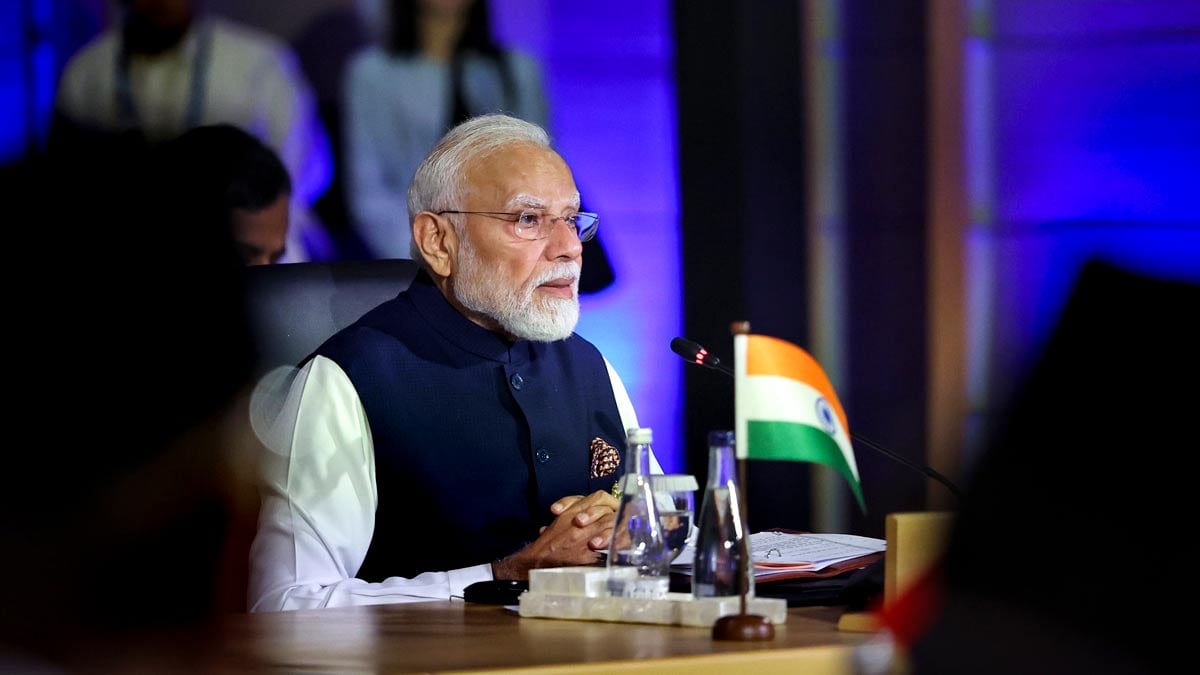
This is the quiet reality behind diplomatic speeches that rarely make the front page outside Asia. When Indian Prime Minister Narendra Modi addressed leaders of the Association of Southeast Asian Nations—commonly known as ASEAN—his central message sounded deceptively simple: India and Southeast Asia must shape the future through cooperation, not competition.
Diplomats hear policy in those words. Budi hears survival.
The Myth of the Inevitable Clash
We have been conditioned to view global economics as a zero-sum cage match. Every port built by one nation is framed as a trap for another; every trade corridor is mapped like a military flanking maneuver. Across the Indo-Pacific—a vast maritime expanse stretching from the eastern coast of Africa to the western shores of the Americas—great-power rivalry has become the default lens through which the world interprets every handshake, tariff, and naval exercise.
That lens is dangerously distorted.
Together, India and the ten member states of ASEAN—Brunei, Cambodia, Indonesia, Laos, Malaysia, Myanmar, the Philippines, Singapore, Thailand, and Vietnam—represent nearly two billion people. That is roughly one-quarter of humanity. Their combined economic output exceeds $7 trillion, and their populations are among the youngest and fastest-urbanizing on the planet. Yet for decades, these neighbors acted like strangers living in adjacent apartments who rarely borrowed a cup of sugar, preferring instead to order everything from across town.
Consider the numbers. Bilateral trade between India and ASEAN crossed $120 billion in recent years, a respectable figure on paper until you compare it to ASEAN’s trade with China, which towers above $900 billion. Historically, the relationship suffered from friction—lingering doubts over tariff barriers, uneven customs rules, and infrastructure gaps that made shipping a container from Chennai to Ho Chi Minh City more expensive and slower than shipping it to Rotterdam.
I still remember walking the docks of Kochi on India’s southwestern coast a few years ago, watching cranes swing lazily over half-empty berths while cargo vessels bypassed the port entirely on their way to larger hubs. Dockworkers smoked near rusted bollards, complaining that while politicians talked endlessly about ancient maritime ties, the actual ships were taking their business elsewhere. You could smell the diesel, the salt rot, and the frustration of missed opportunity. History alone does not pay port fees.
Why Geography Is Not Enough
To understand why Modi’s push for cooperation matters now, you have to look at what happens when supply chains break.
Think of global manufacturing not as a straight assembly line, but as an intricate root system beneath a forest floor. For thirty years, that root system grew overly concentrated in a single patch of soil. When pandemic lockdowns, sudden export restrictions, and maritime chokepoints rattled the global economy, companies across the world realized a terrifying truth: efficiency without resilience is just a slow-motion collapse waiting for a trigger.
Suddenly, boardrooms from Tokyo to Frankfurt began searching for alternatives—a strategy often called "China Plus One." On paper, India and Southeast Asia looked like the obvious winners. India offered massive domestic scale, engineering talent, and ambitious manufacturing incentives. Vietnam, Malaysia, Thailand, and Indonesia offered agile assembly hubs, established electronics ecosystems, and deep integration into global trade networks.
Yet a subtle danger emerged alongside the opportunity. Would India and ASEAN compete furiously to steal factories from one another, racing to the bottom on subsidies and regulations? Or would they wire their economies together so that a microchip designed in Bengaluru, fabricated in Singapore, packaged in Penang, and assembled into a smartphone in Tamil Nadu becomes a shared triumph?
Competition. It sounds healthy until it fractures the very region it is meant to enrich.
If India and Southeast Asia treat each other as rivals, both remain vulnerable to external shocks and economic coercion. Each country stays small enough to be pressured, isolated, or outmaneuvered in trade negotiations. Cooperation turns fragmented markets into an integrated economic engine capable of setting its own rules.
The Digital Bridge Nobody Saw Coming
Most people still picture trade as steel containers stacked on diesel-belching ships. That picture is already outdated.
Step into a bustling night market in Bangkok or a roadside tea stall in Pune, and you will witness the quiet revolution reshaping how ordinary people transact. A customer scans a small square QR code taped to a plastic jar, taps a phone screen, and transfers money instantly from one bank account to another—zero cash, zero credit card fees, zero friction.
India’s Unified Payments Interface—known globally as UPI—now processes more than ten billion transactions every single month, turning street vendors and rickshaw drivers into participants in a real-time digital economy. Meanwhile, across Southeast Asia, countries like Singapore, Thailand, Malaysia, and Indonesia have built their own fast-payment networks, linking national systems so a tourist from Kuala Lumpur can buy noodles in Chiang Mai using their home banking app.
When India and Singapore linked UPI with Singapore’s PayNow system, something profound happened beneath the surface of routine diplomacy. For the first time, a migrant worker in Singapore could send money home to a family member in rural India in seconds, bypassing predatory remittance fees that historically devoured up to seven or eight percent of hard-earned wages.
Let us return to a human scale to feel what that actually means. Imagine a hypothetical nurse named Ananya working double shifts in Singapore to pay for her younger brother’s engineering tuition in Kerala. Under the old banking rails, sending $400 home meant losing enough money to wire fees and currency spreads to pay for a week’s worth of groceries. With interoperable digital payment rails, that leakage vanishes. Multiply Ananya’s story by millions of migrant workers, small exporters, and digital entrepreneurs across the Bay of Bengal, and you begin to see why digital public infrastructure is the true backbone of modern cooperation.
Instead of selling proprietary software that locks countries into expensive vendor dependencies, India has championed open-source digital frameworks—identity systems, payment rails, and data-exchange protocols that neighboring nations can adapt to their own laws and needs. In a world increasingly divided into closed technological spheres, offering shared digital highways without political strings attached is a quiet stroke of genius.
The Sea That Connects, The Sea That Divides
Still, optimism alone cannot calm rough waters. Anyone who claims that India-ASEAN cooperation is effortless is either lying or has never sat through a trade negotiation.
There are real anxieties on both sides. Indian manufacturers still wince at memories of the 2010 ASEAN-India Free Trade Agreement, arguing that lowered tariffs flooded Indian markets with cheap imports while Indian pharmaceuticals, textiles, and agricultural goods faced stubborn non-tariff barriers in Southeast Asia. That bruised trust is precisely why India walked away from the massive Regional Comprehensive Economic Partnership—known as RCEP—in 2019, fearing its domestic industries would be overwhelmed.
On the other side of the Bay of Bengal, some Southeast Asian policymakers have quietly wondered whether New Delhi has the logistical speed and bureaucratic follow-through to match its grand rhetoric. Promises of highways linking northeastern India to Myanmar and Thailand—the long-delayed India-Myanmar-Thailand Trilateral Highway—have stalled repeatedly amid construction bottlenecks and civil conflict inside Myanmar.
Admitting these friction points does not weaken the case for cooperation; it makes the case urgent.
Look at the maritime domain. The South China Sea and the eastern Indian Ocean are no longer sleepy trade routes; they are contested zones where fishing boats, coast guard cutters, and naval destroyers shadow one another daily. Freedom of navigation—the simple, foundational rule that international waters belong to everyone and no single nation can unilaterally redraw maritime boundaries—is the oxygen of Southeast Asian prosperity.
When India conducts joint maritime patrols with Indonesia, sells supersonic cruise missiles to the Philippines, or expands naval logistics agreements with Singapore, it is not trying to start a war. It is trying to prevent one through deterrence and balance. A multipolar Asia—one where smaller nations are not forced to choose between submission to a single neighbor and reliance on a distant superpower—depends entirely on middle powers standing shoulder-to-shoulder.
Climate, Food, and the Invisible Lifeline
Beneath the headlines about semiconductors and naval exercises lies an even more immediate bond: survival in a warming world.
Both India and Southeast Asia sit squarely in the crosshairs of climate disruption. Erratic monsoons threaten rice harvests from the Mekong Delta to the Gangetic Plain. Rising sea levels gnaw at coastal megacities like Jakarta, Mumbai, Bangkok, and Chennai. When extreme heat waves scorch crops or cyclones batter ports, food inflation ripples across borders within weeks.
Consider what happens when a major rice-exporting nation suddenly restricts shipments to protect domestic prices. Panic buying erupts across importing countries, prices spike for families already spending half their income on food, and political stability wobbles. Through shared agricultural research, resilient seed varieties, disaster-response networks, and renewable energy grids—including initiatives like the International Solar Alliance—India and ASEAN have the chance to turn shared vulnerability into collective insurance.
Supply chains are not just about microchips and automobiles. They are about fertilizer, generic medicines, solar panels, and sacks of grain. During the height of the global health crisis, when air cargo grounded to a halt and borders slammed shut, shipments of essential pharmaceuticals from Indian factories kept clinics running across Southeast Asia, while medical supplies and oxygen concentrators flowed back toward India during its darkest wave. Crisis stripped away diplomatic jargon and revealed a simple truth: when the storm hits, your closest neighbors are the ones who reach you first.
The Choice Ahead
Walk down to the waterfront in Marina Bay, Singapore, just after sunset. Across the dark water, dozens of cargo ships sit anchored in neat, glowing rows, their hull lights twinkling like a floating city waiting for morning tide. From that vantage point, the world looks orderly, predictable, almost permanent.
It is an illusion.
The international order built over the past eighty years is straining at its seams. Trade rules are being rewritten through tariffs and industrial policy; maritime lanes are being tested by gray-zone coercion; emerging technologies like artificial intelligence and clean energy are creating new winners and losers at breathtaking speed. In moments like this, nations face a fundamental choice between two instincts.
The first instinct is defensive crouch: hoard resources, raise walls, undercut neighbors, and hope the storm passes someone else’s door. History shows where that road ends—in fragmented markets, stagnant growth, and small nations reduced to pawns in someone else’s rivalry.
The second instinct is harder, slower, and infinitely more rewarding: build bridges before the flood arrives. Harmonize customs rules so a small manufacturer in Surabaya can sell effortlessly to a buyer in Pune. Upgrade the trade agreement so both sides feel the gains are fair. Connect payment systems, share clean energy grids, patrol shared waters together, and treat the two billion people living between the Himalayas and the Java Sea not as rival markets to be conquered, but as a single community of destiny.
Back in Jakarta, the evening rain finally eases into a light mist. Budi closes one of the two manifests on his screen, picks up his phone, and approves a consolidated shipment route linking Chennai, Singapore, and Tanjung Priok through a newly digitized customs corridor. It saves forty-eight hours of transit time and trims twelve percent off the freight bill. Neither the prime ministers in their summit halls nor the pundits on evening television will ever know Budi’s name, yet the entire architecture of Asian peace and prosperity rests on whether millions of people like him find it easier tomorrow to build together than to fight alone.