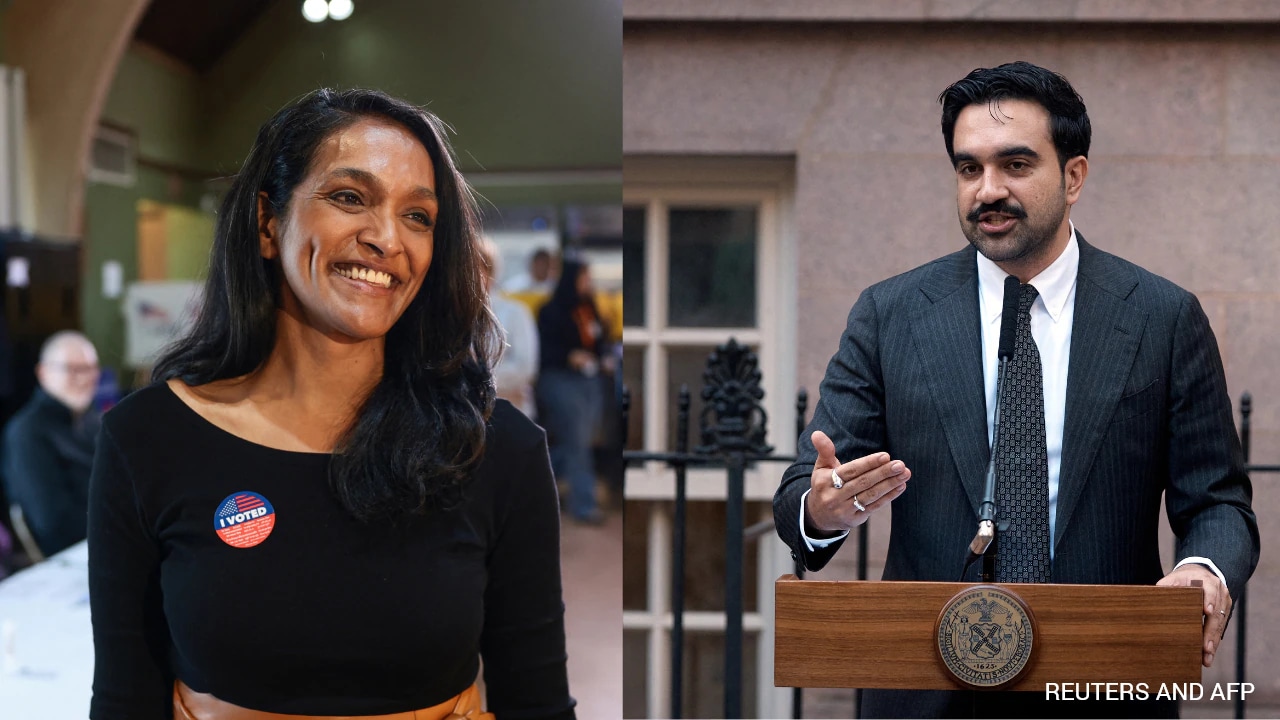
In a historic political shift, Zohran Mamdani and Nithya Raman—both of Indian descent—now hold the mayoral offices of New York City and Los Angeles, the two largest municipalities in the United States.
Their simultaneous rise marks the first time South Asian Americans have led the nation’s top two urban centers concurrently. Yet reducing this moment to simple identity politics misses the real story. Neither candidate won because of their heritage alone; both captured City Hall by weaponizing hyper-local tenant organizing, exploiting fractured establishment coalitions, and riding an unprecedented wave of municipal dissatisfaction over housing costs and public infrastructure.
For decades, the political machinery of New York and Los Angeles operated on predictable, entrenched tracks. In New York, power flowed through county party bosses, municipal labor unions, and real estate developers. In Los Angeles, a sprawling city council system insulated incumbents while business interests and police unions dictated the budget.
Those systems broke down.
The Collapse of the Old Machine
To understand how Indian-origin mayors came to run both coasts, you have to look at the vacuum left by traditional urban Democrats. Over the past decade, rising rents, transit failures, and visible homelessness eroded public trust in centrist governance. Voters in both cities grew tired of incremental policy adjustments that left working-class neighborhoods priced out.
In New York, Zohran Mamdani—a former state assemblymember from Astoria, Queens, with roots in Uganda and India—built his campaign not in Manhattan boardrooms, but in outer-borough apartment buildings and taxi garages. Long before his mayoral run, Mamdani gained national attention by joining a 15-day hunger strike alongside New York City taxi drivers crushed by predatory medallion debt. That action secured hundreds of millions of dollars in debt relief and proved to skeptical working-class voters that he could deliver tangible financial results.
Across the country in Los Angeles, Nithya Raman followed a remarkably similar trajectory. Born in Kerala, India, and trained as an urban planner at MIT, Raman did not climb the traditional ladder of California political staffers. Instead, she co-founded a grassroots homelessness coalition in Silver Lake, mapping encampments and auditing the city’s failure to spend voter-approved housing funds. When she unseated a powerful incumbent on the Los Angeles City Council in 2020, establishment consultants dismissed it as a fluke of pandemic-era mail-in voting. By the time she mounted her citywide mayoral campaign, her district-level constituent service machine had become the template for modern progressive organizing in Southern California.
Beyond Symbolic Representation
Political commentators love an easy narrative about demographic milestones. The headlines write themselves. When South Asian Americans—who represent just over one percent of the U.S. population—suddenly command municipal budgets exceeding $100 billion in New York and $12 billion in Los Angeles, the symbolic weight is undeniable.
Representation does not pave potholes.
Both mayors inherited cities facing brutal fiscal realities. Federal pandemic relief funds have evaporated, leaving structural deficits that cannot be solved with campaign slogans. In New York, Mamdani faces the constant friction between his democratic socialist platform—which includes freezing rents on stabilized apartments and expanding fare-free bus pilots—and the hard realities of state-level tax authority in Albany. A New York City mayor cannot raise income taxes on the wealthy without approval from the governor and state legislature, creating an immediate ceiling on ambitious spending programs.
In Los Angeles, the institutional constraints are even sharper. Los Angeles operates under a "weak mayor" charter, meaning executive authority is heavily diluted by a 15-member City Council whose members act like autonomous governors over their own districts. Raman’s transition from councilmember to mayor required her to build legislative majorities among colleagues who frequently clash over zoning laws, shelter placements, and police staffing levels.
The Coalition Math Behind the Victories
How did two candidates running to the left of the Democratic establishment secure citywide majorities in notoriously complex electorates? They solved a math problem that had tripped up progressive candidates for twenty years.
Historically, left-wing urban candidates dominated wealthy, college-educated neighborhoods while losing heavily in working-class Black, Latino, and immigrant precincts. Mamdani and Raman inverted that dynamic through deliberate, multilingual ground operations.
- Linguistic Infrastructure: In Queens, Brooklyn, and the San Fernando Valley, campaign literature was printed and canvassed in Bengali, Hindi, Urdu, Punjabi, Spanish, Tagalog, and Korean. Rather than treating "Asian American voters" as a monolith, field organizers segmented outreach by neighborhood, religion, and socioeconomic status.
- Economic Pocketbook Focus: Both campaigns ruthlessly subordinated abstract cultural debates to concrete household expenses. They talked about utility bills, bus reliability, childcare costs, and eviction defense.
- Small-Dollar Fundraising: By relying on municipal public matching funds programs—which multiply small local donations by up to eight-to-one in New York and six-to-one in Los Angeles—both candidates neutralized the massive super PAC spending deployed by real estate developers and corporate trade groups.
The Friction of Governing
Winning an election with an activist base is one thing; managing a massive municipal bureaucracy is another. The sharpest criticism facing both Mamdani and Raman comes not from conservatives, who hold minimal institutional power in either city, but from pragmatic liberals and business leaders who question their administrative readiness.
In New York, commercial real estate executives warn that aggressive rent freezes and strict tenant protections will stall new housing construction, worsening the very supply shortage Mamdani promised to fix. Developers argue that without tax incentives and predictable regulatory timelines, private capital will simply flow to New Jersey, Florida, or Texas. Meanwhile, moderate Democrats in the outer boroughs express concern that criminal justice reforms and shifts in policing strategy could alienate homeowners worried about retail theft and subway disorder.
Los Angeles presents an equally unforgiving test. Raman built her political identity on opposing criminalization strategies for unhoused residents, advocating instead for permanent supportive housing and unarmed crisis response teams. As mayor, however, she faces relentless pressure from neighborhood associations, small business owners, and tourism officials demanding immediate clearance of street encampments. Building permanent housing in California takes years and costs upwards of $600,000 per unit due to labor mandates, environmental review lawsuits, and land prices. Voters rarely grant a mayor five years to show visible progress on the sidewalk outside their front door.
The Diaspora Paradox
The ascent of Indian-origin mayors in New York and Los Angeles also exposes deep political fault lines within the South Asian American community itself. For years, political strategists assumed Indian Americans—who boast the highest median household income of any ethnic group in the United States—would naturally gravitate toward fiscally conservative, pro-business policies.
That assumption has shattered along generational and class lines.
While older, wealthier segments of the diaspora often favor tough-on-crime policing, charter schools, and lower business taxes, younger South Asian Americans and working-class immigrant families—including delivery workers, cab drivers, and retail employees—have become the backbone of progressive urban movements. During both campaigns, South Asian business associations frequently endorsed moderate rivals, even as thousands of young Indian, Pakistani, and Bangladeshi volunteers knocked on doors for Mamdani and Raman.
This internal tension mirrors a broader realignment in American cities. Ethnicity no longer guarantees ideological alignment. A second-generation software engineer in Manhattan, a retired physician in Brentwood, and an Uber driver in Jackson Heights share cultural touchstones, yet their economic interests and political priorities collide every election cycle.
What Comes Next for Urban Governance
The administrative performance of Mamdani and Raman will dictate the future of urban politics far beyond New York and Los Angeles. If they manage to stabilize municipal budgets, accelerate housing construction, and improve basic city services without alienating the tax base, their model of grassroots, multi-ethnic coalition building will be replicated in Chicago, Houston, Philadelphia, and San Francisco.
If they stall—bogged down by bureaucratic inertia, union contract standoffs, or rising public disorder—moderate and conservative critics will use their tenures as cautionary tales against progressive governance for a generation.
Right now, the honeymoon is already over, and the real work has begun inside two sprawling bureaucracies that have swallowed far more experienced politicians whole.