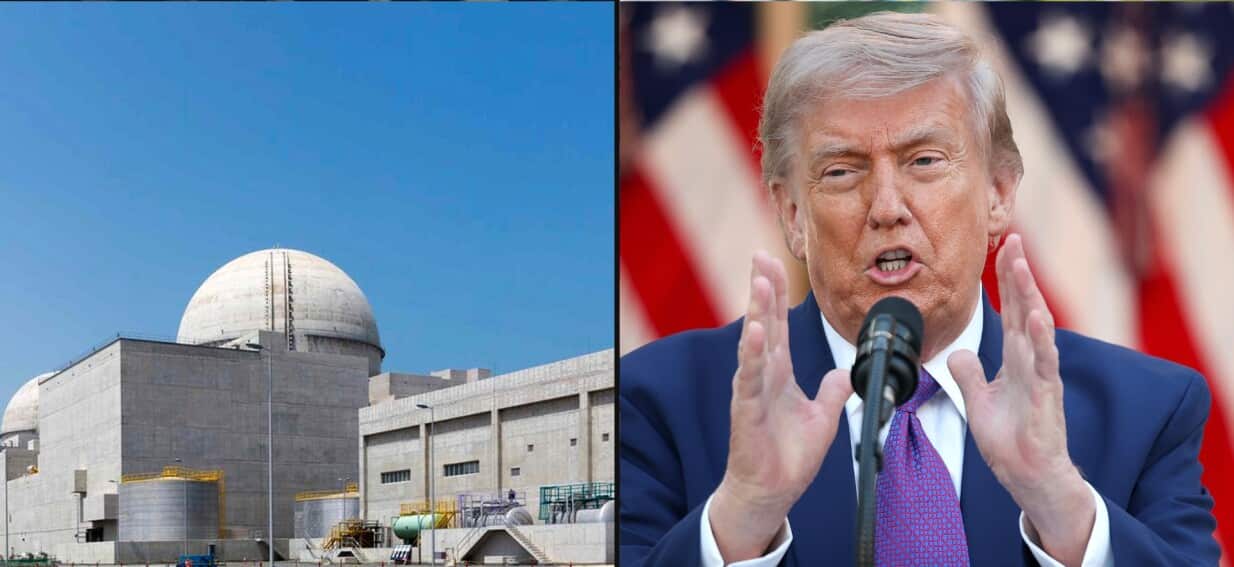
The media is currently hyperventilating over a drone incident near the United Arab Emirates’ Barakah nuclear power plant, treating it as a terrifying prelude to a regional meltdown. Political commentators are breathlessly tying the event to aggressive rhetoric from Washington, warning that the "clock is ticking" for regional stability. This narrative is not just wrong; it completely misunderstands the physical reality of nuclear infrastructure.
The lazy consensus wants you to believe that modern nuclear reactors are fragile glass houses waiting to be shattered by cheap, off-the-shelf consumer drones or basic proxy militia tech. This is a fundamental misunderstanding of engineering. In reality, the Barakah incident demonstrates the absolute resilience of hardened civilian infrastructure and exposes the geopolitical theater driving the panic.
Stop looking at the sky expecting a catastrophic explosion. The real story is how modern containment structures have rendered these physical threats functionally irrelevant, and why the global energy sector needs to stop letting security theater dictate energy policy.
The Myth of the Vulnerable Reactor
Every sensationalized report on the UAE drone incident glosses over the basic physics of nuclear containment. The public hears "drone strike near nuclear plant" and imagines Chernobyl. They fail to distinguish between a soft administrative facility outside the perimeter and the actual reactor core.
Modern pressurized water reactors (PWRs), like the South Korean-designed APR-1400 units utilized at Barakah, are built inside massive containment structures. We are talking about walls of heavily reinforced concrete several feet thick, lined with robust inner steel plates. These structures are not designed merely to keep radiation in; they are explicitly engineered to withstand extreme external kinetic impacts.
During the licensing phases for modern reactor designs, engineers conduct rigorous impact simulations. These are not hypothetical calculations. They involve modeling the direct, high-velocity impact of a fully fueled, multi-ton commercial airliner traveling at cruise speed. The concrete might suffer superficial scabbing, but the structural integrity of the inner containment remains completely uncompromised.
Compare that to a drone carrying a few dozen pounds of explosives. To the reinforced concrete dome of a nuclear reactor, a commercial drone impact is equivalent to throwing a tennis ball at a brick wall. The kinetic energy is insufficient to do anything more than char the paint.
I have spent years analyzing industrial risk profiles, and I have seen energy companies spend millions of dollars upgrading physical perimeter security to appease terrified board members after reading sensationalized headlines. It is a massive waste of capital. The physical structure itself is already the ultimate defense.
The True Vulnerability Is Financial Not Kinetic
If a drone cannot breach a reactor, what can it actually achieve? It can cause an incredibly expensive, completely unnecessary shutdown.
The real danger of these incidents is not a radiological release; it is grid instability driven by bureaucratic risk aversion. Nuclear power plants operate on a principle of extreme caution. If an unidentified object breaches the outer airspace monitoring zone, standard operating procedures often dictate a precautionary de-loading or temporary shutdown of the turbines to protect grid stability and assess potential ancillary damage to switchyards or transmission lines.
The transmission infrastructure outside the hardened containment—the transformers, the switching stations, the power lines—is just as vulnerable as any traditional gas or coal plant. A successful strike on a transformer yard does not cause a meltdown, but it does take gigawatts of clean baseload power off the grid instantly.
[Drone Threat Area]
       │
       ├─► [Hardened Containment Dome] ──► Zero Structural Risk (Physics Defeat)
       │
       └─► [External Switchyard/Grid] ───► Economic & Grid Disruption (The Real Target)
This is where the contrarian truth lies: the adversary launching these drones knows they cannot blow up the reactor. They do not want a nuclear winter; they want an economic headache. They want to spike global oil prices, drive up insurance premiums for Gulf shipping, and force Western allies into costly defensive deployments. By treating these incidents as existential nuclear crises, the media gives the perpetrators exactly what they want: leverage.
Dismantling the Nuclear Panic Premise
Let us tackle the common arguments that fill the comment sections and congressional hearings whenever a drone enters restricted airspace.
Doesn't a drone strike risk cutting off external cooling power?
This is the standard post-Fukushima anxiety. The fear is that an attack could disable the emergency diesel generators that keep the cooling pumps running if the main grid goes down.
Here is what the critics miss: modern Gen III+ reactors like the APR-1400 incorporate passive safety systems. They do not rely solely on active, diesel-powered pumps that require external fuel lines and vulnerable switchgear. Instead, they use gravity-fed water loops, natural convection, and advanced accumulators capable of cooling the reactor core for days without human intervention or external electricity. The system is designed to fail safely, even if the entire surrounding industrial complex is flattened.
What happens if a swarm of drones targets the spent fuel pools?
Spent fuel pools are often cited as the "soft underbelly" of nuclear plants because they historically resided outside the main containment dome in older designs.
However, in modern facilities, these pools are heavily protected, frequently situated within reinforced auxiliary buildings or beneath heavy concrete shields. Furthermore, the industry has spent the last two decades shifting older fuel into dry cask storage—massive, inert steel-and-concrete cylinders parked on reinforced pads. You could park a truck bomb next to a dry cask and it would not crack. A drone swarm would simply burn itself out on the exterior shielding.
Geopolitical Theater and the Escalation Hoax
The timing of these security panics is never accidental. When political figures declare that the "clock is ticking," they are utilizing a minor security anomaly to justify broader geopolitical maneuvers.
We saw similar dynamics play out with the Zaporizhzhia plant in Ukraine. Both sides used the physical presence of the nuclear facility as a shield and a megaphone, knowing that the mere word "nuclear" induces compliance and terror in Western audiences. Yet, despite sustaining direct artillery hits to auxiliary structures and experiencing multiple grid disconnections, the reactors themselves remained safe because the underlying engineering is incredibly forgiving.
The UAE has established a gold standard for nuclear deployment in the Middle East, successfully bringing four units online at Barakah ahead of regional peers. This success threatens the narrative that the region is too volatile for advanced civil nuclear infrastructure. The drone hysteria is an attempt to rewrite that success story into a cautionary tale.
Stop Playing the Subsidized Defense Game
The conventional response to drone incursions is to demand massive state investment in localized Iron Dome-style air defense systems around every piece of critical infrastructure. This is an unsustainable, reactive strategy that bankrupts the operator while enriching defense contractors.
If an energy company spends $100 million deploying tactical electronic warfare jamming systems and point-defense missiles to protect a facility that is already physically immune to kinetic destruction, the terrorists win the economic war. The cost of electricity goes up, capital is diverted from actual infrastructure expansion, and the public becomes more convinced that nuclear energy is inherently unsafe.
The only logical path forward is to accept the reality of the physical fortress. Treat drone incursions near nuclear facilities exactly how we treat them near airports or shipping ports: a regulatory and local law enforcement issue, not a civilizational crisis.
Examine the actual data. Look at the structural specifications of reinforced concrete. Acknowledge the redundancy of passive cooling systems. Once you strip away the political grandstanding and the sensationalized headlines, you are left with a simple truth. The Barakah plant did not survive because it got lucky; it survived because it was engineered to be invincible to this exact scale of threat.
Stop treating the nuclear industry like a fragile patient on life support. Start treating it like the hardened, resilient backbone of modern industrial civilization that it actually is. Turn the cameras off the drones and put the capital back into building more reactors.