UK Plants Stepping Up to Assemble Next-Gen Surveillance Gear
Offshoring critical military hardware used to be standard practice across western defense supply chains. That era is officially over. Today, British manufacturing facilities are ramping up assembly lines for next-gen surveillance gear, bringing high-tech radar production, thermal imaging sensors, and automated reconnaissance hardware back onto home soil.
It isn't just about domestic job creation. It's about sovereign capability.
When global tensions flare, waiting six months for imported microelectronics or specialized sensor housings from across the globe isn't a viable option. Bringing the assembly of advanced surveillance equipment back to regional UK hubs—from Fareham and Edinburgh to Lancashire and Braintree—is a direct response to modern battlefield vulnerabilities and supply chain fragility.
+-------------------------------------------------------------------------+
|                  Sovereign Surveillance Supply Chain                    |
+-------------------------------------------------------------------------+
|  1. Local Sensor & Radar Manufacturing (Fareham / Edinburgh / Luton)    |
|  2. On-Site Secure Assembly & Integration (Regional UK Plants)          |
|  3. Rapid Deployment to Ground Units & Air Fleets (RAF & Army)           |
+-------------------------------------------------------------------------+
The Real Hardware Rolling Off British Production Lines
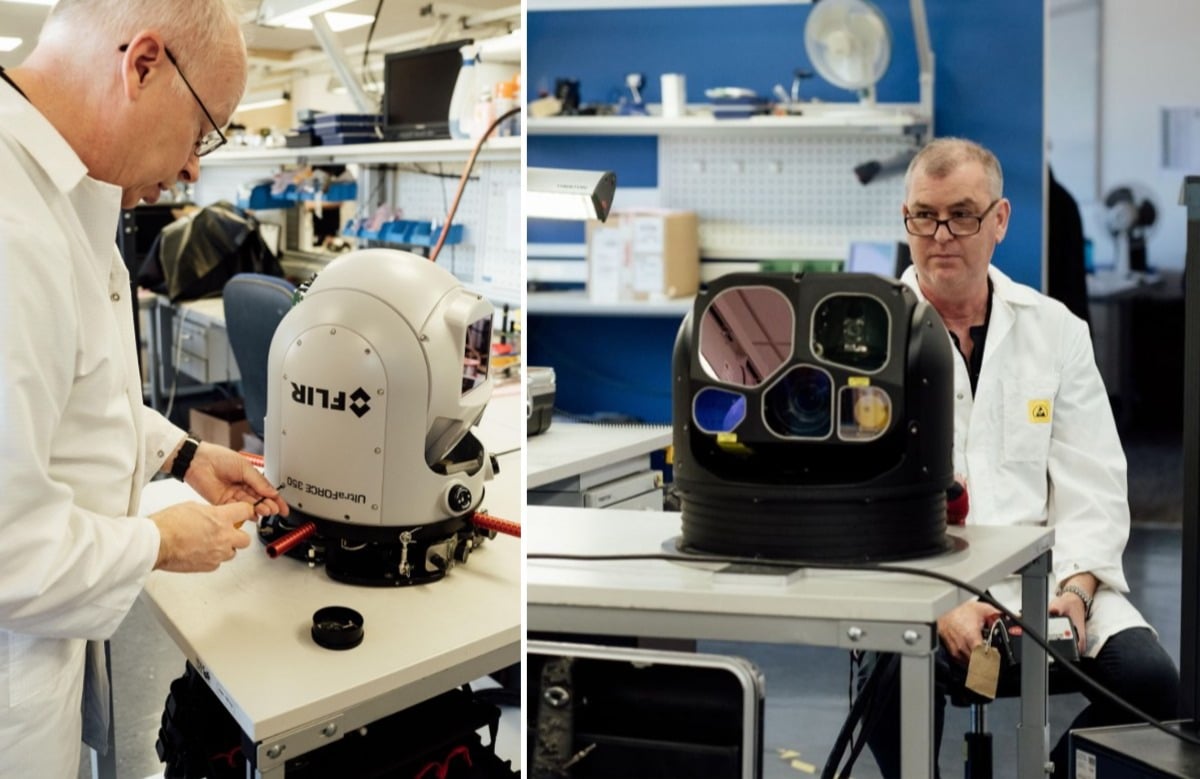
What does next-gen surveillance gear actually look like when it leaves a factory floor? It isn't just one type of camera or a single dish. It's a interconnected web of multi-spectrum sensors designed to detect threats before traditional radar even registers them.
Active Electronically Scanned Array Radars
Primary among these systems are advanced Active Electronically Scanned Array (AESA) radars, such as Leonardo's ECRS Mk2, built across sites in Edinburgh and Luton. Unlike older mechanically rotated radars that sweep back and forth, AESA arrays use hundreds of tiny transmitter-receiver modules. They can track dozens of fast-moving aerial targets simultaneously while jamming enemy communications in real time.
Assembly requires cleanroom conditions and extreme precision. A single misalignment in the high-frequency radar modules can degrade target detection distances by miles.
Compact 3D Battlefield Radar
Further south in Hampshire, manufacturing plants are turning out compact 3D radar units like the Giraffe 1X. These systems weigh little enough to mount on light vehicles or fixed perimeter masts. They spot incoming micro-drones, artillery shells, and low-flying missiles at short range, giving tactical commanders immediate situational awareness.
Having these units assembled domestically means military units get custom software integrations and quick repairs without sending hardware abroad.
Tactical Edge Sensors for Ground Soldiers
Surveillance doesn't stop in the air. On the ground level, facilities are producing dismounted data systems that feed real-time visual information straight to a soldier's helmet-mounted display or handheld tablet.
Companies like BlackTree Technologies are manufacturing AI-capable radios and sensor hubs in Tewkesbury and Hereford. These systems compile optical feeds, thermal imaging, and acoustic readings into a single readable map interface.
- Thermal sensor arrays that detect heat signatures through dense fog and smoke.
- Acoustic gunshot detectors that instantly pinpoint enemy firing locations.
- Encrypted tactical radios that route surveillance data across unit networks without lagging.
- Automated target identification software running locally on ruggedized battlefield hardware.
Why Domestic Surveillance Assembly Matters Right Now
Relying on foreign suppliers for critical defense gear creates massive security bottlenecks. If a component supplier in another continent experiences factory shutdowns or trade restrictions, an entire national defense fleet can end up grounded.
Setting up domestic assembly facilities solves three massive operational problems.
Supply Chain Resiliency
During crisis periods, global shipping routes freeze or get rerouted. When you build and assemble radar components in local facilities, spare parts stay hours away rather than months away. Maintenance teams swap out faulty arrays instantly.
On-Site Quality Control and Security
Defense electronics require strict anti-tamper measures and secure supply chains. Assembling sensor hardware inside high-security UK plants prevents hardware-level backdoors, malicious chip insertions, or unauthorized firmware modifications from creeping into military hardware.
Accelerated Modernization Cycles
In traditional defense procurement, updating hardware takes years. Domestic assembly allows engineers to push iterative hardware revisions directly to the shop floor. If field tests in joint exercises reveal a flaw in sensor cooling, plant engineers modify the assembly process in weeks rather than waiting years for contract renegotiations with foreign plants.
Technical Assembly Challenges Facing UK Defense Facilities
Building next-gen surveillance equipment isn't like running a typical electronics assembly line. The engineering tolerances are ridiculously tight, and the quality assurance testing is grueling.
Micro-Soldering and High-Frequency Calibration
Radar systems rely on gallium nitride (GaN) semiconductors that operate at extreme frequencies and thermal levels. Soldering these components onto dense circuit boards requires automated surface-mount technology paired with microscopic inspection systems. A microscopic gap in solder can cause thermal throttling when the radar operates at full output power.
Environmental Stress Testing
Before any surveillance unit leaves the plant, it undergoes severe physical testing:
- Thermal Shock: Equipment is cycled between freezing -40°C temperatures and intense heat exceeding 70°C to simulate desert and arctic operations.
- Vibration and Impact: Units are mounted on shaker tables that mimic the violent vibrations of armored vehicles and fighter jets.
- Electromagnetic Compatibility: Sensors undergo testing in anechoic chambers to ensure high-power radar emissions don't interfere with friendly communications.
Economic Impact Beyond Defense Capability
Investing in domestic assembly plants isn't just a military decision. It's an industrial strategy.
Facilities producing surveillance electronics create high-skilled engineering jobs, secure long-term apprenticeships, and fund localized research and development hubs. Specialized supply chains grow around these primary assembly plants, driving business to local machine shops, cable assembly specialists, and optical glass manufacturers.
For decades, the UK risk-averse defense policy outsourced manufacturing to cut immediate costs. That short-term thinking left domestic manufacturing capabilities depleted. Rebuilding this infrastructure forces investment back into STEM education, vocational training, and high-tech regional employment.
Actionable Steps for Engineering and Defense Professionals
If you work in defense technology, electronics manufacturing, or systems engineering, the shift toward domestic surveillance gear assembly offers clear strategic opportunities:
- Audit your supply chain vulnerability: Identify single-source components manufactured in geopolitically volatile regions and evaluate domestic alternatives.
- Invest in surface-mount automation: Upgrade regional assembly capabilities with high-speed, automated optical inspection tools suited for defense-grade electronics.
- Focus on secure software integration: Surveillance hardware is only as good as the software running on it. Prioritize local firmware development and zero-trust hardware architecture.
- Partner with technical colleges: Secure future engineering talent early by establishing local apprenticeship programs tailored to sensor assembly and RF calibration.
Domestic assembly of next-gen surveillance gear isn't a temporary trend. It's the new baseline for national security and advanced manufacturing.