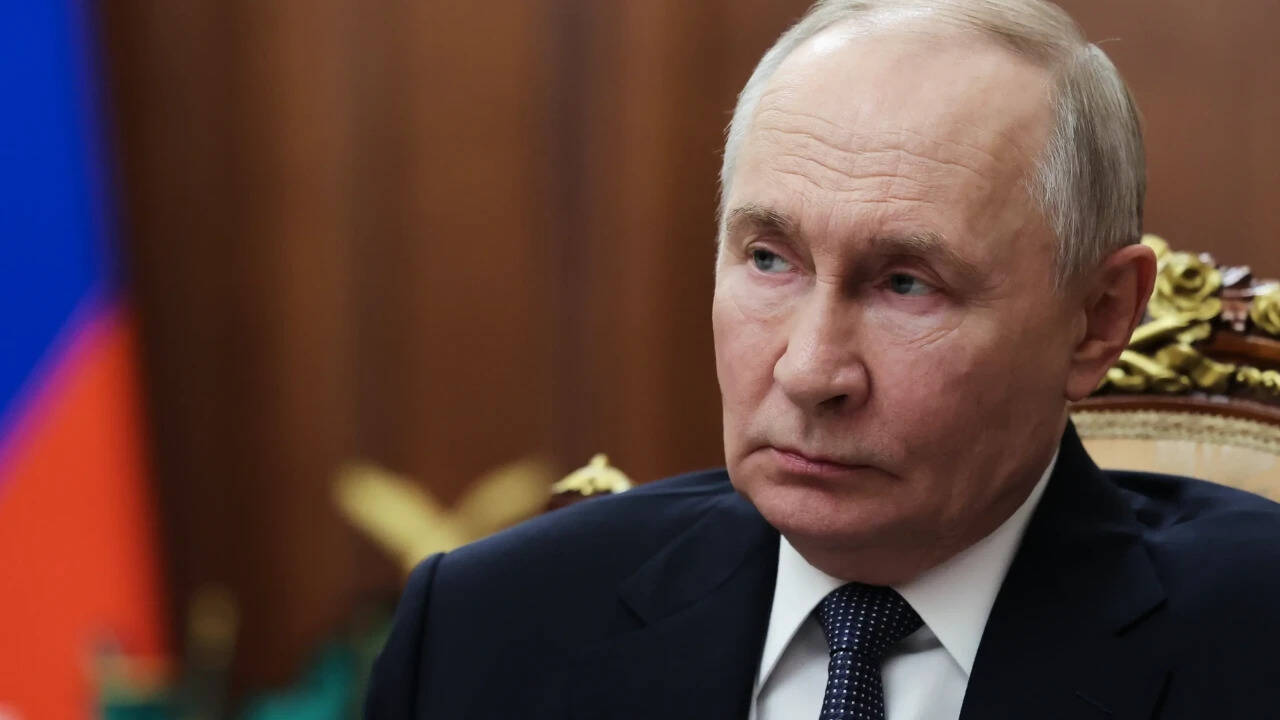
The United Kingdom is preparing to host the G20 summit next year, and British officials—including prominent political figures like Greater Manchester Mayor Andy Burnham—have made it clear that Russian President Vladimir Putin will not receive an invitation. On the surface, this stance looks like a bold diplomatic rebuke against Moscow's ongoing aggression in Ukraine. In reality, it is political theater. Putin has skipped every major in-person G20 gathering since the 2022 invasion, sending Foreign Minister Sergey Lavrov in his stead while avoiding international arrest warrants and guaranteed humiliation. By publicly barring a leader who had no intention of showing up anyway, London is attempting to project moral clarity while sidestepping a much harder truth about the fractured state of global governance.
This symbolic posturing masks a severe structural problem facing the Group of Twenty. Founded in 1999 as an informal forum for finance ministers and central bank governors to stabilize the global economy after the Asian financial crisis, the G20 was never designed to function as a traditional diplomatic club with strict ideological admission criteria. It exists precisely because the world's largest economies—regardless of their political systems or human rights records—must occasionally sit in the same room to prevent global financial contagion, coordinate debt relief, and manage climate transitions. When host nations unilaterally weaponize the guest list for domestic political applause, they fundamentally alter the mechanics of the institution.
The Anatomy of a Hollow Boycott
To understand why the UK's refusal to invite Putin carries zero practical weight in Moscow, you have to look at the legal and logistical realities binding the Russian president. In March 2023, the International Criminal Court issued an arrest warrant for Putin over the unlawful deportation of Ukrainian children. The United Kingdom is a signatory to the Rome Statute, the treaty that established the ICC. Had Putin stepped onto British soil, London would have been legally obligated to arrest him.
Putin knows this. He skipped the 2023 summit in New Delhi, even though India is not an ICC member, because the political optics were too volatile and the flight path risky. He skipped the 2024 summit in Rio de Janeiro, despite Brazilian President Luiz Inácio Lula da Silva initially floating assurances of safe passage before quickly walking them back under pressure from his own judiciary. The pattern is unmistakable. Putin only travels to jurisdictions where his security apparatus holds absolute leverage and where the host government is actively aligned with the Kremlin—places like Beijing, Pyongyang, or Minsk.
So when British politicians declare that Putin is unwelcome at the UK-hosted G20, they are slamming a door that was already bolted from the other side. The declaration serves a domestic audience, reassuring British voters and European allies that London's resolve against Russian aggression remains ironclad. Yet in terms of actual geopolitical pressure, it costs the Kremlin nothing. Moscow simply dispatches Sergey Lavrov—a seasoned diplomat who thrives on absorbing Western hostility—to read out prepared talking points, block consensus statements on Ukraine, and court sympathetic ears among the Global South delegations.
Domestic Politics and the Burnham Factor
The involvement of figures like Andy Burnham in framing the UK's posture toward the G20 highlights how foreign policy rhetoric frequently bleeds into domestic political positioning. As Mayor of Greater Manchester and a perennial figure in British Labour Party leadership speculation, Burnham understands the currency of clear, unambiguous moral stances. Regional leaders in the UK have increasingly sought international profiles, particularly when major global summits rotate outside of London to northern hubs like Manchester or Birmingham to showcase economic regeneration.
Framing the summit around an uncompromising stand against Putin allows British politicians across the spectrum to claim the mantle of Churchillian resolve without having to make a single difficult policy concession. It is easy to ban a pariah. It is infinitely harder to explain to British voters why energy prices remain structurally sensitive to global supply shocks, or why seizing frozen Russian central bank assets in London's financial district carries severe legal and systemic risks for the City of London's reputation as a safe harbor for sovereign wealth.
This dynamic is hardly unique to Britain. Across Western democracies, performative diplomacy has increasingly replaced grinding, transactional statecraft. Politicians are rewarded by a 24-hour news cycle for delivering sharp, quotable soundbites that signal virtue to their base. Meanwhile, the quiet, unglamorous work of building coalitions with non-aligned nations—the very nations needed to isolate Russia economically—often gets neglected.
How the G20 Became a Geopolitical Battlefield
The crisis over the G20 guest list exposes a deeper fault line running through the international order. The bloc represents roughly 85 percent of global GDP and two-thirds of the world's population, bringing together the G7 industrial democracies and the major emerging markets of the BRICS coalition. For its first two decades, that diversity was its greatest asset. During the 2008 global financial crisis, the G20 functioned as the world's premier crisis committee, coordinating stimulus packages and regulatory reforms that prevented a second Great Depression.
That consensus evaporated in February 2022. Since Russia's full-scale invasion of Ukraine, every G20 ministerial meeting and leaders' summit has been hijacked by the conflict. Western nations demand explicit condemnation of Russian aggression in the final communiqué; Russia and China block any language that assigns blame; and the host nation is left scrambling to salvage a watered-down declaration just to avoid the embarrassment of a total diplomatic collapse.
Consider what happened during previous summits. In 2022, Indonesian President Joko Widodo spent months shuttle-diplomacy pleading with both Volodymyr Zelenskyy and Putin just to prevent a mass walkout in Bali. In 2023, Indian diplomats worked through the night to craft a consensus paragraph on Ukraine that avoided naming Russia as the aggressor—a compromise that infuriated Kyiv and left Western officials grimacing through forced smiles. By 2024 in Brazil, the Ukraine language had been reduced to a single generic paragraph lamenting human suffering, effectively conceding that the G20 could no longer speak with a unified voice on European security.
Now, with the UK taking the helm, London faces an acute dilemma. Does it use its presidency to turn the G20 into an anti-Russian tribunal, risking a boycott or obstructionism from key Global South partners? Or does it swallow its pride, seat Lavrov at the table, and focus on salvaging cooperation on debt restructuring, artificial intelligence governance, and climate finance?
The Unintended Consequences of Exclusion
Unilaterally barring a member state from a consensus-based forum carries significant blowback, particularly among the emerging economies that the West is desperately trying to woo away from Moscow and Beijing. To countries like India, Brazil, South Africa, and Saudi Arabia, the G20 is one of the few global institutions where they sit as true equals alongside the United States and Europe—unlike the United Nations Security Council, where five permanent members hold absolute veto power.
When a Western host nation decides it has the unilateral authority to revoke another member's invitation, it triggers deep anxieties in capitals across the Global South. The unspoken question echoing through diplomatic corridors in New Delhi and Brasília is simple: If London can bar Moscow today because of a war in Europe, what stops a future Western host from barring us tomorrow over a trade dispute, a human rights controversy, or a refusal to align with Washington's foreign policy?
This perception feeds directly into the Kremlin's favorite narrative. For years, Russian propaganda has portrayed Western-led international rules as arbitrary tools designed to preserve Anglo-American hegemony. By bypassing established diplomatic protocols to score a symbolic point against Putin, the UK inadvertently validates Moscow's framing for millions of observers outside the NATO alliance.
Furthermore, excluding Russia's head of state does nothing to stop Russia from participating. Under G20 rules, membership belongs to the state, not the individual leader. Unless the entire bloc votes unanimously to expel Russia—an impossibility given Chinese, Indian, and Brazilian opposition—Moscow retains its seat at every working group, sherpa meeting, and ministerial session. The empty chair at the leaders' table simply becomes a visual prop for Russian state media to claim that the West is afraid of an open debate.
The Real Leverage the UK Refuses to Touch
If British officials truly wanted to inflict strategic pain on the Kremlin ahead of next year's summit, they would stop worrying about Putin's travel itinerary and look instead at the financial plumbing running through their own jurisdiction.
London remains a critical node in the global movement of capital, insurance, and commodities. Despite sweeping sanctions imposed since 2022, enforcement gaps persist across maritime shipping, luxury real estate, and corporate shell structures registered in British Overseas Territories like the British Virgin Islands and the Cayman Islands.
Consider the shadow fleet of aging oil tankers transporting Russian crude above the G7 price cap. Many of these vessels rely on complex webs of opaque ownership and dubious insurance certificates to navigate international waters. Closing those loopholes requires exhaustive forensic accounting, aggressive regulatory enforcement, and sustained diplomatic pressure on third-party intermediaries in the Middle East and Asia. It does not generate viral headlines, and it irritates powerful lobbying interests in the financial and shipping sectors.
Similarly, the debate over immobilizing and seizing roughly $300 billion in Russian sovereign assets held across Western jurisdictions—with tens of billions sitting in UK institutions—remains mired in legal caution. While G7 nations have agreed to use the windfall profits from these frozen assets to back loans for Ukraine, seizing the principal remains taboo in London due to fears that sovereign wealth funds from Saudi Arabia, China, and Singapore would pull their capital out of British banks in retaliation.
Comparing these hard policy choices to the decision not to invite Putin reveals the stark contrast between substance and spectacle. Seizing assets or dismantling shadow banking networks requires political courage and carries real economic trade-offs for Britain. Refusing to send an envelope to the Kremlin is completely free.
A Fork in the Road for Multilateralism
The controversy surrounding next year's UK G20 summit is a symptom of a broader erosion in international diplomacy. For decades, the underlying philosophy of global forums was that engagement—even with bitter adversaries—was preferable to isolation. During the height of the Cold War, American and Soviet leaders still met in Geneva, Vienna, and Reykjavik to negotiate arms control treaties while proxy wars raged across the globe. They did not meet because they trusted one another; they met because the alternative was catastrophic miscalculation.
Today, that transactional realism has largely vanished from Western capitals, replaced by an all-or-nothing moralism that treats diplomatic presence as an endorsement of a regime's legitimacy. While understandable in the face of brutal aggression, this approach leaves very little room for managing crises that transcend borders.
Climate change does not pause because Moscow and London are at war. Sovereign debt defaults in developing nations cannot be resolved without Chinese and Western creditors sitting in the same room. Pandemic preparedness and artificial intelligence safety standards mean nothing if major technological powers are excluded from the drafting table.
If the G20 devolves into a venue where hosts curate the guest list to suit domestic political pressures, the institution will slowly hollow out. Emerging powers will increasingly shift their diplomatic energy toward alternative blocs like BRICS+ or the Shanghai Cooperation Organisation, leaving Western democracies talking to themselves in an echo chamber while the rest of the world cuts deals elsewhere.
Britain's declaration that Vladimir Putin is unwelcome next year will undoubtedly earn praise in Parliament and generate favorable coverage in the domestic press. Yet when the summit finally convenes, the empty chair reserved for the Russian president will stand as a monument not to Western strength, but to a global order that has forgotten how to negotiate with its enemies.


