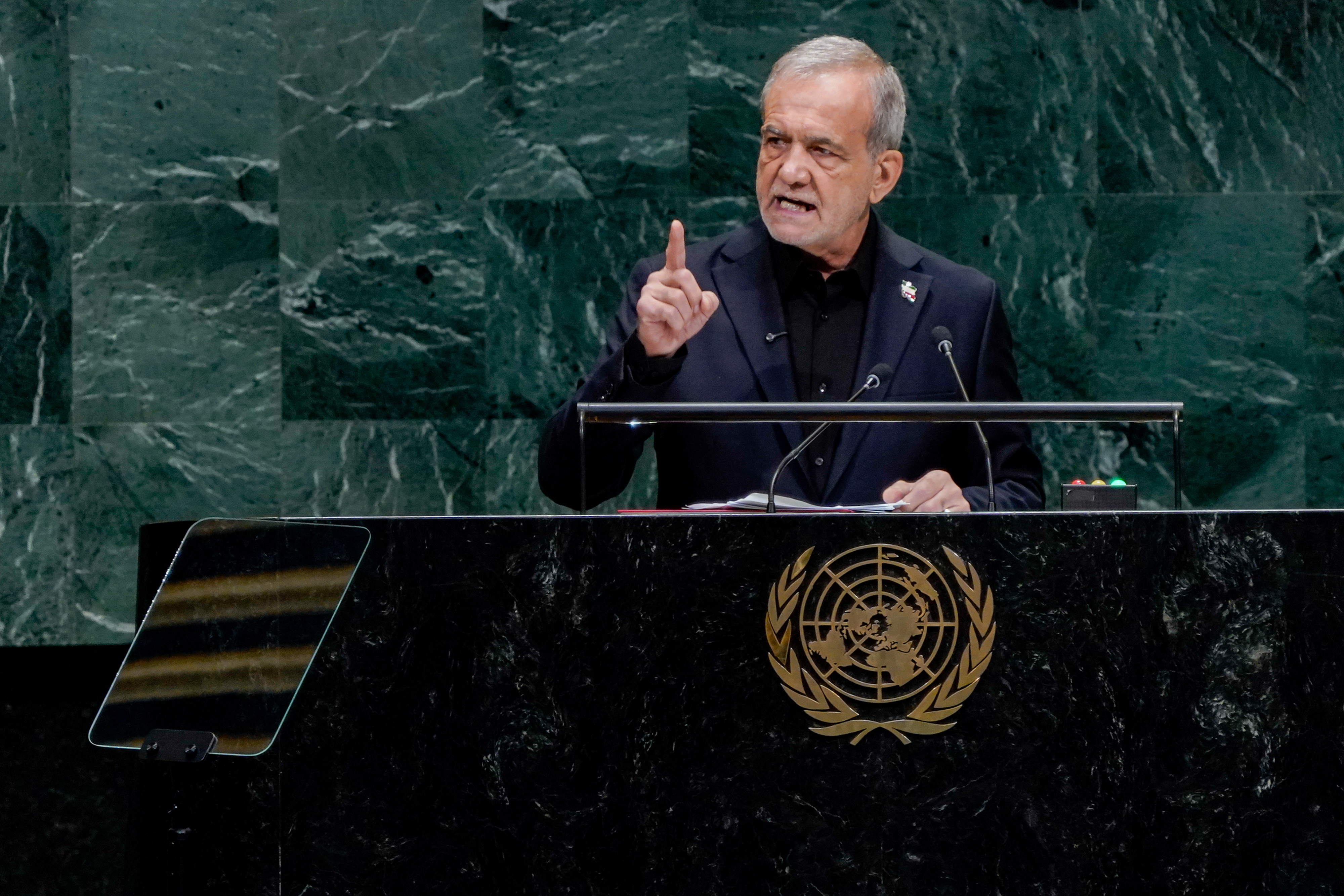
Every single time an Iranian official steps up to the glass podium in Manhattan, the pundit class loses its collective mind. Cable news anchors adjust their ties with grave concern, think-tank fellows publish instant five-thousand-word breakdowns within minutes of the final syllable, and diplomats act as though a theatrical performance delivered in a chamber of recycled air carries the weight of a treaty. They call it a rare wartime address. They parse every adjective for hidden signals of de-escalation, searching for tea leaves in a cup that was poisoned decades ago.
It is all pure, unadulterated nonsense.
If you spent the last forty-eight hours dissecting the phrasing, tone, or body language of Tehran's chief executive at the United Nations General Assembly under the assumption that you were witnessing a pivot in Middle Eastern geopolitics, you fell for the oldest trick in the diplomatic playbook. You mistook a domestic broadcast for foreign policy. You treated a piece of street theater designed for consumption inside Tehran's revolutionary stronghold as an olive branch offered to Washington and Brussels.
Let us strip away the diplomatic varnish and examine why this entire media circus is a masterclass in missing the forest for the trees.
The Lazy Consensus Of The Podium Obsession
The prevailing narrative peddled by mainstream foreign policy analysts is deceptively simple: when a nation engaged in active regional conflict sends its leader to the international community's biggest stage, that leader is either signaling an opening for backchannel negotiations or doubling down on apocalyptic defiance. Analysts split into two predictable camps. The doves scream that dialogue is just a speech away if only the West would compromise. The hawks scream that the rhetoric proves the regime is incorrigible and preparation for total war is mandatory.
Both camps are wrong because both camps are looking at the wrong map.
The United Nations General Assembly is not a negotiation table. It is a megaphone. No sovereign state with an entrenched ideological core alters its military posture, nuclear ambitions, or proxy network strategy because a few ambassadors politely clap or walk out of the room. Treating a speech in New York as a barometer for actual state behavior ignores how power is exercised in modern authoritarian theocracies.
I have watched career diplomats spend decades chasing ghosts in General Assembly transcripts, burning millions of dollars in research grants trying to decode subtext that simply does not exist. The text of these speeches is vetted by security councils, revolutionary committees, and ideological hardliners back home. By the time it reaches the podium, it has been scrubbed of any genuine tactical surprise. It is a finished product built for maximum export value to two distinct audiences: domestic loyalists who need to see their leader thumbing his nose at Western hegemony, and foreign adversaries who mistakenly believe words carry the same weight as ballistic missile inventories.
The Domestic Audience Illusion
To understand why the speech sounded the way it did, you have to stop looking at Washington and start looking at the bazaar in Isfahan, the university halls in Tehran, and the revolutionary guard barracks scattered across the provinces.
The regime faces a persistent crisis of legitimacy. Economic mismanagement, crushing sanctions, rampant inflation, and deep-seated public resentment over social restrictions have created a volatile pressure cooker. When the streets periodically erupt in protests, the ruling apparatus does not respond by rethinking its economic model. It responds by cranking up the nationalist volume.
Sending the president to New York to deliver a defiant, fire-and-brimstone address against Western imperialism is not about intimidating the White House. It is about airing a blockbuster movie back home. It tells the domestic base that the regime stands unbowed, that the economic misery citizens experience daily is the noble cost of resisting an evil global order, and that the supreme leadership remains firmly in control.
When analysts in Western capitals spend hours dissecting whether a specific line about sovereignty indicates a willingness to restart nuclear talks, they are projecting their own desires onto a script written entirely for domestic survival. The regime does not care about your policy briefs. It cares about maintaining its monopoly on violence and political authority within its own borders. Every minute spent analyzing the poetry of their UN rhetoric is a minute wasted not analyzing their cyber warfare capabilities, their grey-market oil smuggling routes, or their clandestine uranium enrichment milestones.
The Myth Of Wartime Diplomacy
Another persistent delusion shared by the punditry is the idea that we are witnessing a unique "wartime" diplomatic phase. This terminology implies that there was once a peacetime phase governed by normal diplomatic rules, and that this current period of shadow war, proxy skirmishes, and targeted assassinations represents an aberration that can be talked away with the right combination of UN resolutions and backroom mediation.
This is a profound misunderstanding of how the Islamic Republic has operated since 1979.
Conflict is not a temporary interruption of their foreign policy; conflict is their foreign policy. The export of revolution, the maintenance of the so-called Axis of Resistance through proxies in Lebanon, Yemen, Iraq, and Syria, and the perpetual state of controlled tension with Israel and the United States are the foundational pillars of the state's security architecture. You cannot speechify your way out of a foundational ideology.
Imagine a corporation whose entire business model relies on maintaining a hostile monopoly in a regulated market. Now imagine inviting the CEO to an industry convention where he gives a speech about how much he values fair competition. Would you restructure your investment portfolio based on his keynote address? Of course not. You would look at his balance sheet, his aggressive patent lawsuits, and his hostile takeovers. Yet, when nation-states do the exact same thing on an international stage, smart people suddenly develop collective amnesia.
The reality on the ground is governed by cold, unyielding logistics, not oratorical flourishes. While everyone was busy arguing over the tone of the president's opening remarks, military logistically moved hundreds of precision guidance kits to regional proxies. While reporters wrote think pieces about the subtle nuances of his closing sentence, underground centrifuge cascades kept spinning in subterranean facilities carved into granite mountainsides.
Dismantling The False Choice
Let us address the "People Also Ask" queries that flood search engines every time an Iranian leader steps up to the international microphone.
Is diplomacy still possible? The question itself is fundamentally flawed because it assumes diplomacy is a light switch that can be flipped on and off by changing the rhetoric. Diplomacy with an asymmetric actor only works when the cost of non-compliance vastly exceeds the cost of compliance. Right now, sanctions bite deeply, but they have not altered the core calculus of regime survival. Until the internal cost of their regional aggression outweighs the internal cost of backing down, no speech in New York will change a single gear in their geopolitical machine.
Another common inquiry: Does the speech signal an imminent escalation or de-escalation?
Neither. Escalation and de-escalation are driven by kinetic events, intelligence assessments, and battlefield realities—not by the literary stylings of a speechwriter catering to a General Assembly audience that has grown numb to decades of rehearsed posturing. If deterrence holds, it is because of aircraft carrier strike groups, missile defense shields, and credible threats of massive retaliation, not because a diplomat smiled or frowned at the podium.
The Cost Of Our Own Naivety
Why does this matter? Why waste energy tearing down a speech that everyone secretly knows is largely performative?
Because intellectual laziness has a body count. When policymakers and media elites treat theatrical performances as substantive diplomatic openings, they create artificial cycles of false hope followed by bitter disillusionment. This erratic cycle prevents the formation of a coherent, long-term strategic posture. Instead of building a durable, cold-eyed policy based on containment, deterrence, and economic resilience, Western governments bounce from one diplomatic gimmick to the next, reacting to speeches instead of shaping reality.
We keep making the same mistake because it is comfortable. It is much easier to hold conferences, draft feel-good communiques, and pretend that words possess magical transformative powers than it is to confront the grim reality of protracted regional conflict and ideological intransigence.
It is time to grow up. Stop watching the podium. Start watching the ledgers, the shipping manifests, the enrichment centrifuges, and the financial networks that keep the apparatus afloat.
The speech was a distraction wrapped in diplomatic theater. The sooner we stop buying tickets to the show, the sooner we can deal with the actual architects of regional instability on terms that reflect reality rather than wishful thinking.
The microphones were turned off the moment he stepped away from the dais. The room emptied out, the translators packed their headphones, and the diplomats headed to cocktail parties where they said the exact opposite of what they said in public. Back in Tehran, the centrifuges never stopped spinning for a single second. That is the only metric that ever mattered.


