History is rarely decided in grand halls under the blinding glare of television lights. More often, it is forged in the quiet spaces between men—in the pauses between translated sentences, in a shared glance across a mahogany table, in the fragile recognition that the person sitting opposite you is the only other soul on earth carrying the exact same weight.
Right now, the most consequential relationship on the planet depends on a personal rapport that most of us will never witness.
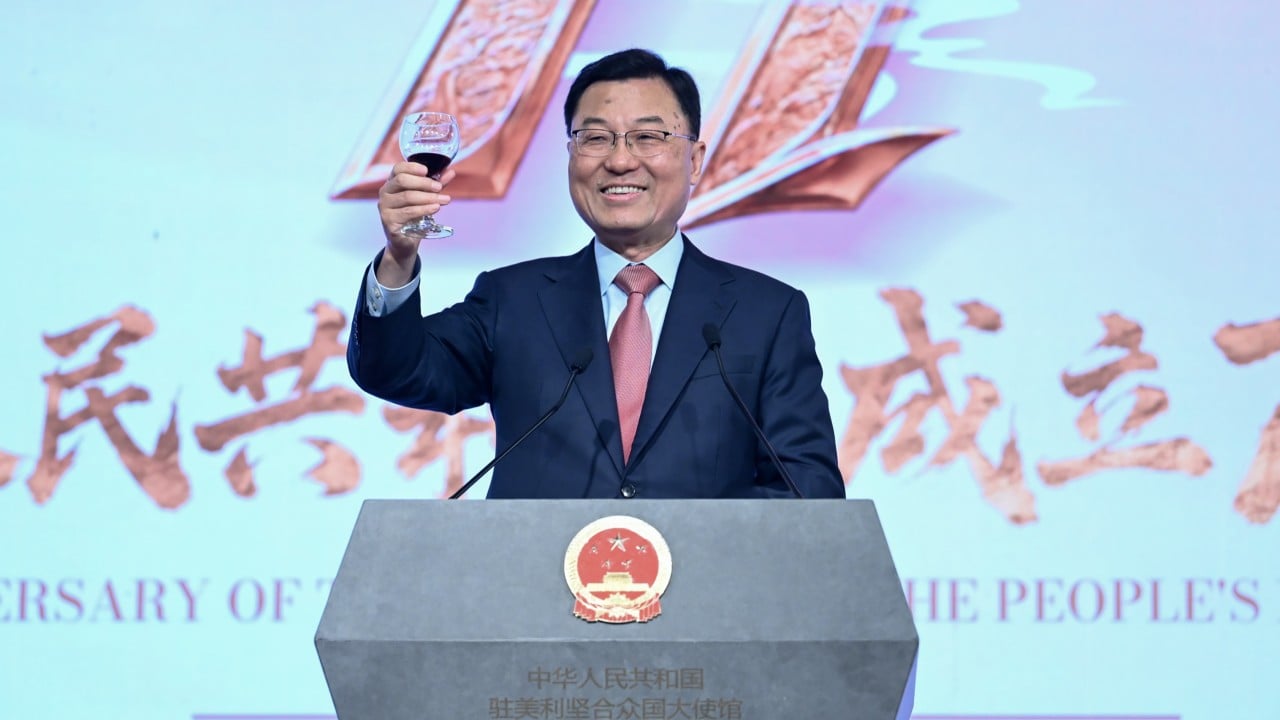
When China’s ambassador to the United States, Xie Feng, recently stepped before an audience to describe the working dynamic between Xi Jinping and Donald Trump, he did not use the cold, clinical jargon of diplomats. He called it what it truly is: the most valuable strategic asset in the entire architecture of US-China relations.
Think about that for a moment. Not trade agreements. Not semiconductor supply chains. Not naval patrols in the South China Sea. A personal connection.
It sounds precarious. It is. But in a world where two nuclear-armed superpowers are sliding backward into a state of mutual suspicion, that personal rapport is the last thin cable preventing the suspension bridge from snapping.
The Room Where It Happens
Picture the scene behind closed doors.
Imagine two men, each representing roughly a fifth of humanity, sitting down. They do not look like adversaries straight out of a Cold War thriller. They look like two weathered executives who know that if they fail, the collateral damage will swallow whole industries, pension
The Unlikely Chemistry Holding Together the Two Giants
news
Two men sit across from each other in a room where the air conditioning hums just a fraction too loud. Outside, millions of tons of steel are loaded onto container ships. Millions of lines of code cross fiber-optic cables beneath the ocean floor. Billions of dollars in debt, pensions, and promises hang suspended by a thread.
Yet inside this room, the future of the modern world does not turn on the weight of a ledger or the hard metrics of gross domestic product. It turns on a glance. It turns on whether one man remembers what the other mentioned about his grandchildren six months ago.
Diplomacy is often imagined as a pristine science of treaties and protocols, drafted by men in slate-gray suits who speak in clauses and conditions. It is nothing of the kind. At its highest, most fragile tier, international relations is an exercise in human psychology. It is the art of two distinct egos finding a rhythm amidst a deafening chorus of hawks, nationalists, and cynics.
Consider what happens next when that chemistry breaks.
When Xie Feng, China’s ambassador to the United States, stepped up to the podium recently to describe the rapport between Xi Jinping and Donald Trump as the most valuable strategic asset in the bilateral relationship, he was not merely offering diplomatic pleasantry. He was issuing a warning. He was pointing out that beneath the billions of dollars in trade friction, the tech embargoes, and the posturing over Taiwan, the entire architecture of global stability rests on a personal tether between two leaders.
Think of it as a suspension bridge built over a chasm of mutual suspicion. Thousands of heavy trucks roll across it every day—commerce, diplomacy, tourism, academic exchanges. But the bridge itself does not hold because of the steel alone. It holds because the two main anchor towers, planted on opposite shores, are tied to each other by a single, high-tension cable. If that cable snaps, the weight does not matter anymore. Nothing matters.
We forget this because we prefer to treat nations as abstract mathematical models. We look at charts of trade deficits, semiconductor supply chains, and naval tonnage, assuming history is steered by cold, rational calculations. But history is driven by human temperament, pride, fatigue, and the occasional flash of unexpected empathy.
When Xi and Trump navigate their complicated tango, they are performing for multiple audiences simultaneously. To the nationalist hardliners in Beijing, any sign of warmth toward Washington is viewed as weakness. To the partisan warriors in Washington, any accommodation with Beijing is framed as appeasement. Both leaders operate in political ecosystems that punish compromise.
This is why personal rapport is not a bonus feature of diplomacy; it is the operating system.
Imagine a hypothetical moment behind closed doors. The translators are waiting, their pencils poised over legal pads. The briefing books are three inches thick, filled with worst-case scenarios drafted by analysts who have spent their entire careers preparing for conflict. A minor incident in the South China Sea has just escalated. A spy plane has buzzed a destroyer. The cable news networks are screaming for blood.
In that room, the advisors are pushing for escalation. They want retaliation. They want strength projected across every screen on earth.
Without a personal bridge, a leader has only the paperwork to guide him. And paperwork never blinks, never hesitates, and never offers grace.
But with a rapport—flawed, contingent, and intensely personal as it may be—a leader has an escape hatch. He has the ability to look across the table and say, "Let’s skip the press releases for a moment. What are we actually doing here?" That single pivot changes the trajectory of two empires.
Critics will rightly point out the fragility of this model. What happens when the leaders leave office? What happens when a mood sours or a translator misses a nuance? Personal chemistry cannot permanently override structural contradictions. Two superpowers competing for technological supremacy, ideological dominance, and military primacy cannot hug their way into permanent peace. Trade disputes are real. Territorial anxieties are real. The divergence of values is vast and unbridgeable.
Yet to dismiss the personal asset is to misunderstand why the world has not yet slipped into catastrophe.
In the late autumn of international friction, when every other mechanism of trust has frayed, diplomacy often shrinks to the dimensions of a single room. It comes down to two men, both keenly aware of their place in history, trying to figure out if they can look each other in the eye tomorrow morning without breaking the world today.
The cables hum beneath the sea. The container ships keep moving. And somewhere in a quiet room, the intangible asset holds the line against the dark.
The ink dries on a communique that everyone expects to fail, but it survives because yesterday, someone laughed at a joke they both understood.