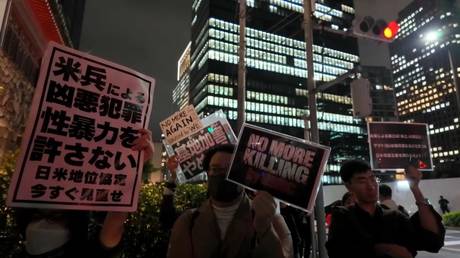
When a United States service member commits a violent crime abroad, the shockwaves rarely stay confined to a courtroom. They ripple straight into the streets, testing decades-long geopolitical alliances. That friction flared up vividly in Japan following high-profile criminal cases involving American military personnel.
You see it every time local anger spills past the gates of US bases. The immediate reaction isn't just grief for the victim. It's an explosion of long-standing frustration over sovereignty, legal jurisdiction, and the heavy footprint of foreign military installations on domestic soil. Also making headlines lately: The Diplomatic Calculus Behind Washington Stalling Ukraine NATO Membership.
The Status of Forces Agreement Boiling Point
At the heart of every single protest in Tokyo lies a contentious legal artifact known as the Status of Forces Agreement (SOFA). If you're wondering why local police often struggle to move quickly or take custody of a suspect, this treaty is usually the culprit.
Under SOFA rules, the United States military often retains primary custody of suspects until Japanese authorities formally indict them. To everyday citizens walking the streets of Tokyo or Okinawa, that rule looks an awful lot like special protection. Further insights on this are explored by NBC News.
- Jurisdictional friction: Local prosecutors have to fight for access while suspects remain behind base fences.
- Historical precedent: Decades of similar incidents have turned legal technicalities into raw political touchstones.
- Public perception: Every delay feeds the narrative that foreign soldiers operate above local law.
When a murder arrest happens, the public doesn't parse international law. They look at the victim, they look at the suspect, and they ask why a foreign government gets first crack at justice in their own backyard.
Why Tokyo Becomes the Epicenter
Okinawa usually bears the brunt of American base friction due to the sheer concentration of military assets there. But when protests erupt in Tokyo, the message changes entirely. It moves from regional grievance to national politics.
Demonstrators gather near government ministries to send a direct message to the prime minister. They aren't just protesting an individual crime. They are challenging the security paradigm that allows foreign troops to maintain massive garrisons across the island nation.
Governments in Tokyo walk a tightrope daily. They need the security umbrella provided by the US-Japan alliance to navigate regional tensions. At the same time, they have to answer to voters who see red every time a service member steps out of line.
The Real Cost of Base Politics
Diplomats usually prefer quiet negotiations behind closed doors. They issue statements about deep regret, cooperation with local authorities, and the ironclad nature of the alliance.
Those talking points fall flat when thousands of people are chanting outside government gates. The anger is visceral because the proximity between military bases and civilian neighborhoods is literal. People live right next to these installations. They shop in the same towns, walk the same streets, and bear the brunt when things go disastrously wrong.
If Washington and Tokyo want to stop these recurring explosions of public rage, tinkering with base curfews won't cut it. The fundamental framework governing military conduct and legal accountability needs a total overhaul. Until then, every
Why the Latest US Marine Murder Arrest in Japan Breaks the US Alliance Trust
news
Another brutal crime in Okinawa has triggered a familiar, bitter cycle of outrage across Japan. When police arrested 20-year-old U.S. Marine Lance Corporal Devin Jacob Ballard for the robbery and murder of 39-year-old Anna Yagi in Naha, it wasn't just a localized tragedy. It instantly reignited a decades-old national debate over the heavy American military footprint in Japan and the controversial legal protections shielding foreign troops.
Protesters gathered outside government offices in Tokyo and across Okinawa, demanding immediate changes. Prime Minister Sanae Takaichi called the killing an extremely brutal and heinous crime, lodging formal complaints with Washington while pushing for strict troop discipline. Yet, behind the diplomatic statements lies an exhausted local population that has heard these exact promises before.
The Breaking Point in Okinawa
Okinawa hosts about 70 percent of all U.S. military facilities in Japan, despite making up only a tiny fraction of the country's total land area. For local residents, strategic defense arguments mean living next door to constant aircraft noise, safety incidents, and periodic violent crimes committed by service members.
According to police investigations, security footage captured Yagi entering a hotel room with a man resembling Ballard, who later left alone. Investigators found the victim strangled with a telephone cord, her backpack and wallet missing. Ballard has denied the allegations, but the damage to community relations was immediate.
Okinawa Governor Genta Koja traveled straight to Tokyo to press Prime Minister Takaichi, stating bluntly that U.S. military efforts to maintain discipline and educate personnel have proven completely ineffective. When a military force stationed abroad treats a host community with such disregard, security pacts start looking less like alliances and more like occupations.
The Shadow of the Status of Forces Agreement
At the heart of the public fury sits the 1960 Japan-U.S. Status of Forces Agreement, commonly known as SOFA. Critics have long argued that this pact grants American military personnel virtual extraterritoriality, shielding them from local Japanese laws and granting U.S. authorities primary jurisdiction during official duties.
Even when off-duty cases are handled by Japanese courts, the structural imbalance of the agreement fosters deep resentment. Local lawmakers and citizens point out that crimes ranging from assaults to drunk driving keep happening because disciplinary crackdowns, curfews, and temporary alcohol bans fail to address the root culture inside the bases. Following Ballard's arrest, additional misconduct—such as another Marine being arrested for drink driving during a supposedly strict curfew—proved that internal military policing lacks teeth.
Strategic Realities Versus Local Costs
Washington and Tokyo view Okinawa as an irreplaceable geopolitical asset. Situated roughly 100 kilometers from Taiwan, the island chain serves as an anchor for deterring regional aggression. Defense planners treat local friction as an acceptable collateral cost of maintaining a strong deterrence posture against rising threats in East Asia.
That calculation ignores the human cost paid by Okinawans. Every high-profile violent crime strips away another layer of public consent. When ordinary citizens have to march outside the Ministry of Foreign Affairs just to feel heard by their own government, the alliance develops a severe domestic vulnerability.
What Happens Next
The U.S. military has promised full cooperation with Japanese authorities, and the suspect faces prosecution that could result in severe prison time. But cosmetic fixes like temporary base lockdowns or short-term drinking bans won't solve a systemic crisis.
Governor Koja's push to fundamentally review the SOFA agreement reflects a growing refusal to accept business as usual. If Tokyo and Washington want to preserve their vital security partnership, they have to address the legal double standards and behavioral rot festering inside these bases. Otherwise, every new headline out of Naha pushes the host-nation relationship closer to a breaking point.