The carpet was never just wool.
It never had been. For centuries, the crimson path laid out on tarmac or marble floor has served as a silent translator, speaking a language older and more rigid than any treaty drafted in ink. It whispers of respect, of order, of the fragile choreography between sovereign states that would rather posture in silk than clash in steel. Meanwhile, you can explore related stories here: Assessing Sovereign Risk Exposure During U.S. Led Military Intervention Scenarios.
Then came the clip.
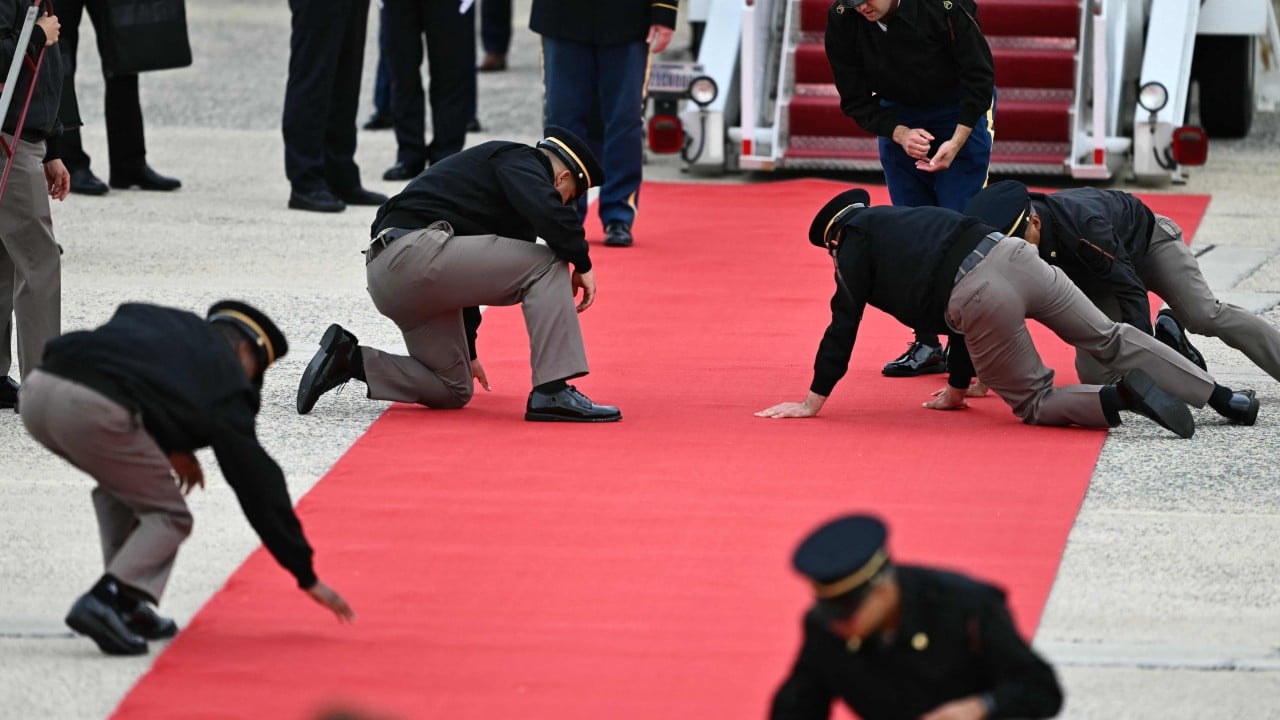
It lasted only a few seconds. A snippet of digital video captured on a bright, sterile afternoon. In the frame, crisp uniforms of United States military personnel moved with practiced precision, kneeling, tugging, and smoothing out the deep red runner awaiting a foreign leader. Not just any leader, but Xi Jinping, the president of a nation locked in a sprawling, high-stakes geopolitical and economic dance with Washington. To explore the complete picture, check out the detailed analysis by NPR.
Within minutes of hitting the internet, the algorithmic winds caught fire.
Screens across the world lit up with commentary, outrage, and disbelief. To critics scrolling through their feeds from living rooms, offices, and commuter trains, those few seconds of fabric adjustment looked less like diplomatic courtesy and more like a shocking display of deference. Why were American service members tending to a foreign head of state's pathway? Why was the superpower of the West kneeling—even metaphorically—to arrange the floor for Beijing?
The outrage cascaded downward through thousands of retweets, hot takes, and outraged monologues. Commentators diagnosed it as a symptom of national decline, a visual metaphor for a fading empire bowing before its ascendant rival. The internet, hungry for symbols of humiliation or dominance, seized upon the red felt with ravenous intensity.
Yet, beneath the frothing surface of viral commentary lies a vast, invisible machinery that most people never see. A machinery built not on political weakness, but on the cold, unrelenting mechanics of protocol.
To understand those few seconds on the tarmac, one has to step far away from the glowing screen and into the windowless briefing rooms where state visits are mapped out down to the millimeter.
Imagine the planners. Not faceless bureaucrats, but career officers and protocol experts whose entire professional lives are dedicated to preventing accidental wars. In international diplomacy, chaos is a spark, and protocol is the firebreak. When two nuclear-armed superpowers meet, every single variable is negotiated months in advance. The motorcade routes, the exact angle of handshakes, the placement of flags, the altitude of aircraft, and yes, the positioning of the red carpet.
Nothing is left to chance.
When a head of state arrives on foreign soil, host nations extend specific honors dictated by centuries of international custom. These honors are reciprocal. They are the currency of mutual recognition. When an American president lands in Beijing, Chinese honor guards snap to attention, banners fly, and carpets are rolled out with meticulous exactness. It is not an admission of subservience; it is an acknowledgement of status. It is the polite fiction that allows tense rivals to sit at the same table without immediately drawing knives.
The military personnel caught on camera smoothing that carpet were not acting out of political ideology or personal submission. They were executing an order rooted in military discipline and professional pride. To a soldier, sailor, or airman detailed to protocol duty, perfection is the standard. If a wrinkle exists in the carpet, it reflects poorly on the host unit, not on the visitor. A crease in the felt becomes an international embarrassment on a micro-scale. They kneel because their uniform demands precision, because their chain of command expects flawless execution, and because the diplomatic weight of the United States depends on the illusion of absolute control.
But nuance has always been a rare commodity in the digital public square.
We live in an age that demands instant moral clarity from every visual fragment. We crave heroes and villains, winners and losers, moments of absolute humiliation or absolute triumph. A video of a service member touching a red carpet for a rival leader does not fit the clean binary of modern digital tribalism. So, the algorithms warp it. They strip away the context, discard the history of diplomatic reciprocity, and package the moment as a betrayal.
Consider the human beings inside those uniforms.
Teenagers and young adults from Ohio, Texas, and California, standing on a windy runway under the watchful eyes of superior officers. They woke up before dawn, ironed their dress uniforms until the creases could cut glass, polished their brass, and rehearsed their bearings. Their minds were focused on the physical mechanics of the task: don't trip, keep alignment, hold posture, ensure the visiting dignitary's safety and the protocol’s integrity.
They had no idea that their split-second movement would be dissected by millions of armchair strategists thousands of miles away. They did not know they were starring in a digital morality play about the decline of Western hegemony. They were simply doing a job, fulfilling a protocol older than the internet itself, unaware that the ground beneath their boots had become a symbolic battlefield.
This is the strange reality of modern geopolitics. Power is no longer measured solely in aircraft carriers, GDP growth, or nuclear arsenals. It is fought over in the pixelated trenches of social media, where a wrinkle in a rug can trigger a national identity crisis.
The backlash reflects a deep, underlying public anxiety. People across the democratic world feel a palpable shift in the global tectonic plates. They sense that the unipolar moment of the late twentieth century is fracturing. They watch the headlines—supply chain shifts, regional conflicts, technological races, trade wars—and they feel a quiet, pervasive unease about the future.
When a society feels anxious about its standing in the world, it becomes hyper-vigilant. Every symbol is scrutinized for signs of rot. Every gesture is interrogated for weakness. In that state of mind, a red carpet is never just a red carpet. It becomes a Rorschach test for national self-doubt.
If you believe your country is winning, you view the carpet-adjusting video as a minor, meaningless formality—a standard courtesy extended to any visiting dignitary. If you believe your country is losing, you view that same video as a humiliating capitulation, undeniable proof of a shifting throne.
The video exposes less about the state of American military readiness or foreign policy than it does about the fragility of public perception in an hyper-connected world. We are drowning in information, yet starving for context. We consume reality in bite-sized, context-free fragments, and then wonder why our understanding of the world feels so fractured and combustible.
Diplomacy has always been an uncomfortable theater. It requires statesmen and soldiers to smile at men they distrust, to shake hands with adversaries who threaten global stability, and to maintain an outward veneer of civility while titanic struggles rage beneath the surface. It is messy, performative, and entirely necessary.
If the United States and China are to navigate the treacherous waters of the twenty-first century without stumbling into catastrophic conflict, it will not happen through grand, cinematic declarations of war or peace. It will happen in boring, airless rooms where diplomats argue over comma placements in trade agreements. It will happen on tarmacs where service members ensure that red carpets are straight, not out of love for the guest, but out of respect for the office and the fragile architecture of international peace.
The red carpet was rolled up hours after the cameras stopped rolling. The leaders departed behind tinted windows in armored motorcades. The internet moved on to the next outrage, the next viral flashpoint, the next fleeting object of collective fury.
Yet the fabric remains a potent reminder of how easily we are startled by shadows. We watch the world through tiny screens, assigning apocalyptic meaning to the mundane choreography of states, forgetting that the real work of empires is rarely performed in the spotlight. It happens quietly, in the spaces between the noise, where people in uniforms do what they are told, smoothing out the wrinkles so the rest of us can pretend the ground beneath our feet is entirely stable.