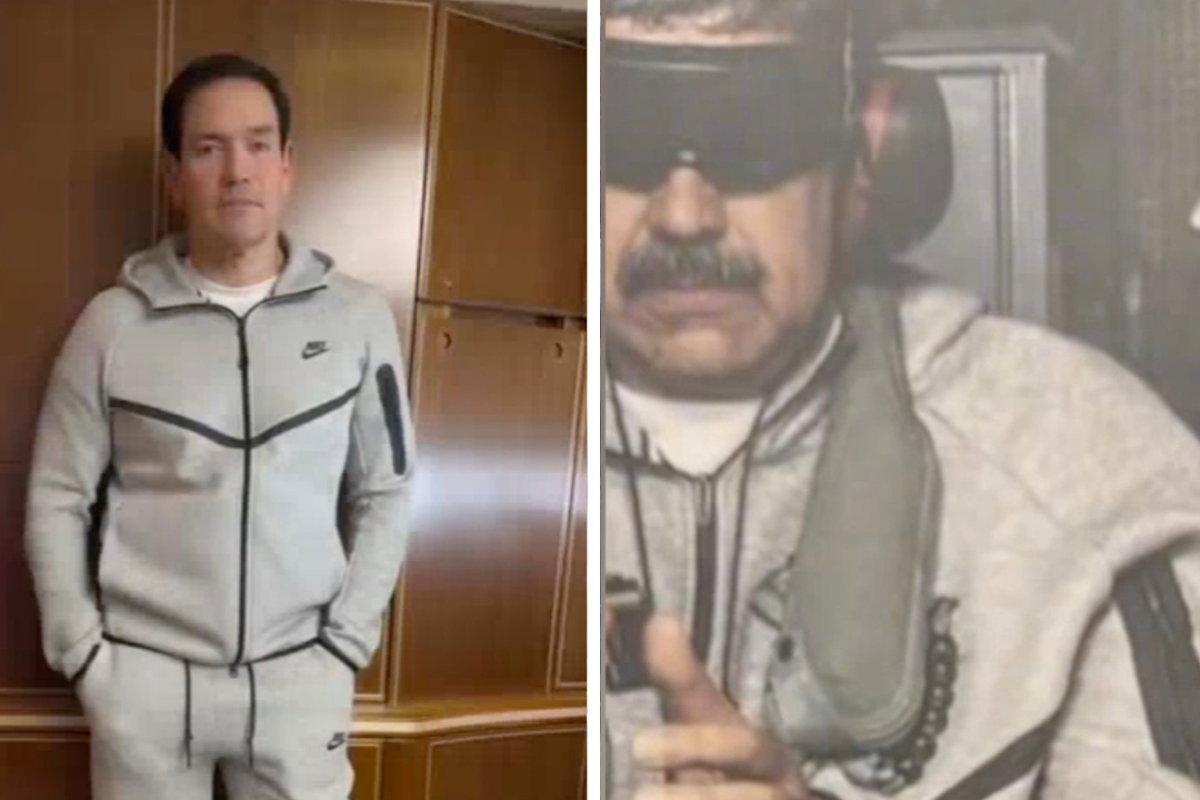
The cabin of Air Force One is arguably the most scrutinized interior design space on the planet. Every inch of its duck-egg blue upholstery and polished wood grain serves as a stage for the theater of American power. Usually, the costumes are predictable. We expect the crisp white shirts, the navy blazers, and the flags pinned to lapels with surgical precision. But when Marco Rubio stepped into that pressurized sanctuary wearing a matching navy tracksuit, the silent rules of political costuming didn't just bend. They shattered.
It was a choice that felt heavy. It felt intentional. In the grainy snapshots that leaked to the public, the Florida Senator looked less like a lawmaker on a diplomatic mission and more like a man leaning into the comfort of absolute authority.
The reaction was instantaneous. Social media didn't just critique the fit; it reached for a historical mirror. Within hours, side-by-side images began to circulate, pairing the American senator with a man thousands of miles away and a world apart in ideology: Nicolás Maduro.
The Uniform of the Strongman
Clothing is rarely just about fabric. In the high-stakes world of geopolitics, what a leader chooses to wear when they aren't "working" is often a louder statement than their State of the Union address. There is a specific, peculiar history to the tracksuit in Latin American politics. It is the unofficial uniform of the "revolutionary" who has transitioned into the "permanent resident" of the palace.
Consider the visual legacy of Hugo Chávez and his successor, Maduro. They traded the olive drabs of the guerrilla for the polyester sheen of the national athlete. By donning a tracksuit adorned with the colors of the Venezuelan flag, Maduro sends a calculated message to his base. He is saying: I am the country. I am always on the clock. I am the coach of the national soul.
When Rubio, a man whose political identity is inextricably linked to his fierce opposition to the Venezuelan regime, appeared in a nearly identical silhouette, the irony was thick enough to choke on. Critics didn't see a casual traveler. They saw a visual rhyme. They saw the "strongman aesthetic" crossing the Florida Straits and boarding the most famous plane in the world.
The Psychology of the Power Lounge
Imagine the atmosphere inside that fuselage. You are 35,000 feet above the Atlantic. The world below is a grid of problems you are tasked with solving. In this environment, the suit is a cage. It represents the bureaucracy, the decorum, and the rigid expectations of the voter.
To take off the suit and put on a coordinated athletic set is an act of liberation. But for a politician, it also signals a shift in status. It says that you have reached a level of influence where the traditional dress code no longer applies to you. You are part of the inner circle. You are "off-duty" in a way that suggests you are never truly off the throne.
The "tracksuit trope" carries a specific weight of populist bravado. It bridges the gap between the elite and the everyday man, while simultaneously signaling that the wearer is above the rules of the boardroom. It is the clothing of someone who doesn't need to impress you because they already hold the keys.
A Collision of Branding and Perception
The controversy isn't really about fashion. Nobody actually believes Marco Rubio is shopping at the same boutiques as the Miraflores Palace residents. The friction comes from the collision of two very different brands.
Rubio has spent decades positioning himself as the primary antagonist of Latin American autocracy. He has been the voice of the exile, the defender of democratic norms, and the harshest critic of the "Tracksuit Revolutionaries." By adopting the very look he has spent a career vilifying, he created a cognitive dissonance that his opponents were all too happy to exploit.
It highlights a growing trend in modern American politics: the drift toward a more casual, almost imperial style of leadership. We see it in the hoodies of Silicon Valley billionaires and the golf attire of former presidents. We are moving away from the era of the "statesman in a suit" and toward the era of the "influencer in a brand."
But when that brand carries the baggage of a continent's suffering, the stakes change. For the Venezuelan diaspora in Miami, the tracksuit isn't a comfortable choice for a long flight. It is a trigger. It is the garment worn by the men who presided over the collapse of their economy and the exile of their families.
The Invisible Stakes of a Photo Op
Every photograph taken on Air Force One is a historical document. The people in the frame know this. They understand that these images will be archived, analyzed, and used as ammunition.
When the photo of Rubio hit the wire, it served as a Rorschach test for the American public. To his supporters, it was a non-issue—a busy man seeking comfort on a long journey. To his detractors, it was a slip of the mask, a moment where the aesthetic of the American Right seemed to borrow a page from the playbook of the very dictators they claim to loathe.
This is the danger of the modern political image. In an age of instant memes and historical echoes, there is no such thing as "just a tracksuit." There is only the narrative. And right now, the narrative is grappling with why an American leader would choose to look like the ghost of the regime he promised to haunt.
The plane eventually landed. The passengers disembarked. The tracksuit was likely hung in a closet or tossed into a laundry bin. But the image remains, suspended in the digital ether, a velvet-blue reminder that in politics, you are always wearing your intentions on your sleeve.
The suit might make the man, but the tracksuit defines the era. It is an era where the lines between the democratic representative and the populist figurehead are becoming increasingly blurred, one zip-up jacket at a time.
:max_bytes(150000):strip_icc():focal(819x186:821x188)/Murdaugh-Family-e90854a716884d608fb6fd925e18d840.jpg)
