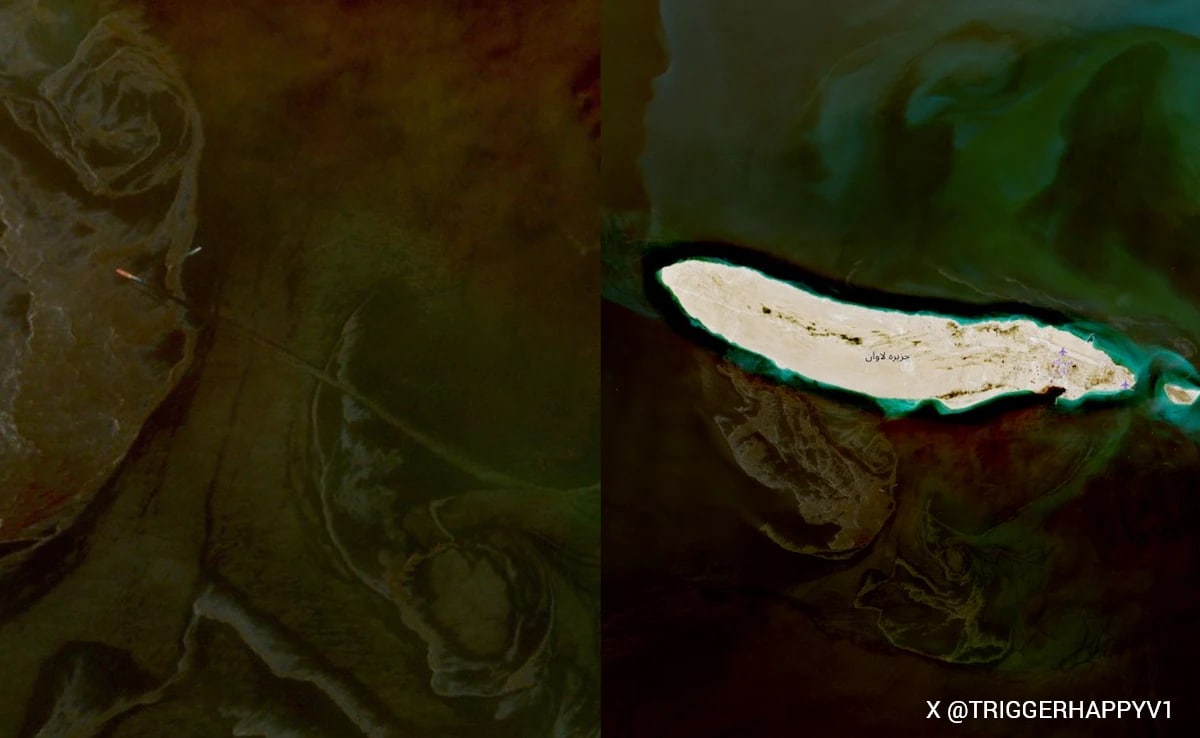
Massive black slicks are choking the Persian Gulf right now. They're so large that satellite sensors thousands of miles above the Earth can track them in real-time. This isn't just another industrial accident. It's the predictable, horrific result of the escalating maritime shadow war between US-Israeli forces and Iranian assets. When missiles hit tankers, the ocean pays the price in millions of gallons of crude oil.
I’ve tracked regional conflict trends for years. The sheer scale of the current pollution suggests we’ve moved past targeted sabotage and into a period of total environmental disregard. We aren't just looking at a local disaster. We're looking at a systemic collapse of the most vital waterway on the planet. The Strait of Hormuz is becoming a graveyard for both ships and marine life.
Why the Persian Gulf is Choking
The geography of the Persian Gulf is a nightmare for oil spill recovery. It’s a shallow, semi-enclosed sea. Think of it like a giant bathtub with only one small drain. Most of the water takes years to circulate back out into the Indian Ocean. When a tanker leaks millions of barrels after a drone strike or a naval skirmish, that oil doesn't just wash away. It lingers. It coats the coral reefs. It destroys the mangroves.
Current satellite imagery from agencies like the European Space Agency (ESA) shows plumes extending for dozens of miles. These aren't the thin, shimmering films you see from a motorboat leak. These are thick, viscous "chocolate mousse" emulsions. They block sunlight. They kill the phytoplankton that form the base of the entire food chain. If you think your gas prices are the only thing affected by this war, you're missing the bigger picture.
The Satellite Data Tells a Darker Story
You can't hide these spills. While military spokespeople on both sides downplay the damage to "maintain operational security," the eye in the sky doesn't lie. High-resolution synthetic aperture radar (SAR) is particularly good at this. SAR can "see" through clouds and smoke. It detects the way oil smooths out the surface of the water, making it look like a black scar against the rougher, natural waves.
Recent data indicates that the volume of oil entering the water since the start of 2026 has tripled compared to previous years of low-level friction. We're seeing spills that rival the 1991 Gulf War disaster, though they are happening in a series of "mini-disasters" rather than one single event. It’s death by a thousand cuts. Every time a "shadow tanker" carrying Iranian crude is intercepted or a Western-linked vessel is struck in retaliation, the slick grows.
The Problem With Shadow Tankers
A huge part of this mess comes from the use of the "dark fleet." These are aging, poorly maintained vessels used to circumvent sanctions. They don't have the same safety standards as modern double-hulled tankers. When these ships are involved in the US-Israeli conflict with Iran, they fail spectacularly.
- They often turn off their AIS (Automatic Identification System) transponders.
- They engage in risky ship-to-ship transfers in the middle of the night.
- Their crews are often under-trained for emergency response.
When one of these ships is hit, there is no corporate cleanup crew. There is no insurance company rushing in to deploy booms. The oil just sits there. It spreads until it hits the coastline of Kuwait, Saudi Arabia, or the UAE.
The Economic Suicide of Environmental Warfare
It’s ironic. The very nations fighting over these waters rely on them for survival. Desalination plants provide nearly all the drinking water for cities like Dubai, Doha, and Abu Dhabi. These plants are incredibly sensitive. If oil gets sucked into the intake valves, the entire water supply for millions of people could be knocked offline in hours.
The cost to fix a fouled desalination plant is astronomical. We're talking billions of dollars and months of downtime. This isn't just about saving the sea turtles. It's about basic human survival in a desert climate. The US and Israel might be focused on "degrading Iranian capabilities," and Iran might be focused on "deterring Western aggression," but both sides are poisoning the well they drink from.
Beyond the Slicks Marine Life is Vanishing
The Persian Gulf is home to unique species that can survive in high-salinity, high-temperature water. They're tough. But they aren't "missile-strike-and-crude-oil" tough. The dugong population—a relative of the manatee—is in freefall. Their seagrass beds are being smothered by sinking oil aggregates.
Once the oil sinks, it's game over for the seabed. It forms "tar mats" that can persist for decades. We still find oil from the 1991 spills buried under the sand today. What we're seeing now is a fresh layer of toxicity being draped over a region that never fully recovered from the last century's wars.
What Happens When the Smoke Clears
People ask if we can just clean it up later. The short answer? No.
Chemical dispersants often make the problem worse by pushing the oil deeper into the water column where it becomes even more toxic to fish. Physical skimming is too slow when the spills are this large and frequent. The only real solution is to stop the ships from leaking in the first place, which is impossible as long as the kinetic conflict continues.
The international community is toothless here. Organizations like the International Maritime Organization (IMO) have rules, but those rules assume everyone is playing by the same book. In a hot war zone, environmental regulations are the first thing tossed overboard.
The Reality Check
Don't wait for a formal announcement that the Gulf is dying. Look at the maps. If the slicks are visible from the International Space Station, the damage is already systemic. We've reached a point where the environment isn't just "collateral damage." It's becoming the primary victim of a geopolitical stalemate that has no end in sight.
The next time you see a headline about a tanker "limping to port" after an explosion, understand that the ship is only half the story. The other half is the trail of black sludge it left behind—a trail that will outlast the political careers of every leader currently ordering those strikes.
Monitor the live satellite feeds from providers like Sentinel-1 if you want the truth. Pay attention to the water prices in the Gulf States. Watch the fish markets in Oman. The evidence of a dying sea is everywhere, provided you're willing to look at what the satellites are showing us.