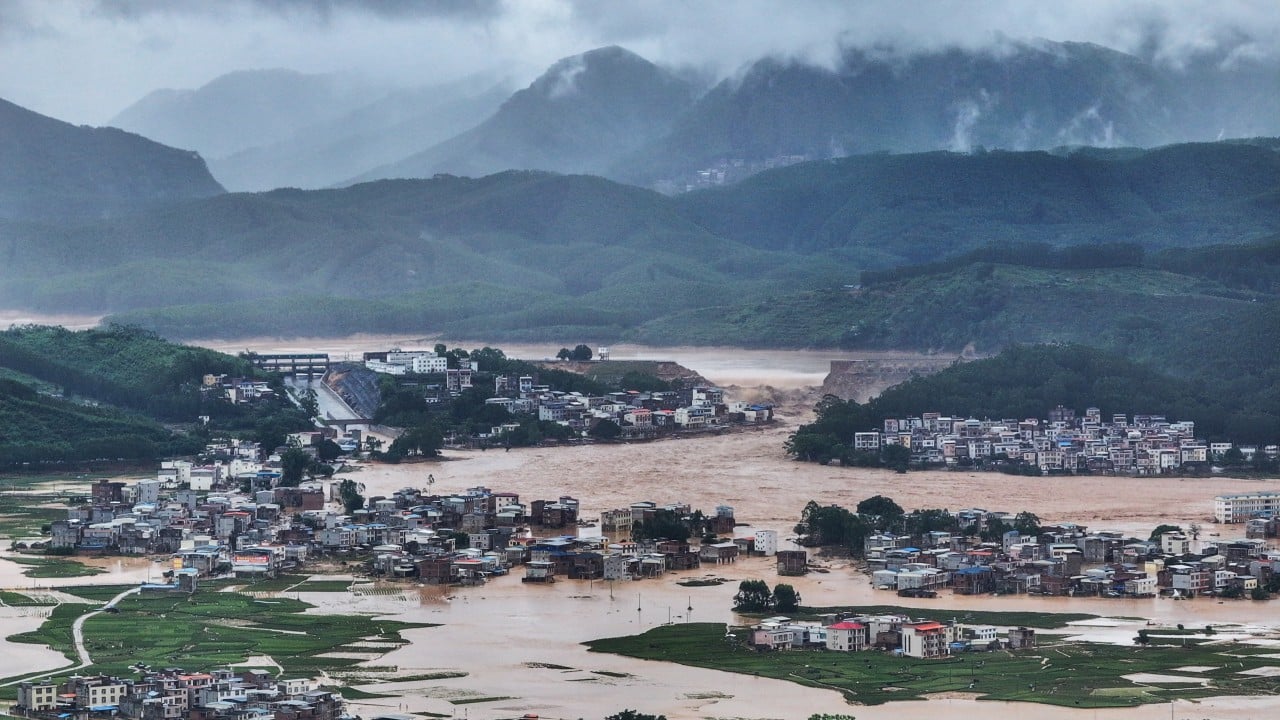
The rain over Hengzhou did not fall as water. It fell as weight.
For days, Typhoon Maysak battered southern China’s Guangxi region, turning fertile green valleys into churning, slate-gray seas. In the rural township of Yunbiao, the sound came before the sight—a low, mechanical groan that vibrated through the soles of the feet. It was the sound of earth giving up its hold.
When the 66-year-old Liulan Reservoir dam finally fractured, tearing a fifty-meter gash into its earthen spine, it did not merely release water. It released decades of deferred maintenance, administrative blind spots, and bureaucratic silence.
Consider what happens when a concrete upgrade is measured in cosmetic triumphs rather than structural survival. Built during an era of mass collective labor in 1958, the Liulan Reservoir was designed to tame the capricious floods of a different century. Over the decades, it grew old. Its internal veins clogged with silt, its compacted core softened by microscopic channels carved by water and tunneling termites. Yet, on paper, the dam was cared for. Millions of yuan flowed into its ledger books, earmarked for modernization.
The money arrived, but the strength did not.
In a hypothetical reconstruction of the fiscal paper trail—mirrored closely by deleted investigative reports later preserved by digital archivists—investigators discovered a startling disconnect. Of the roughly seventy-four million yuan allocated for structural upgrades, the lion's share vanished into peripheral comforts. Irrigation canals were smoothed. Pumping stations received fresh coats of paint. Roads atop the dam crest were paved over, offering a neat, flat surface for inspectors to drive across. Every surface looked prosperous. Every cosmetic box was checked.
Meanwhile, the internal body of the earthen dam—the hidden mass holding back millions of cubic meters of water—remained starving for reinforcement.
Water is an unforgiving auditor. It does not care about fresh asphalt or polished concrete plaques. It finds the weak seam, the uneven compaction, the forgotten void. When Maysak’s deluge pushed the reservoir past its design capacity, the water did what water always does: it tested the lie.
The disaster was not entirely a surprise to those who lived beneath the shadow of the wall. Months before the collapse, local villagers had noticed unsettling signs. Fine spiderwebs of cracks fractured the newly paved road on the dam's crest. Subsidence pulled the earth downward in subtle, alarming dips. Farmers walking their livestock home in the evening pointed at the shifting soil, whispering concerns to one another. Some videos recorded by observant citizens captured the visible decay, uploading warnings into the digital ether.
Those warnings met the great institutional sponge. They were absorbed, filed under routine notices, and left unheeded. The daily inspections continued as a theatrical performance of safety, manned by people who looked at the surface and saw what they wanted to see.
Complicating this fragile ecosystem of risk was another hidden pressure: profit. Across many small and medium-sized reservoirs in the region, a multi-purpose economic model had taken root, blending irrigation and flood control with commercial fish farming. In quiet seasons, this partnership seemed efficient. But when floodwaters rise, competing priorities emerge. Fish farmers, desperate to protect their lucrative stocks from washing away, have historically been known to privately tinker with discharge channels, delaying the release of vital pressure or blocking gates altogether. Whether institutional hesitation or private reluctance played a role in holding back the necessary pre-emptive discharge at Liulan remains a central question for investigators.
When the breach finally tore open, it swallowed that question whole.
A wall of muddy water surged across the lowlands, erasing fields, lifting utility poles like toothpicks, and trapping families inside their homes. In Fulong village, ordinary routines turned fatal in a heartbeat when sudden torrents swept away residents navigating the roads. In Wangzhuang, families scrambled to third-floor balconies, watching the brown tide swallow the ground floors of their lives.
Rescue operations required extraordinary measures. Drones hummed through the heavy rain, airdropping emergency rations to stranded students and lifting isolated villagers out of swirling currents with ropes tied to their waists. Emergency responses were thrust to their absolute maximum limits.
Yet, as the floodwaters slowly recede, exposing the raw, torn earth of the fifty-meter breach, the nature of the recovery shifts. This time, the government has turned outward, appealing directly to the public for help in unearthing the truth behind the disaster.
Citizens are being asked to step forward with documents, photographs, and memories that can pierce the corporate and bureaucratic armor of local oversight. It is a rare admission that institutions cannot audit themselves. The deleted social media exposés, the citizen videos from a year prior, the whispered warnings of neglected core maintenance—these are no longer just digital noise. They are evidence.
Water recedes. Mud dries. But the cracks in the foundation remain exposed to the open air, waiting to see if anyone is finally willing to look deeper than the surface.
China rescuers race to save thousands stranded after Typhoon Maysak floods
This video captures the intense rescue operations and the devastating scale of the flooding across the region following the disaster.
http://googleusercontent.com/youtube_content/1