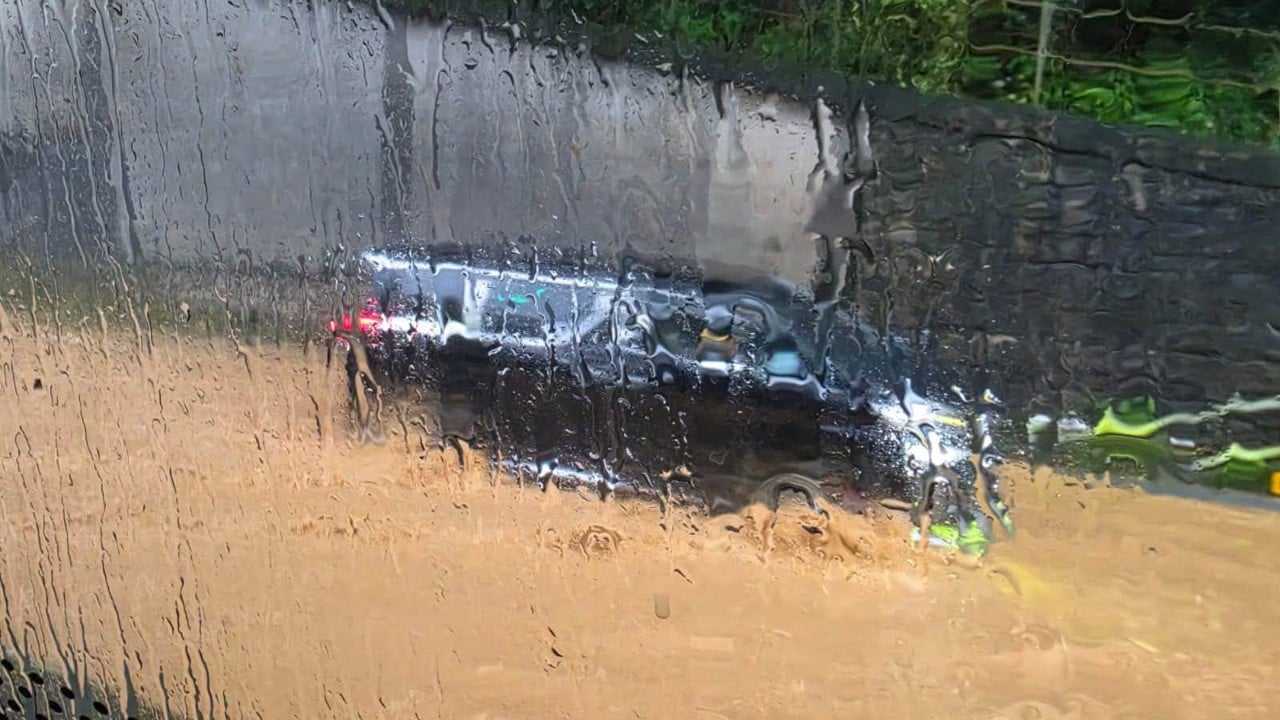
Rain in the New Territories does not arrive as a polite mist. It falls with an industrial weight, a gray wall dropped suddenly from the sky that turns the transition between city and countryside into a blur of grey asphalt and blinding spray.
I remember the sound of it hitting the corrugated metal roof of a roadside stall in Yuen Long, a deafening drumroll that obliterated speech. Within twenty minutes, the drainage ditches, choked by a sudden surge of runoff from the hills, stopped functioning as channels and started acting as lakes.
Water has a memory. It seeks the lowest path, the oldest creek bed we paved over, the valley we built our warehouses upon. On days when the heavens open over Hong Kong, the New Territories become the frontline of a quiet, recurring emergency. Drivers heading toward Lok Ma Chau or navigating the narrow lanes of Kam Tin suddenly find themselves calculating variables they never signed up for: engine height, current speed, and the precise moment a puddle transforms into a trap.
The Anatomy of a Flash Flood
To understand what happens when drivers struggle through floods in Hong Kong's New Territories, you have to look beyond the dramatic footage of stranded buses and half-submerged sedans. You have to look at the geography.
This is a region of sharp contrasts. Gleaming new housing estates sit mere yards away from historic low-lying villages, active brownfield sites, and winding river loops. When torrential downpours hit—often dumping over a hundred millimeters of rain in a single hour—the drainage infrastructure, no matter how meticulously engineered by the government, faces a brutal mathematical mismatch. The volume simply exceeds the capacity.
Consider what happens next: a delivery truck stalls on a flooded connector road. The driver, isolated in the cabin, watches the muddy water creep up the door panels. Every passing vehicle sends a mini-tsunami crashing against the chassis, rocking the cabin and pushing water closer to the air intake.
It is a terrifying gamble. Turn back? There is no space to turn around on a narrow, congested rural track. Push forward? A hydrolocked engine means thousands of dollars in repairs and a ruined day of work.
The Human Cost Behind the Windshield
Statistics tell us about rainfall rates, amber and black rainstorm warnings, and the number of traffic accidents reported by the Transport Department. But statistics do not capture the heartbeat of a father trying to get his daughter home from cram school in Fanling while the road ahead vanishes beneath an expanding sheet of brown water.
They do not capture the anxiety of logistics workers whose livelihoods depend on keeping goods moving between the border ports and the urban core. For these individuals, a flooded highway is not a weather event; it is an economic threat.
"You see the water rising, and your brain tells you to stop," notes a veteran freight driver who has navigated these northern routes for two decades, speaking from the memory of countless storms. "But your responsibility tells you to keep going. Everyone behind you is relying on that delivery. You weigh the risk of your van against the risk of losing your job."
That tension defines the daily struggle in the northern districts during severe weather. It is a collision between modern urban pace and primordial environmental force.
Navigating the Deluge
When the Hong Kong Observatory issues urgent warnings, the response across the New Territories is a study in contrasts. Some drivers heed the alerts immediately, pulling into high-ground parking lots or service stations to wait out the worst of the squall. Others, caught mid-journey by the sheer speed of tropical downpours, are forced into high-stakes improvisation.
Urban planners talk about sponge cities and retention ponds. But on the ground, success or failure comes down to split-second human judgment. Do you know the depth of that water? Is that ripple hiding a deep pothole or an open maintenance hatch?
Water is deceptive. Six inches of moving water can knock a person off their feet, and a foot of water can sweep a vehicle away. Yet, every rainy season, drivers misjudge the depth, trusting the familiarity of a route they have driven a thousand times in the sunshine. Sunshine lies. Rain reveals the truth of the land.
Where the Roads End
As the storm finally begins to exhaust itself, leaving behind a landscape of dripping vegetation, slick mud, and the heavy smell of damp earth, the true resilience of the New Territories comes into view. Tow trucks hum through the districts, clearing the casualties of the deluge. Neighbors clear blocked grates with their hands, sweeping away accumulated plastic bags and fallen leaves.
The water recedes, draining slowly into Deep Bay or the Shenzhen River, leaving behind a thin film of silt on the roads. Traffic resumes its frantic rhythm.
We patch the potholes, check the drainage reports, and wait for the next atmospheric river to test our boundaries once more. The sky clears. But the mud on the shoulder remains, a quiet reminder of how quickly the world can turn upside down when the rain decides to stay.