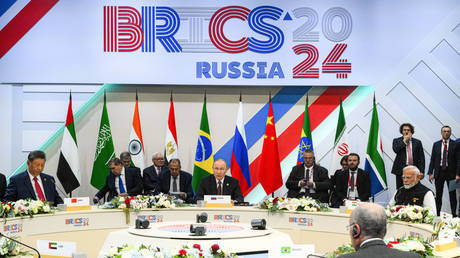
The tea shop in downtown Cairo smells of cardamom and aged cedar. On a Tuesday afternoon in the late summer of 2023, Mahmoud adjusted the collar of his shirt, listening to the radio crackle with news from Johannesburg. Thousands of miles to the south, leaders of Brazil, Russia, India, China, and South Africa were shaking hands under television lights, expanding an acronym that had long sounded like an academic footnote into something resembling a gravitational pull.
Mahmoud did not care about acronyms. He cared about the price of imported wheat.
For three decades, Mahmoud had watched his profit margins evaporate not because his customers bought fewer pastries, but because the currency in his pocket lost its standing against the dollar every time a distant central bank sneezed. When global commodities are priced in a currency controlled by Washington, every grocery store owner in Cairo, every textile merchant in Mumbai, and every logistics manager in São Paulo lives downstream from monetary decisions they cannot influence and votes they cannot cast.
That is the invisible architecture of modern commerce. It is an architecture built in Bretton Woods nearly eighty years ago, sustained by naval patrols, deep capital markets, and the quiet habit of global trade. Yet habits change when the cost becomes too high. BRICS represents less a military alliance and more a massive, groaning pressure valve for nations tired of holding their breath every time the Federal Reserve adjusts interest rates.
Listen closely to the official communiqués and you hear dry talk of de-dollarization, alternative payment systems, and multipolar governance. Strip away the diplomatic polish, however, and the human reality is stark. It is about a shopkeeper in Egypt wondering if he can afford flour next month. It is about an exporter in Brazil locked out of traditional Western settlement channels. It is about sovereignty in an age where financial plumbing can be turned off with a keystroke.
Yet wanting a new house and building one are entirely different matters.
Consider what happens when five nations with wildly divergent domestic systems attempt to construct a shared financial future. India and China share a heavily militarized Himalayan border and a deep, historical distrust that stretches back generations. Brazil operates as a vibrant, messy democracy with shifting political winds, while Russia sits under an unprecedented canopy of Western sanctions that turns any transaction involving its financial institutions into a compliance nightmare. South Africa possesses an advanced banking sector but navigates severe domestic electricity shortages and high unemployment.
To believe these nations can effortlessly stitch together a unified monetary zone is to misunderstand the sheer brutality of economics. Economics is not friendship. It is math, trust, and institutional muscle.
When people ask what BRICS needs to succeed, they often look for a silver bullet. A single headline-grabbing solution. But economic gravity cannot be repealed by a declaration in a convention center. For this bloc to transition from a diplomatic club into a functional counterweight, it must solve three profound structural dilemmas.
First, trade imbalances must find a home. China runs a massive, persistent trade surplus with almost everyone. In the old system, surplus dollars flowed back into US Treasury bonds, recycling global liquidity in a continuous loop. If nations trade in local currencies like the yuan or the rupee, what does Beijing do with billions of rupees it cannot easily spend on Chinese goods? Without deep, liquid capital markets that allow surplus holders to invest safely across member borders, bilateral currency swaps hit a hard ceiling. You can only trade local paper for so long before someone demands something of intrinsic value.
Second, institutional trust must replace political convenience. The European Union spent decades harmonizing laws, judicial standards, and fiscal rules before launching the euro, and even then, it nearly fractured under the strain of divergent national economies. BRICS has no shared parliament, no binding central bank, and no shared political ideology beyond a collective weariness of Western hegemony. Trust cannot be decreed. It must be forged through years of painful compromise, transparent data sharing, and binding legal frameworks that protect minority members from the economic dominance of the largest player in the room.
Third, alternative payment rails require immense technological and political coordination. Creating a messaging system to rival SWIFT or a settlement platform to bypass Western correspondents is entirely possible. Russia and China have already built domestic alternatives. But plumbing is only half the battle. Acceptance requires liquidity, and liquidity requires confidence that the underlying assets will hold their value tomorrow. If a central bank in a developing nation trades its hard-earned goods for a currency that depreciates rapidly due to domestic mismanagement or geopolitical shock, that nation has not gained independence; it has merely changed its master.
Back in Cairo, the radio broadcast fades into a traditional oud melody. Mahmoud pours another glass of tea for a regular customer, smiling through the exhaustion that comes with running a business through a currency crisis. He does not know the intricacies of capital account convertibility, nor has he read the academic papers analyzing the structural flaws of the New Development Bank.
He only knows that when he looks at his ledger, the numbers tell a story of vulnerability.
The expansion of BRICS to include major energy producers like Iran, the United Arab Emirates, and Saudi Arabia changes the arithmetic of global trade in profound ways. When oil is increasingly priced and settled outside the traditional Western financial architecture, the plumbing of global power shifts by degrees. It is a tectonic process. Slow, grinding, and largely invisible to those who live inside the old fortresses.
Success for this coalition will not arrive as a singular, triumphant morning when the dollar collapses and a new global currency reigns supreme. History rarely moves with such cinematic neatness. Instead, success will look like a thousand quiet workarounds. A bilateral trade deal settled in local rupees. A grain shipment financed through a regional development bank. A digital settlement ledger humming silently in the background of a warehouse in Shanghai and a port in Durban.
The architects of this new world face a steep, unforgiving climb. They must bridge civilizational divides, overcome mutual suspicions, and build institutions robust enough to withstand the inevitable tremors of global finance. If they fail, the bloc will remain what cynics claim it is: a photographic opportunity for leaders seeking domestic leverage, a loud megaphone signifying very little.
If they succeed, the quiet hum of commerce across the Global South will no longer echo through Western clearinghouses. And down in Cairo, at a wooden table scarred by decades of hot tea glasses, a shopkeeper might finally open his ledger to find a stability he has never known.