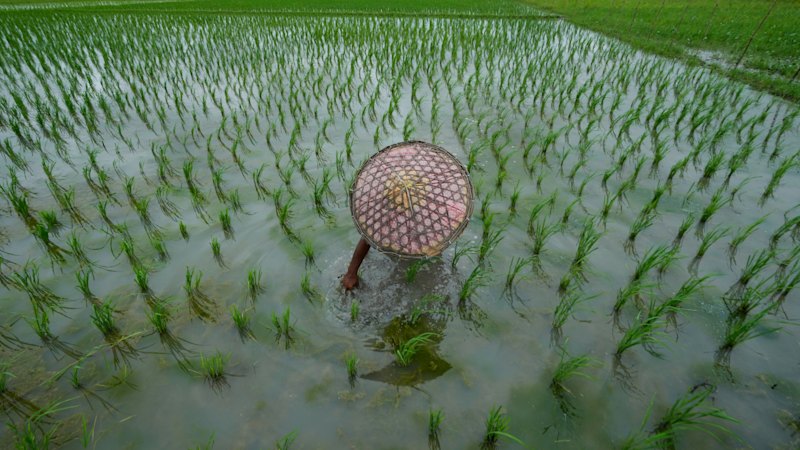
We forget how to look. We scroll. We swipe. We consume pixels like fast food, letting the geometry of our glowing rectangles sanitize the chaotic, beautiful violence of being alive on this spinning stone. Today is September 2, 2026. Somewhere right now, a meteorologist is watching a radar screen turn a terrifying, violent shade of purple. Somewhere else, an artisan’s calloused thumb is tracing the smooth grain of an instrument that took four months to carve.
We rarely pause to consider the sheer choreography required to keep this planetary theater running.
Let us fix our gaze downward for a moment. Not at a screen, but at the dirt. Or upward, past the troposphere, where silent aluminum tubes trace white chalk lines across the blue.
Consider a small fishing village on the northeastern coast of Japan. At 4:14 AM local time, an older man named Kenji pushes his wooden skiff into water the color of bruised steel. His joints ache—a dull, familiar throb that arrives with the autumn tide. He doesn't know that three thousand miles away, a trader in Frankfurt is frantically selling commodity futures based on the very harvest Kenji is pulling from the deep. He only knows the weight of the nets. He knows the smell of salt and diesel mixed with the damp wool of his sweater.
Kenji is a data point. But he is a breathing one.
When global news agencies aggregate the day's images, they flatten Kenji. They reduce his life, his debt, his quiet competence, and his fear of warming waters into a horizontal scroll labeled World in Pictures. It is a clinical phrase. It implies distance. It suggests that you can safely observe the planet from behind a pane of museum glass.
You cannot. The glass is already cracking.
Step into the archive of the immediate present. On this exact day, through the lens of photojournalists scattered across five continents, human history is whispering in code. Look at the shadows cast across a drought-stricken riverbed in sub-Saharan Africa. A child holds a cracked plastic jug, staring not at the camera, but past it, toward a horizon that promises nothing. That image isn't content. It is an indictment. It is a record of policy failures and atmospheric arithmetic written in the dust.
Yet, balance is the strange, stubborn engine of human endurance.
Five hundred miles away from that dry riverbed, inside a sterile cleanroom in Zurich, a technician named Elena adjusts a microscope with a breath held so tightly her chest burns. She is aligning a microscopic optical sensor designed to track glacial melt with atomic precision. She hasn't seen the sun in two days. Her coffee is cold. Her eyes burn with exhaustion. But she works because she believes, against the mounting weight of statistical despair, that naming a problem accurately is the first step toward surviving it.
We consume these moments in fragments. A snapshot of a festival in Spain where people smear themselves in crushed tomatoes. A quiet portrait of a solitary archivist in Dublin preserving fragile parchment from the eighteenth century. A chaotic street scene in a mega-city where delivery riders weave through gridlocked traffic like schools of silver fish.
Why do we look?
Because isolation is a modern plague. We are hyper-connected and profoundly untethered. When we peer into the daily visual record of the globe, we are searching for mirrors. We want to know if our private panic matches the public noise. We want proof that humanity is still capable of both catastrophic folly and staggering grace.
The camera shutter is a guillotine blade slicing through time. It kills the moment to preserve its ghost.
Think of the photojournalist standing behind that lens in a conflict zone or a quiet courtyard. They are sweating, trembling, perhaps smelling cordite or damp earth. They make a split-second ethical choice: Do I help, or do I record? That tension is the invisible gravity holding our collective story together. Every compelling image you scroll past was bought with someone else's risk, patience, or heartbreak.
We are living through a hinge of history. The climate shifts. Political maps fray at the edges. Algorithms dictate what we love and whom we fear. In such an era, bearing witness becomes a radical act.
Kenji pulls his last net. The sun breaks over the Pacific, turning the water from steel to hammered gold. He smiles, a brief, tight-lipped crease at the corner of his eyes, because the catch is decent today. Just barely enough.
In Zurich, Elena locks her lab door, walks out into the crisp European morning, and finally blinks against the sudden, blinding glare of a September sun.
Across the ocean, the riverbed waits for rain.
The pictures keep coming. The shutter keeps clicking. The world keeps turning, heavy with the quiet, uncelebrated grace of ordinary people carrying the weight of an extraordinary hour.