The gravel at Yasukuni Shrine crunches with a particular, hollow rhythm. It is a sound designed to slow a person down, to pull their attention from the frantic pulse of modern Tokyo toward the heavy, ancient quiet of the precinct. On a clear morning, sunlight filters through the dense canopy of zelkova trees, casting sharp shadows across the path. To a casual observer, it is a serene park. To the diplomat, the historian, and the veteran, it is a battlefield of memory.
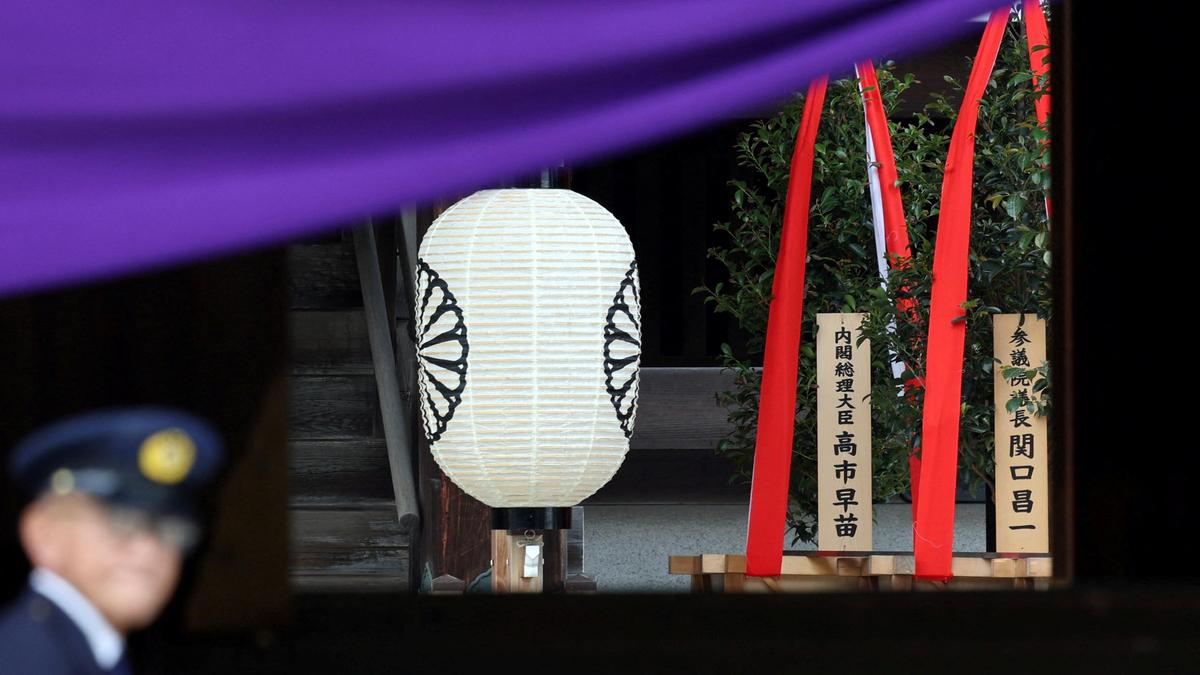
When the Prime Minister sends a masakaki tree—a ritualistic offering of evergreen and silk—to these grounds, the ground itself seems to shift. It is a gesture of profound simplicity. A plant. A card. A bow. Yet, in the machinery of East Asian geopolitics, that small act functions like a detonator.
Sanae Takaichi, standing within the machinery of the Japanese state, understands the weight of these symbols. When she sends this offering, she is not merely participating in a religious rite. She is asserting a definition of nationhood that rests on a fault line of history. To understand why a single tree can incite diplomatic firestorms, one must step out of the office and into the living room of someone for whom this shrine is not a site of reverence, but a grave of scars.
Consider a man in a small apartment in Seoul. He is eighty-eight years old. His memory of the occupation is not a historical entry; it is the smell of fear and the sound of soldiers’ boots on a dirt road. For him, Yasukuni is not a memorial to the war dead. It is the address of the ghosts who destroyed his youth. When he sees the news of a Japanese leader sending an offering to a place that enshrines Class-A war criminals—those responsible for the systematic devastation of his home—he feels a cold, familiar ache. It is the sensation of being erased.
This is the invisible stake of the Yasukuni controversy. It is a contest between two incompatible versions of reality.
For the faithful at the shrine, Yasukuni is a sanctuary. It is a place where the spirits of 2.5 million souls who died in service to the Emperor are meant to find peace. It is the ultimate expression of gratitude to those who gave everything for the nation. In this narrative, the offering is an act of piety. It is an acknowledgment that a country exists only because its predecessors were willing to walk into the fire. There is a deep, primal human need here: to honor the fallen, to ensure that death in uniform is not death in vain.
But then, the shadow falls.
Among those 2.5 million souls are fourteen men designated as Class-A war criminals by the International Military Tribunal for the Far East. These were the architects of expansion, the men who ordered the atrocities that left millions of civilians across Asia in mourning. They are enshrined there, spirits indistinguishable from the conscript who died in a foxhole or the nurse who perished in an air raid.
This is the knot that cannot be untied. How do you honor the tragedy of the war while the very symbols of its criminality sit at the altar?
The Prime Minister’s offering is a statement on this knot. By sending it, the leader is essentially signaling a refusal to perform the surgical separation of the perpetrators from the victims. It is a choice to embrace the entire historical lineage of the nation, warts and all. It is a declaration that the state will not be dictated to by the sensitivities of foreign powers. It is a assertion of sovereignty.
But sovereignty, like memory, exists in a relational space.
In Beijing, the reaction is not one of abstract academic debate. It is visceral. The Chinese government views this offering as a litmus test. Every time a Japanese official acknowledges Yasukuni, it is interpreted as an endorsement of the Imperial era's aggression. It is a signal that Japan is not ready to turn the page. The silence from Tokyo—the refusal to move the war criminals to a separate memorial—is perceived as a roar.
The consequences ripple far beyond the shrine’s wooden gates. When this ritual repeats, it drains the political capital needed for genuine reconciliation. It makes the mundane work of trade deals, maritime security pacts, and cultural exchange harder. Trust is not built in summit meetings or signed treaties. Trust is built in the acknowledgement of the other person's pain. When that acknowledgement is withheld, the friction increases.
I walked the perimeter of the shrine once, long before the news cycle demanded I care about it. It was rainy. The stone lanterns were slick with moss. There was a profound loneliness to the place. I watched an elderly woman bow. Her back was bent, her coat worn thin. She was not bowing for an ideology. She was likely bowing for a father or an uncle whose name was inscribed on a scroll hidden deep within the shrine’s archives.
That woman is the reality of Yasukuni. She is the human face of the controversy. Her grief is valid. Her desire to remember her kin is a fundamental human right.
Yet, the institutional weight of the shrine co-opts her grief. It leverages her private sorrow to validate a public narrative of imperial justification. This is why the Prime Minister’s offering matters. It takes that woman’s quiet, private mourning and elevates it to a state-sanctioned, political reality. It forces her grief to stand on the same altar as the war criminals.
The conflict here is not about religion. It is not about the Shinto tradition of honoring ancestors. It is about the definition of the future.
If a nation cannot look at its own past with a critical eye, how can it lead in the modern era? The irony is that by clinging to a rigid, unyielding interpretation of the war, the state limits its own potential. It remains tethered to a narrative that requires the exclusion of its neighbors' humanity.
Think about the dynamics of forgiveness. It is not a binary switch. It is a process. It requires one party to be vulnerable enough to say, "We did wrong," and the other to be strong enough to say, "I acknowledge your change."
The offering breaks this process. It is a rigid, vertical action. It does not ask for conversation. It demands acceptance. And so, the stalemate persists.
The geopolitical consequences are sharp and immediate. Economic partnerships are chilled. Security alliances are complicated by the lingering ghost of the mid-twentieth century. Japan finds itself in a paradoxical position: it is a modern, thriving democracy, technologically advanced and socially intricate, yet it is repeatedly dragged back to the middle of the last century by the specific, heavy gravity of this single shrine.
Is there a solution?
Some suggest the answer lies in the separation of the enshrined spirits. If the Class-A criminals were moved to a different location, the controversy might dissolve. The Prime Minister could pay respects to the war dead without the stench of the war’s architects clinging to the ritual. It seems like a logical, mechanical fix.
But history is rarely mechanical. History is made of blood, tears, and stubbornness. For the right-wing base that forms a portion of the political support for leadership in Tokyo, the shrine is a fortress. To remove the criminals would be seen as a surrender, a capitulation to foreign pressure. And so, the political calculation remains: the cost of domestic backlash is higher than the cost of international friction.
And so, we return to the masakaki tree.
It is a small, green symbol. It is beautiful, in its own way. It represents the continuity of the season, the cycle of life, the resilience of nature. But in the hands of a government official, it becomes a weapon. It is a way of saying, "We are who we were."
The man in Seoul will continue to watch the news. He will see the headlines. He will feel the same, tired disappointment. The woman at the shrine will continue to bow. She will feel the same, quiet love.
The tragedy is not that the shrine exists. The tragedy is that the space between these two people—the man who remembers the horror and the woman who remembers the love—is being filled by the choices of politicians who find more utility in the conflict than in the peace.
The gravel path at Yasukuni remains. The trees sway in the wind. The names are carved into the wood. The past is not gone. It is not even past. It is sitting in the center of Tokyo, waiting for someone to finally have the courage to rewrite the story.
Until then, the silence at the shrine will continue to be a heavy thing. It is not the silence of peace. It is the silence of a question that has been asked a thousand times, and to which no one is truly listening.
The ritual ends. The tree is delivered. The camera shutters click. And somewhere, across the sea, a door shuts. The cycle resets, waiting for the next season, the next offering, the next reminder that memory, when weaponized, is the most destructive force a nation can possess.
The shrine stands on. A monument of stone, a fortress of memory, and a cage for the present. The sun sets over Tokyo, casting long, dark fingers across the gravel, stretching toward the horizon, reaching for a tomorrow that looks exactly like yesterday.