The map room in any command center does not look like the movies. There are no flashing red lights or dramatic sirens. Instead, there is a low, persistent hum of cooling fans and the soft, scratching sound of dry-erase markers against plexiglass. It is a quiet place where loud decisions are made. On the screens, thousands of miles away, the Persian Gulf appears as a jagged fracture of blue cutting through sand and stone. For the drone operators, logistics officers, and regional analysts stationed across the globe, that fracture is not just geography. It is a tightrope.
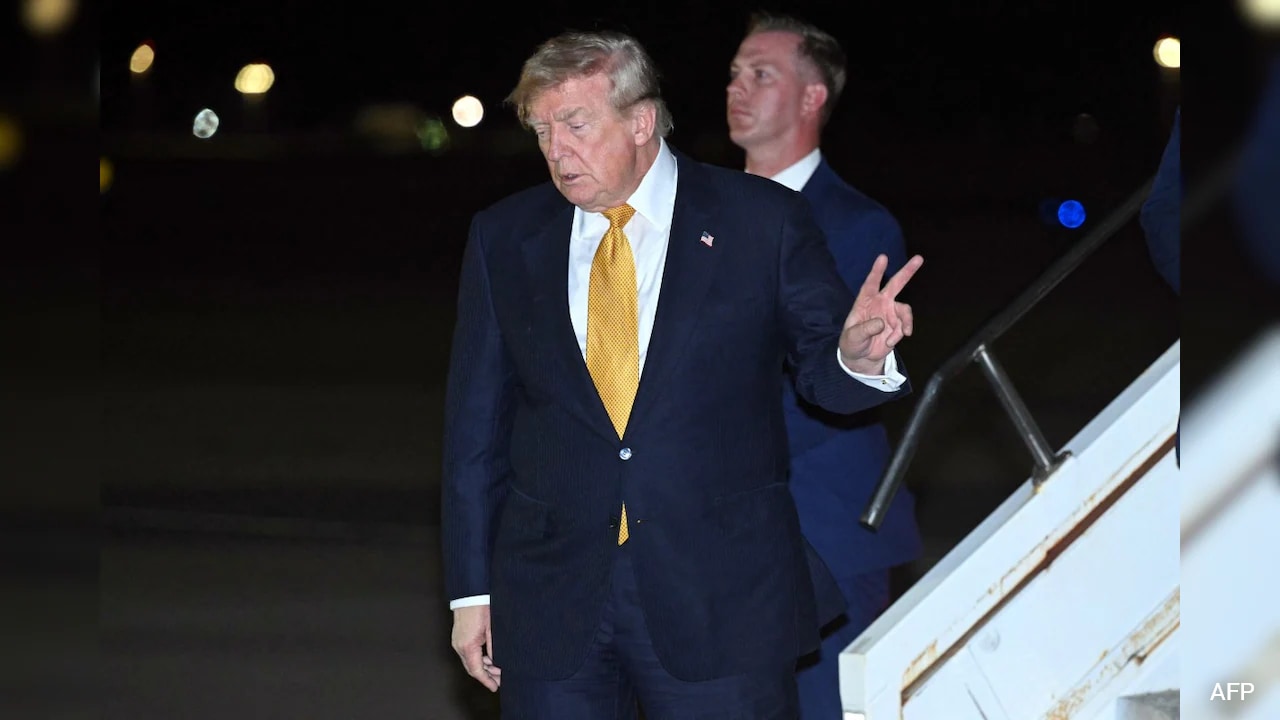
When word traveled from Mar-a-Lago that Donald Trump had issued a stark warning to Tehran, the atmospheric pressure in these rooms shifted instantly. The statement was brief, stripped of diplomatic nuance, and carried the heavy thud of a closed fist on a wooden table. If the attacks from Iranian-backed proxies did not cease immediately, the American bombardment would "get much worse."
Geopolitics often feels like an abstraction—a series of press releases, shifting oil prices, and talking heads on cable news. But geopolitical friction possesses a physical weight. It is measured in the sleepless nights of families stationed at remote desert outposts, the sudden rerouting of commercial oil tankers, and the frantic recalculations of intelligence analysts trying to separate bluster from a genuine blueprint for war.
Consider the reality on the ground at a forward operating base in western Iraq. Let us call it Base Alpha, a hypothetical yet entirely accurate composite of the outposts currently dotting the region. At midnight, the air is cold enough to make your teeth chatter, smelling faintly of diesel fuel and burning waste. A twenty-two-year-old specialist from Ohio stands watch. He wears eighty pounds of ceramic plates and nylon. His world has shrunk to the green-hued glow of a night-vision optic and the heavy silence of the desert.
For him, a headline about a "worsening bombardment" is not a political talking point. It means anticipating the sudden, terrifying whoosh of an incoming one-way attack drone or the deafening crack of a 107mm rocket splintering the concrete barriers outside his barracks. Over the past several years, hundreds of these strikes have targeted American installations across Iraq, Syria, and Jordan. Most are intercepted. Some are not. The shrapnel does not care about foreign policy theories; it only cares about kinetic energy.
The administration’s strategy hinges on a concept as old as conflict itself: deterrence through disproportionate threat. The logic dictates that by projecting an absolute willingness to escalate, you force the adversary to de-escalate.
But deterrence is a fragile psychological game. It requires the opponent to believe not just that you have the capability to inflict pain, but that you possess the reckless resolve to do it. The danger lies in the margin for miscalculation. History is littered with conflicts that nobody actually wanted, ignited because one side misread a bluff or felt backed into a corner where face-saving aggression was the only perceived option left.
The current friction points are not happening in a vacuum. Tehran views its network of regional proxies—the "Axis of Resistance"—as a vital shield. By utilizing groups in Yemen, Lebanon, Syria, and Iraq, Iran projects power and disrupts its adversaries without ever having to fire a missile from its own soil. It is a strategy of plausible deniability, a gray-zone warfare that leaves Washington frustrated. How do you retaliate against a ghost?
Trump’s recent ultimatum attempts to shatter that ambiguity. The message is unambiguous: the United States will no longer distinguish between the puppet and the puppeteer. If a drone launched by a militia in Baghdad injures an American soldier, the response may land directly on an Islamic Revolutionary Guard Corps command node in Iran.
This shift in posture changes the mathematics of survival for everyone involved.
Think of the merchant mariners navigating the Bab el-Mandeb strait. These are ordinary sailors, often from developing nations, working long contracts to send money back to families in Manila or Mumbai. They stand on the bridge of massive container ships, watching the horizon for the telltale wake of an incoming anti-ship ballistic missile. If the conflict escalates as promised, these vital shipping lanes could transform into an active combat zone, choking global trade and sending shockwaves through economies completely detached from the Middle East.
The psychological toll of this waiting game is immense. Uncertainty is a unique kind of poison. It breeds exhaustion. When a superpower signals that the gloves are coming off, the entire region holds its breath, waiting for the other shoe to drop. Will it be a cyberattack that darkens the grids of major cities? A surgical airstrike on a enrichment facility? Or a grinding, multi-front escalation that drags another generation of young Americans into the desert sands?
Back in the command centers, the dry-erase markers continue to squeak against the glass, drawing new lines of flight paths, target packages, and defense perimeters. The facts of the standoff are documented in intelligence briefings and satellite imagery, frozen in time. But the human element remains fluid, unpredictable, and profoundly terrified.
As the sun begins to rise over Base Alpha, the young specialist from Ohio finishes his watch. His muscles ache from the cold and the armor. He climbs down from the tower, unbuckles his helmet, and listens to the quiet roar of the generator. He knows that somewhere far away, leaders are trading words that could change the trajectory of his life before the sun sets again. For now, the desert is quiet. But it is the heavy, suffocating quiet that always precedes a storm.