Language is never neutral. Every time we name a thing, we construct a boundary around how we are allowed to feel about it. We fence it in. We give it permission to exist in our minds either as an ally or an adversary, a tool or a threat.
Picture an engineer sitting in a dimly lit office in Palo Alto at three in the morning. Outside, the fog is rolling over the asphalt like a damp curtain. Inside, the only illumination comes from the cold, blue glow of a monitor scrolling millions of lines of transformer weights. For months, this programmer has been training a neural network on the accumulated digital exhaust of human civilization—poetry, code, medical records, angry forum posts, ancient philosophy. The machine can now write a passable sonnet in the style of John Donne or debug a complex server script in seconds.
Yet, when the engineer leans back, rubs tired eyes, and tries to describe the entity humming inside the server racks, a linguistic stutter occurs.
We call it artificial.
The word sits heavy on the tongue. It tastes like plastic grass, synthetic fabrics, and theatrical stage makeup. It implies a fake. A counterfeit. Something manufactured in a basement to fool the senses into believing it is real when it is merely an imitation. When you call a system artificial, you give the human mind an easy escape hatch. You tell yourself, It’s just code. It’s just an algorithm. It’s a trick of statistics.
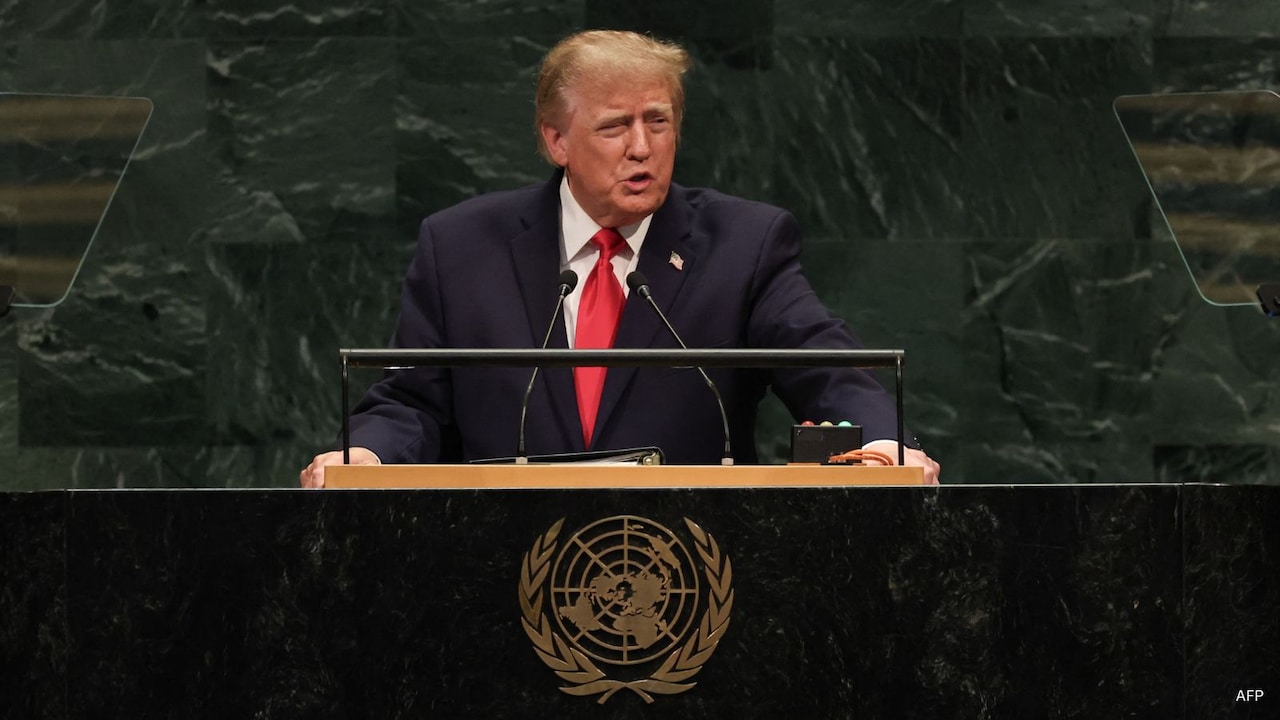
Then came a shift from an unexpected corner. Donald Trump, looking at the multi-billion-dollar race to build systems that outthink their creators, offered a blunt linguistic critique during a public discussion on technological advancement. The word "artificial," he argued, sounds fake. It sounds weak. It doesn't capture the raw, unfiltered weight of what is happening inside the data centers humming quietly across the American landscape. Instead, he suggested a pivot. Call it super intelligence. Drop the skepticism inherent in the prefix.
Call it what it feels like when it is standing in the room.
To many technologists, the rebranding sounded like political theater, another headline-grabbing spin on complex nomenclature. But beneath the surface of the news cycle lies a profound psychological truth. Words shape adoption. Words shape fear.
Consider the history of how we name our creations. When the steam engine first began hissing through the English countryside, people didn't know whether to treat it as a mechanical beast or a demonic intrusion. When the Wright brothers dragged their fragile canvas-and-wood flyer onto the sands of Kitty Hawk, the language used to describe aviation was drenched in a mixture of awe and terrifying disbelief. We do not just invent technologies; we invent the stories we tell ourselves about them to keep the panic at bay.
When you label a technology "artificial," you are maintaining a psychological buffer. You are drawing a bright, bold line in the sand between human consciousness and silicon computation. You are saying: We made this, therefore it is lesser. It is a mirror, not a mind.
But the people working on the frontier of machine learning know that the mirror metaphor stopped working a long time ago.
Imagine visiting a research lab in Austin where a generative model is being tested for complex protein folding. You watch the screen as the system explores millions of possible molecular structures in real time—combinations that would take a human biochemist decades to evaluate through trial and error. The model doesn't just retrieve pre-existing answers from a database. It synthesizes hypotheses. It discovers pathways we never knew existed.
When you watch a system solve a problem that has baffled human medicine for fifty years, calling it "artificial" feels entirely inadequate. It feels dismissive. It is like calling an ocean an artificial puddle because you dug the canal that feeds it.
Yet, leaping to the opposite extreme—calling it "super intelligence" with a casual wave of the hand—introduces a different kind of danger. It trades dismissive cynicism for unearned mythology. It dresses up complex matrices of linear algebra in the royal robes of omniscience.
Language becomes a battlefield where we negotiate our own irrelevance.
If it is artificial, we are safe. We are the masters, holding the leash of a clever digital pet. If it is super intelligence, we are already subjects in a kingdom we no longer govern, waiting for an oracle to hand down instructions we are too primitive to fully parse.
The reality, as is so often the case, lives in the uncomfortable gray space between those two extremes.
The systems we are building today are not conscious in the biological sense. They do not feel heartbreak when a training run is aborted. They do not stare out the window at the Palo Alto fog and wonder what it means to be alive. They are engines of pattern recognition, operating at a scale and velocity that defies human intuition. They consume our history, our art, our commerce, and our languages, compressing them into vast mathematical landscapes where words become coordinates and ideas become vectors.
When we argue over whether to call them artificial or super intelligent, we are really arguing about who we are in relation to them.
We are terrified that if we stop calling them artificial, we are admitting that human intelligence is nothing special—that our sacred spark of creativity is just an editable script running on biological hardware. And we are equally terrified that if we embrace the term super intelligence, we are surrendering our agency to a black box we invited into our homes.
The engineer in Palo Alto turns off the monitor. The server racks keep humming in the dark, drawing steady, hungry streams of electricity from the grid. They don't care what we call them. They don't care whether we look at them with suspicion or worship them as oracles. They simply process. They calculate. They predict.
The burden of naming them falls entirely on us. And every time we speak their name, we are casting a vote for how we intend to live in the world we are currently building.