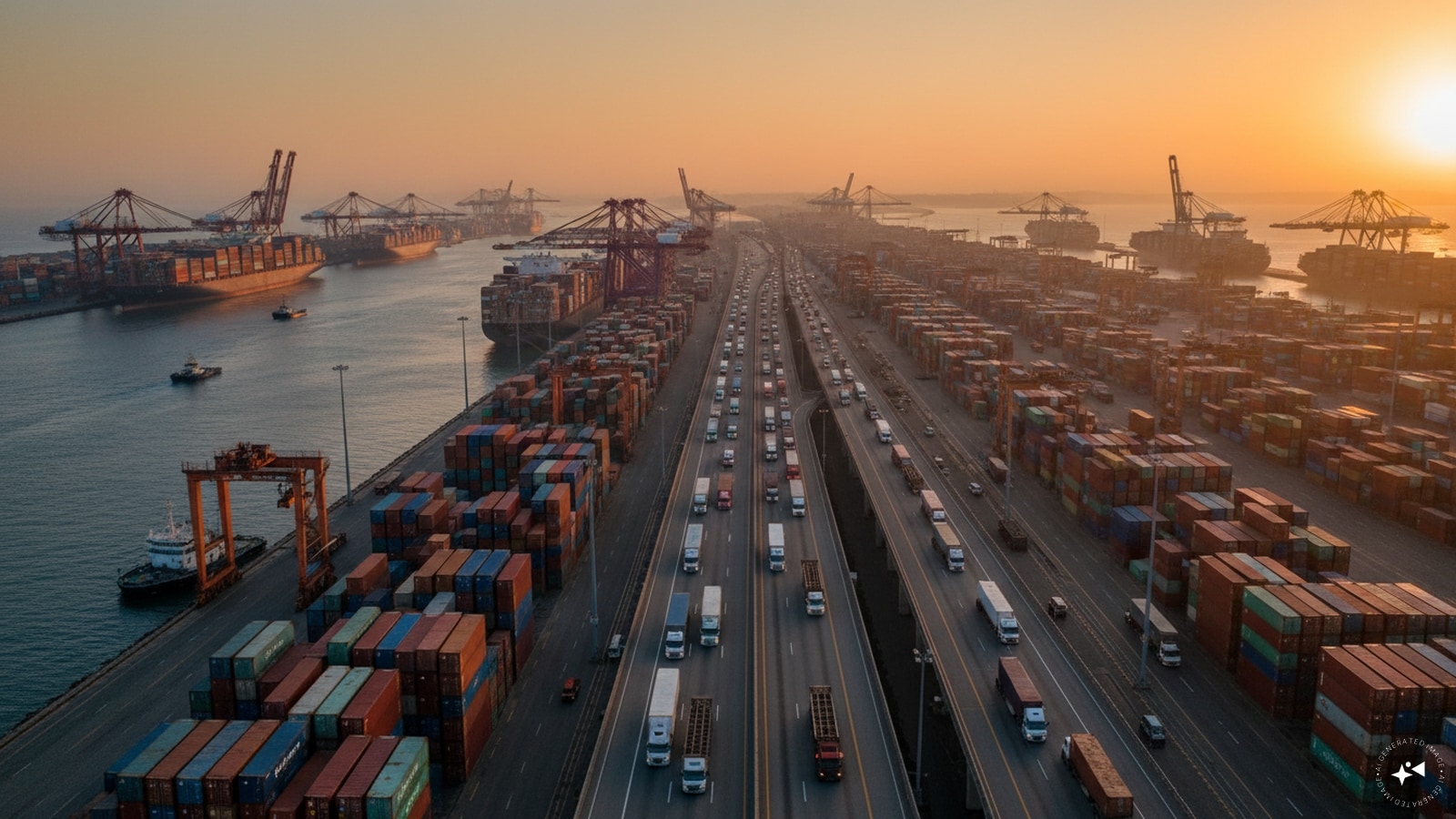
Every time the monthly trade figures drop, the financial press loses its mind. Headlines shriek about a widening deficit, politicians wave warning flags about hollowed-out domestic industries, and pundits dust off fifty-year-old textbooks written when physical cargo ships carrying steel plates were the baseline of global commerce. The panic is predictable. It is also entirely wrong.
When the US trade deficit expands, it is not a sign of economic failure or industrial weakness. It is a sign of unmatched structural dominance. It means the rest of the world wants to sell us tangible goods because they want our dollars, and they want our dollars because our economy is the only game in town worth parking capital in.
Let us clear out the economic debris right from the start. A trade deficit is not a balance sheet loss. It is a capital account surplus wearing a mask that confuses accountants. If I buy a thousand dollars worth of electronics from a manufacturer overseas, I am not poorer by a thousand dollars in net wealth terms. I have a thousand dollars less in cash, but I now own high-end electronics. Meanwhile, the foreign producer holds a thousand US dollars. What do they do with those greenbacks? They do not stuff them into a mattress. They buy US Treasury bonds, invest in American startups, or purchase commercial real estate in Texas. They recycle the capital right back into the most liquid, stable financial ecosystem on earth.
For the past twenty years, I have watched corporate boards panic over supply chain metrics while missing the macro reality staring them in the face. They treat imports as a disease and exports as the cure. That mental model belongs in the nineteenth century.
The Consumption Powerhouse Fallacy
The lazy consensus assumes that a nation should export more than it imports to stay healthy. This mercantilist nonsense was dismantled by Adam Smith and David Ricardo before your grandparents were born, yet it refuses to die because it fits nicely on a cable news graphic.
Think about it this way. If you earn three hundred thousand dollars a year as a surgeon, your personal trade balance with the local grocery store, the car dealership, and the appliance repairman is deeply negative. You buy groceries, cars, and refrigerators from them; they rarely buy anything from you. Are you losing out? Are you economically distressed because your personal trade deficit with the supermarket is massive? Of course not. Your deficit exists because your purchasing power is astronomical. You specialize in high-value surgery, and you trade your surplus income for goods produced elsewhere.
America is the surgeon of the global economy.
When domestic demand surges, consumers and businesses buy more foreign machinery, raw materials, and consumer goods. A widening trade deficit is the natural byproduct of robust domestic growth. Economies in recession do not run massive trade deficits; their imports collapse because nobody has disposable income. If you want to see a trade surplus, look at a nation suffering from weak internal demand and depressed consumer confidence.
Where the Traditional Models Fail
Standard economic commentary treats every import as a localized job loss and every export as a triumph. This ignores global value chains.
Consider an advanced smartphone designed in California, engineered with components sourced from South Korea, Taiwan, and Japan, and assembled in China. When that phone enters a US port, the entire retail value gets logged as an import from China, widening the headline trade deficit. Does that mean American workers got shortchanged? The high-margin intellectual property, the software architecture, the marketing, and the lion's share of the profit margins stayed right here in the United States. The physical assembly is the lowest-margin part of the entire value chain.
Accounting rules trap us in a distorted narrative. We measure the weight of physical cargo containers because they are easy to count, while ignoring the invisible flow of intellectual property, cloud infrastructure, financial services, and media entertainment that America exports to the entire planet in staggering quantities. Services trade surplus? Ignored. Digital export dominance? Minimized.
If you isolate goods trade while pretending that software, patents, and streaming media do not count as exports, you get the panic-inducing deficit numbers that trigger congressional hearings. It is equivalent to judging a tech company's financial health solely by looking at how much printer paper it buys while ignoring its software license revenue.
The Global Dollar Loop
There is a deeper structural engine driving this entire dynamic, and it is the reason why other nations tolerate our perpetual deficits without blinking. It is the exorbitant privilege of the US dollar.
The world needs dollars. Global trade is priced in dollars. Central banks hold reserves in dollars. To get those dollars, foreign nations must export goods and services to the United States. They send us physical merchandise; we send them pieces of paper or digital entries backed by the full faith and credit of the US government. We get the actual goods to consume, build with, and deploy immediately. They get a pristine, risk-free reserve asset that they can use to stabilize their own banking systems.
It is an asymmetrical trade, and it heavily favors the nation consuming the goods. Critics call this living beyond our means. I call it running the ultimate liquidity machine.
Imagine a scenario where the US government panics over the deficit and enacts aggressive tariffs and trade barriers to force a balance. What happens the moment we stop importing? The supply of US dollars to the rest of the world dries up. Foreign central banks scramble for liquidity. Global trade seizes up. Emerging market debt, denominated in dollars, becomes unpayable. The global financial system wobbles on the brink of an abyss because the anchor currency stopped circulating.
A trade deficit is the mechanism by which global liquidity is supplied. When the deficit widens, it means liquidity is expanding, economic activity is humming, and the global engine is turning over.
The Honest Downsides of the Trade Deficit
Any serious economic analysis must acknowledge the friction points. I am not here to paint a picture of frictionless utopia.
Running perpetual trade deficits does create localized economic dislocation. Entire manufacturing towns in the Rust Belt felt the brunt of globalized supply chains over the last few decades. When capital and production migrate toward comparative advantages, human cost follows. Workers whose specific skills are displaced do not magically find high-tech software engineering jobs overnight. That transition is painful, messy, and politically explosive.
Furthermore, relying on foreign capital to finance domestic consumption means we are perpetually dependent on the rest of the world's willingness to hold US assets. If foreign sentiment shifts abruptly, or if alternative financial hubs mature to the point where they can rival US capital markets, the music could theoretically stop.
These are real risks. But the solution is not protectionist wall-building or manufacturing nostalgia. The solution is investing heavily in domestic human capital, education, and advanced infrastructure so that our workforce dominates the next wave of economic value creation—biotech, artificial intelligence, aerospace, and advanced energy—rather than trying to resurrect mid-century assembly lines.
Stop Fighting the Wrong War
Policymakers love trade deficits as a political punching bag because they are simple to understand and easy to blame for complex structural shifts. It is much easier to point at a deficit number and scream about unfair foreign competition than it is to address domestic regulatory burdens, failing educational outcomes, or sluggish productivity growth.
The next time you read a breathless report about the trade gap widening, ask yourself what is actually driving it. If it is driven by domestic business investment in cutting-edge foreign machinery and American consumers flexing their purchasing power, pop open a drink and celebrate. It means the engine is running at full throttle.
Stop treating the scoreboard like it is a penalty box. America does not win by hoarding goods inside our borders. We win by being the destination where the entire world wants to send its best work, in exchange for the currency we print.