Mass evacuations during Mediterranean wildfire events expose systemic vulnerabilities in regional disaster management, municipal infrastructure, and emergency response sequencing. When thousands of residents and tourists are displaced from destinations like Crete, the crisis is rarely a failure of immediate firefighting tactics alone. Instead, it represents a systemic failure of risk modeling, evacuation logistics, and infrastructure capacity under extreme environmental stress.
To understand why recurring seasonal wildfires consistently overwhelm European destination zones, we must deconstruct the event through three analytical lenses: environmental ignition vectors, logistical throughput constraints during evacuation phases, and secondary economic shocks to regional tourism infrastructure.
Environmental Ignition Vectors and Meteorological Amplifiers
The Mediterranean climate basin operates under a predictable yet intensifying stress regime. High summer temperatures, prolonged drought periods, and low relative humidity create a baseline environment where vegetation moisture content drops below critical combustion thresholds.
However, natural fuel dryness is merely the baseline condition. The propagation velocity of fires in complex topography is governed by three interacting environmental variables:
- Topographic Convection: Fires travel uphill exponentially faster than downhill because the slope pre-heats the fuel bed ahead of the fire front via radiative and convective heat transfer. Mountainous terrain, characteristic of Greek islands and peninsulas, accelerates flame fronts through narrow gorges and canyons via localized chimney effects.
- Anemometric Force: High-velocity regional winds, such as the Etesian winds in the Aegean, dictate directional vectors and create spotting phenomena. Emigrating embers can ignite secondary fires kilometers ahead of the primary front, bypassing physical firebreaks and rendering static defense lines obsolete.
- Fuel Load Continuity: Decades of rural depopulation and the reduction of traditional extensive grazing have led to unmanaged forest and shrub biomass accumulation. Continuous tracts of dry scrubland provide an uninterrupted energy corridor for fire progression.
Standard emergency reporting often attributes these crises exclusively to climate anomalies. A rigorous operational analysis reveals that climate change increases the frequency of extreme weather windows, but the structural vulnerability is compounded by inadequate fuel management and a lack of real-time predictive modeling at the municipal level.
The Logistical Bottleneck of Mass Evacuation
Moving thousands of individuals out of a high-risk zone within a compressed operational window stresses standard municipal transport networks past their breaking point. Evacuation infrastructure in high-density tourist regions is typically optimized for seasonal tourist throughput under normal operating conditions, not simultaneous, panic-driven radial egress.
The primary failure mode in these scenarios is network saturation. When coastal or mountainous settlements rely on limited arterial road networks, an influx of evacuating vehicles quickly exceeds road capacity, generating gridlock. Once an evacuation route becomes blocked by congestion or spot fires, the entire egress system fails, trapping populations within the hazard zone.
To quantify evacuation efficiency, emergency planners must evaluate three operational parameters:
- Warning Lead Time: The interval between credible threat detection and the mandatory evacuation order. Insufficient lead time compresses the egress window, turning an orderly movement into a chaotic stampede.
- Modal Diversity: Reliance on a single transit mode—predominantly private automobiles—introduces critical points of failure. Zones lacking integrated maritime or mass bus evacuation plans cannot absorb populations whose primary vehicles are disabled or unavailable.
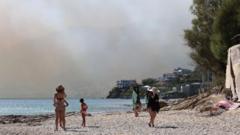
- Destination Capacity: Evacuation requires a designated reception zone with adequate shelter, logistical support, and communication infrastructure. Displacing people to open beaches without logistical support shifts the crisis from a fire hazard to a humanitarian exposure problem, where evacuees face smoke inhalation, dehydration, and radiant heat.
Municipalities frequently fail to implement dynamic zoning protocols. Static evacuation orders often direct populations toward roads that intersect the path of the advancing fire front. Advanced routing requires real-time simulation engines that account for wind shifts and traffic density to dynamically reroute civilian transit.
Cascading Economic and Structural Failures
The immediate human displacement captures public attention, but the secondary economic and operational shocks dictate long-term regional viability. Tourism-dependent economies operate on tight seasonal margins. A catastrophic disruption during peak booking windows triggers immediate revenue contraction and long-term reputational damage.
The economic fallout distributes across distinct operational layers:
- Asset Destruction: Direct physical damage to hospitality infrastructure, agricultural assets, and power grids. Rebuilding these assets under stringent modern environmental and seismic codes requires capital expenditure that exceeds standard municipal budgets.
- Operational Interruption Costs: The immediate cessation of economic activity. Tour operators face massive refund liabilities, repatriation logistics costs, and immediate cancellations for subsequent weeks, wiping out projected annual profit margins.
- Insurance Market Re-pricing: Following repeated loss events, property and casualty insurers reassess risk profiles. Insurance premiums for Mediterranean tourism infrastructure escalate sharply, or coverage is withdrawn entirely, pricing out smaller operators and concentrating market risk.
The systemic risk is compounded by reactive policy responses. Governments frequently rush to subsidize immediate disaster relief without mandating structural modifications to building codes, defensible space regulations, and mandatory early-warning integration.
Strategic Operational Redesign
Mitigating future mass displacement events requires shifting from reactive disaster response to predictive risk engineering. Emergency management frameworks must abandon the assumption that historical weather patterns serve as reliable baselines for future infrastructure design.
Municipalities and regional authorities must decouple evacuation planning from standard civil traffic engineering by adopting military-grade logistics modeling. This involves establishing redundant, hardwired communication channels that do not rely on cellular networks vulnerable to power grid failure during fires. It requires pre-designated, cleared maritime evacuation corridors utilizing commercial and naval assets to bypass choked terrestrial road networks entirely.
Furthermore, zoning laws must enforce mandatory defensible perimeters around all structural assets in high-risk wildland-urban interfaces. Property owners must maintain clearance zones where combustible biomass is strictly managed, interrupting the continuous fuel bed required for high-intensity crown fires to reach inhabited structures.
The ongoing repetition of mass evacuations is not an insurmountable act of nature, but a predictable consequence of misaligned infrastructure and outdated emergency protocols. Transitioning to a resilient operational posture requires rigorous investment in real-time predictive spatial modeling, redundant egress logistics, and uncompromising enforcement of land-use planning standards. Without these structural pivots, seasonal wildfire crises will continue to overwhelm regional capacity with absolute predictability.