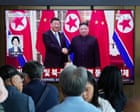
Xi Jinping doesn't travel much anymore. Since the pandemic, the Chinese leader has dramatically cut his international schedule, forcing global leaders like Donald Trump and Vladimir Putin to book flights to Beijing if they want face time.
That makes his sudden arrival in Pyongyang on Monday a massive geopolitical statement.
Xi is kicking off a high-stakes, two-day state visit to North Korea at the explicit invitation of Kim Jong Un. It's Xi's first time crossing the border into North Korea in seven years, and remarkably, his very first trip outside China in 2026. If you want to know how worried Beijing is about its backyard, look no further than this sudden break in Xi's travel routine.
This isn't a courtesy call. It's a calculated chess move designed to check an increasingly reckless Kim Jong Un and reassert Chinese dominance over a peninsula that feels like it's spinning out of control.
The Russian Shadow Pulling Beijing to Pyongyang
To understand why Xi is on a train to Pyongyang, you have to look at Moscow.
Ever since Putin and Kim signed their Comprehensive Strategic Partnership Treaty in 2024—complete with a mutual defense pact—North Korea has been acting like a country that found a new big brother. Kim has shipped millions of artillery shells, missiles, and thousands of troops to aid Russia's war in Ukraine.
In return, Moscow gave Kim a get-out-of-jail-free card at the UN Security Council, effectively deadlocking international sanctions enforcement.
This newfound bromance makes Beijing deeply uncomfortable. While China enjoys watching the US struggle to manage multiple global crises, it absolutely despises regional instability right on its border. A militarily emboldened North Korea, backed by Russian tech and cash, disrupts the balance of power in Northeast Asia.
Worse, it gives Washington the perfect excuse to build up its military presence and strengthen alliances with Japan and South Korea.
Xi’s goal here is simple: rebalance the scales. China is North Korea’s vital economic lifeline, and Beijing wants to remind Kim that while Russia can provide military tech, Moscow can't feed the North Korean population or rebuild its crumbling economy.
What Kim Wants vs What Xi is Willing to Give
Kim Jong Un is entering this summit with unprecedented confidence. He isn't playing the role of the pliant little brother anymore. Just hours before Xi's arrival, Kim's influential sister, Kim Yo-jong, blasted a message to the world: North Korea's nuclear status is "absolutely irreversible" and entirely non-negotiable.
Kim wants three specific things from this meeting:
- Economic Lifelines: North Korea’s economy actually grew by an estimated 3.7% in 2024, thanks to Russian trade and a post-pandemic rebound. But to keep that momentum going, Kim needs China to open the taps.
- Infrastructure Openings: Look for movement on the long-delayed New Yalu River Bridge, a massive project that has sat unused for years despite being completed.
- Tourism and Border Trade: Kim wants Chinese tourists flowing back across the border and joint economic development zones in the border region where China, Russia, and North Korea meet.
But don't expect Xi to just hand over a blank check. Beijing has its own shopping list. China wants navigation rights in the waters off the east coast of the Korean Peninsula and increased access to the Tumen River estuary.
More importantly, Xi wants strategic veto power. By planting his flag in Pyongyang right now, Xi is sending a clear warning to both Washington and Moscow: you can't reshape the security architecture of the Korean Peninsula without China's approval.
The Trump Factor and the Secret Drive for a Summit
The timing of this trip is incredibly deliberate. Just last month, Xi hosted both Donald Trump and Vladimir Putin in Beijing for separate, back-to-back meetings. The White House claimed that Trump and Xi reaffirmed their shared goal of a denuclearized North Korea, though Beijing kept its public comments vague, choosing instead to talk about a "political settlement."
This trip places a potential Trump-Kim summit squarely back on the table before the US midterm elections in November.
Insiders in Seoul are already buzzing about the possibility. Kim knows that Russian weapons deals can only take him so far. To turn North Korea into a genuinely powerful state, he needs western investment and relief from crippling sanctions. For that, he needs a deal with Washington.
By securing China's backing first, Kim gains the security blanket he needs to walk into a room with Trump without looking weak. Xi, meanwhile, gets to play the ultimate puppet master, positioning himself as the only global leader who can actually manage the North Korean nuclear threat.
Real Economic Leverage Trumps Military Bluster
While the headlines focus on missiles and military treaties, the real story here is cash and commodities. Despite Kim's flirtation with Putin, China remains North Korea's indispensable partner. Trade between Beijing and Pyongyang hit $2.79 billion last year, roaring back to pre-pandemic levels.
Passenger trains started running again in March after a six-year pandemic freeze, and Air China flights are finally back in the air. This year also marks the 65th anniversary of the China-North Korea Treaty of Friendship, Cooperation, and Mutual Assistance—notably the only formal defense pact China maintains with any nation on earth.
Kim might be flexing his muscles with Russian help, but his factories run on Chinese oil, and his people rely on Chinese grain. Xi knows this, and he will use that economic leverage to keep Kim from doing anything too reckless, like conducting a fresh nuclear test that would force a massive US military response.
Watch the state media readouts closely over the next 48 hours. If we see concrete agreements on border infrastructure, the opening of the Yalu River bridge, or new resource concessions near the Tumen River, it means Xi successfully bought back his influence. If the statements stay stuck in vague socialist brotherhood platitudes, it means Kim is holding his ground, betting that his alliance with Russia gives him enough leverage to stand up to Beijing.
The immediate next step for regional analysts is monitoring South Korean and US intelligence briefings on Wednesday to see how much tech transfer or economic relief actually changed hands behind closed doors.
N Korea's Kim Jong Un calls for 'exponential' expansion of nuclear arsenal
This video provides essential context on North Korea's recent military escalations and Kim's aggressive nuclear rhetoric leading right up to this high-stakes meeting with Xi Jinping.