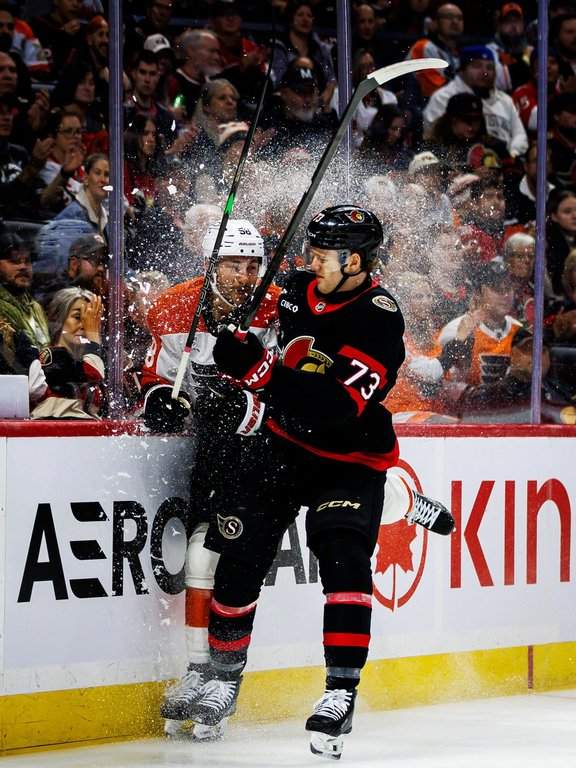
The margins in professional hockey are terrifyingly thin. You spend eighty-two nights running bodies into the boards, blocking frozen vulcanized rubber with your shins, and grinding down the biological clock of your ligaments, all to arrive at a Tuesday night contest where a single defensive breakdown dictates the entire narrative.
When the Ottawa Senators edged the Philadelphia Flyers 2-1, the box score told a tidy, unremarkable story of a tight, low-scoring hockey game. But anyone who stood in the bowels of the arena, smelling the stale sweat and industrial disinfectant after the final horn, knew the scoreline papered over a much more compelling tactical shift. This was not merely a gritty goaltending duel. It was a masterclass in modern defensive activation, headlined by a young blueliner willing to take calculated risks when the rest of the ice was frozen in gridlock. You might also find this similar article insightful: Why Enzo Maresca is Right to Ignore the Noise and Why Everyone Else is Missing the Point.
The Anatomy of a Deadlock
For forty minutes, Philadelphia and Ottawa played a suffocating brand of hockey that relied on neutral zone congestion and methodical board battles. Modern NHL coaching has turned the neutral zone into a digital tollbooth. Every entry requires exact calculations, and the Flyers have built their identity around clogging the red line, forcing dump-ins, and punishing forecheckers.
The Senators struggled early to generate clean zone entries. Their usual east-west eastings were systematically choked off by Philadelphia's active sticks and disciplined gap control. When your primary scorers are denied time and space at the offensive blue line, frustration creeps in. Passes start to force the issue. Sticks tighten. The game threatens to devolve into a stagnant cycle of clearing attempts and icing calls. As discussed in recent reports by Yahoo Sports, the implications are worth noting.
This is precisely where the role of the modern defenseman must evolve. You cannot simply wait for forwards to break a locked structure. You have to break the lock yourself.
Enter the Catalyst
Late in the contest, with the tension thick enough to fracture bone, Artem Zub and the Ottawa coaching staff orchestrated a subtle tactical adjustment. They stopped asking their forwards to beat three men on the rush and began encouraging late-wave secondary pressure from the defense.
That philosophy birthed the game-winning sequence.
When the puck squirted free along the offensive boards, most defensemen in the league are conditioned to pinch defensively, ensuring the puck doesn't leak out for an odd-man rush the other way. It is a conservative, risk-averse mindset drilled into players from the minor leagues onward. But the elite players recognize the fleeting window where structural hesitation turns into an offensive breakthrough.
By aggressively stepping down the wall rather than retreating to the blue line, the Ottawa attack completely scrambled Philadelphia’s rotational coverage. The ensuing chaotic scramble left the defensive zone seam exposed. The puck arrived on the tape, and the finish was clinical. It was a sequence born of spatial awareness and the courage to abandon structural safety for a fraction of a second.
Why Philadelphia Keeps Coming Up Short
The Flyers deserved credit for their defensive structure over two periods, yet this 2-1 defeat highlights a recurring ceiling for their current roster construction. They defend hard. They block shots. They make life miserable for opponents in the dirty areas of the ice.
However, defensive grit without dynamic transition play is a treadmill. You can skate furiously for sixty minutes, absorb immense physical punishment, and still find yourself on the losing end because you lack the offensive creativity from the back end to punish an overshifted penalty kill or a disorganized breakout.
Philadelphia’s defensive corps tends to play reactive hockey. They wait for the opponent to make a mistake rather than forcing the issue through aggressive gaps and calculated pinches. Against an Ottawa side that was also playing a conservative road style, that hesitation proved fatal. If you give a talented young blue line an inch of operating room in the offensive zone, they will eventually find a way to make you pay.
The Evolution of the Modern Blueliner
The NHL has entered an era where traditional defensive defensemen are becoming relics of a bygone era. You cannot survive on clearing the front of the net and chipping pucks off the glass anymore. The game moves too fast, and structural systems are too well-coached to be beaten by simple cycle work alone.
Success now demands defensemen who can read the geometry of the entire sheet in real-time. They must act as fourth forwards when the offensive zone breaks down, identifying coverage breakdowns before the opposing bench can even register the threat.
Ottawa's ability to manufacture that winning goal out of nothing is proof that player development is shifting toward high-IQ risk tolerance. Coaches are finally realizing that you cannot win consistently by playing not to lose. You have to force the opponent's defensive shell to make a panicked choice under duress.
The horn sounds, the skaters head down the runway toward the showers, and the ice is scraped clean for the next game. But the tactical lesson from this tight contest remains for any team trying to break through a suffocating trap. Safety is a myth in a league this fast. Sometimes, the only way to survive is to skate directly into the chaos and dare the defense to stop you.