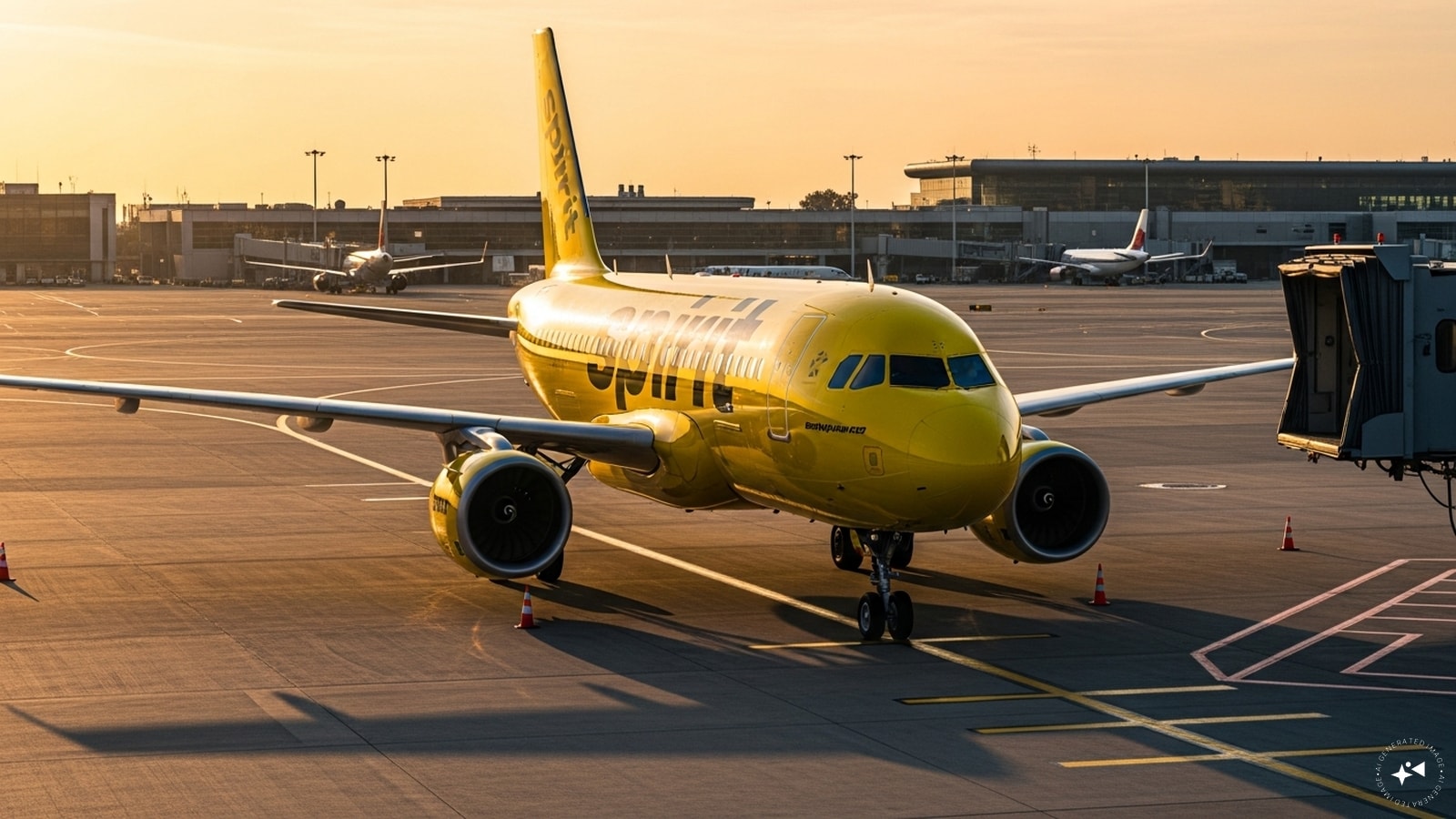
The cabin smell is a distinct cocktail of upholstery cleaner and anticipation. For millions of travelers, that bright yellow fuselage wasn't just a plane; it was a ticket out of a life that couldn't afford the luxury of a legacy carrier. But today, the silence in the boardroom at Spirit Airlines headquarters is heavier than any engine roar. The clock isn't just ticking; it’s screaming.
Spirit Airlines is staring into an abyss. This isn't just another bad quarter or a seasonal dip in ticket sales. It is a fundamental collapse of the math that kept the "Ultra Low-Cost Carrier" model airborne for decades. As the federal government remains silent on the prospect of a bailout, the airline is reportedly preparing for a bankruptcy filing that could see the yellow planes grounded for good.
The Math of the Common Man
Consider a hypothetical traveler named Elias. He’s a middle school teacher in Detroit who hasn't seen his mother in Florida for three years. He doesn't care about free Biscoff cookies or extra legroom. He cares about the $69 fare. For Elias, Spirit wasn't a punchline for a late-night talk show host; it was his bridge to family.
When Spirit fails, Elias loses more than a flight. He loses the ability to participate in a world that is increasingly priced for the upper middle class.
The core of the problem lies in a brutal pincer movement. On one side, Spirit’s operating costs have skyrocketed. Fuel, labor, and maintenance are no longer cheap. On the other side, the "Big Three"—Delta, United, and American—have figured out how to fight back. They introduced basic economy seats, essentially colonizing the low-cost territory while offering a more reliable network. Spirit found itself squeezed. It was too big to be a niche player and too small to survive a price war with the titans.
The numbers are haunting. Since the pandemic, Spirit has struggled to find a path back to profitability. While the rest of the industry saw a surge in "revenge travel" that padded bottom lines, Spirit was plagued by engine issues that grounded dozens of its Airbus A320neo jets. Imagine owning a fleet of taxis but being told you can't drive half of them because the engines might fail. Now, imagine you still have to pay the drivers and the bank.
The Ghost of the JetBlue Merger
There was a moment when the story had a different ending. JetBlue wanted Spirit. They were willing to pay $3.8 billion to create a national challenger that could actually compete with the legacy giants. It was a lifeline.
Then came the regulators.
In a move intended to protect competition, the Department of Justice sued to block the merger. They argued that if Spirit disappeared, the "Spirit Effect"—the way other airlines lower their prices when Spirit enters a market—would vanish. The court agreed. The merger died on the vine.
The irony is thick enough to choke on. By "protecting" the low-cost carrier from being bought, the government may have inadvertently guaranteed its total extinction. Without the JetBlue capital, Spirit was left standing alone in a hurricane with a broken umbrella. Now, the very competition the DOJ sought to preserve is on the verge of evaporating because the smallest player simply cannot pay its bills.
The Invisible Stakes of a Shutdown
What happens if the yellow birds stop flying?
It starts with the employees. We’re talking about thousands of pilots, flight attendants, and ground crew who have spent years navigating the high-stress environment of budget travel. These aren't just names on a payroll; they are people with mortgages and tuition payments. In a liquidation scenario, that institutional knowledge and those livelihoods vanish overnight.
But the ripple effect goes deeper.
Spirit pioneered the point-to-point model in secondary markets. They flew routes that the big guys ignored because the margins were too thin. When Spirit exits a city like Myrtle Beach or Latrobe, the vacuum left behind isn't always filled. The local economy takes a hit. Small airports that relied on Spirit’s landing fees suddenly find themselves in the red.
Then there is the psychological cost. For thirty years, we lived in an era of the democratization of flight. We moved from the "Golden Age" of aviation—which was really just an age where only the wealthy could fly—to an age where a college student could fly home for a weekend on a whim. If Spirit goes under, we are effectively signaling the end of that era. We are returning to a world where the sky belongs to those with a corporate credit card.
The Bailout Dilemma
The word "bailout" is radioactive in Washington. After the 2008 financial crisis and the 2020 CARES Act, the American public has little appetite for cutting checks to corporations. But the aviation industry is different. It is infrastructure.
If the government steps in, they are accused of rewarding poor management. If they stay out, they watch a vital piece of the American transportation network crumble. It is a political lose-lose.
The reality of Spirit’s situation is that time has run out. They are currently in talks with bondholders to restructure their massive debt, but those creditors aren't charities. They want to see a viable path forward. Without a government guarantee or a sudden, miraculous surge in cash flow, the path leads to a Chapter 11 filing. At best, it’s a reorganization. At worst, it’s a total liquidation.
The View from 30,000 Feet
I remember a flight from Baltimore to Orlando three years ago. The plane was loud, the seats didn't recline, and I had to pay $5 for a bottle of water. But the woman sitting next to me was crying. I asked if she was okay. She told me her daughter was giving birth to her first grandchild, and without a $40 Spirit ticket, she wouldn't have been able to be there.
That is what is at stake.
We can talk about debt-to-equity ratios and Pratt & Whitney engine failures all day. We can analyze the antitrust implications of blocked mergers until the sun goes down. But the heart of the matter is that a piece of the American dream—the freedom of movement regardless of income—is on life support.
The yellow plane sits on the tarmac, the sun glinting off its wings. The pilots are in the cockpit, the flight attendants are at the doors, and the passengers are waiting at the gate with their backpacks tucked under their arms. Everyone is waiting for a signal that may never come.
If the engines don't start this time, it won't just be a company that dies. It will be the end of the idea that the sky is for everyone.


