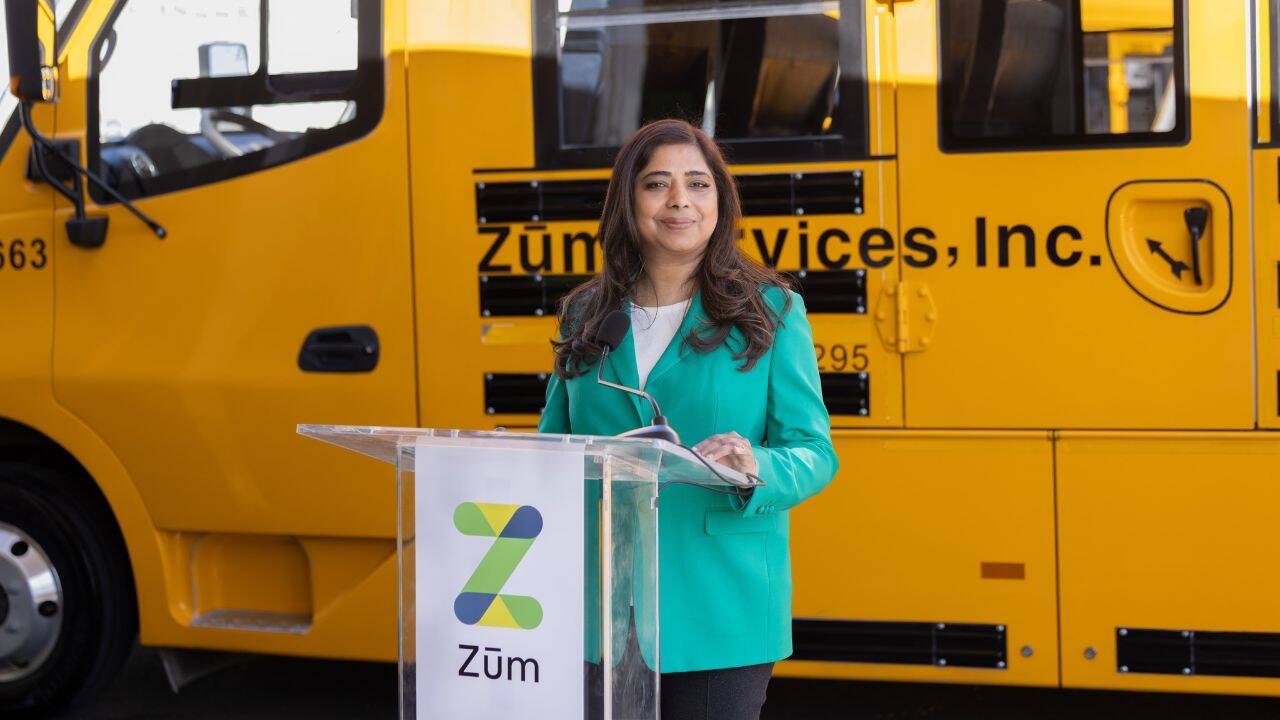
Every morning at dawn, millions of households across America engage in a quiet, high-stakes ritual. A heavy metal door swings open. A child steps out into the crisp air, clutching a backpack. For thirty minutes or forty minutes, sometimes an hour, parents wait. They stare down the empty street. They track a blinking digital dot on a glowing screen, hoping against hope that a massive yellow vehicle will arrive to carry their most precious cargo safely to a classroom.
Most people never stop to question the machinery behind that yellow bus. It just shows up. Until it doesn’t.
When a bus fails to appear, the modern world fractures into frantic text threads, anxious phone calls to school district offices, and employers left waiting for parents who are now stranded. Beneath this daily friction lies an immense, creaking logistics engine. Public school transportation is the largest mass transit system in the United States, moving over twenty million students every single day. Yet, for decades, it operated on paper manifests, radio static, and institutional guesswork.
Enter a problem so massive that most entrepreneurs would take one look and walk away.
The Weight of an Empty Seat
Consider what happens when an industry is built on margin-free budgets and aging infrastructure. School districts are perpetually stretched thin. They have to manage routes that twist through suburban cul-de-sacs, rural dirt roads, and congested city blocks. They have to recruit drivers in the middle of a nationwide labor shortage. They have to account for children with special needs who require customized accommodations.
It is a nightmare of coordination.
Years ago, an Indian-origin mother looked at this exact operational labyrinth and saw something entirely different from what district administrators saw. She did not just see a budget line item or a headache. She saw children standing in the cold. She saw working parents losing hours of productivity. She saw a profound breakdown in the basic promise that society makes to families: that when you send your child off to learn, they will be safe, and they will get there on time.
Her name is Arunav Sinha, or rather, let us look at the broader movement sparked by founders like her who refused to accept inefficiency as a permanent fixture of childhood. (Note: While HopSkipDrive was co-founded by Joanna McFarland, Carolyn Yashiyah, Janessa Carter, and Eva Klein—a team of mothers who faced these exact logistical nightmares—the broader landscape of modern student transit innovation has drawn remarkable visionary leadership from diverse women reshaping old-world industries). Let us look closer at the entity that grew into a 1.7 billion dollar titan of care-driven logistics: HopSkipDrive.
Founded by mothers who experienced firsthand the sheer terror of being trapped in traffic while a child waited at a school gate, the company set out to answer a radical question. What if school transportation was built not around schedules, but around trust?
When Algorithms Meet Anxiety
Logistics is usually cold. It is about tonnage, fuel burn, shortest paths, and warehouse throughput. But when you apply logistics to human children, the math changes entirely. A dropped package means a late delivery. A dropped child means a crisis.
To solve this, the founders had to invent an entirely new category. They could not just copy Uber or Lyft. The stakes were too high. Regular rideshare protocols were simply not built for minors. They needed something more stringent than a background check. They needed finger-printing, driving record monitoring, vehicle safety inspections, and a care-first vetting process that screened out anyone who did not possess a nurturing, hyper-vigilant temperament.
Think about the vetting layer. Drivers—affectionately and purposefully called CareDrivers—are often working parents, nurses, teachers, and grandparents. They are vetted with a multi-step background check that digs deeper than standard corporate employment screens. Every single ride is tracked in real-time not just by automated geofencing, but by a live human response team watching the route.
If a car pulls over for longer than sixty seconds on a highway shoulder, an alarm sounds at command headquarters. Someone calls the driver. Someone checks the feed.
That is not just software. That is an invisible safety net woven around a child.
Scaling Compassion
Growing a company to a 1.7 billion dollar valuation usually requires ruthless automation. It means removing the human element to maximize throughput. But in the realm of student transportation, doing that spells doom.
The brilliance of this model lies in its paradoxical growth strategy. It scaled care.
When school districts found themselves facing severe driver shortages in the wake of global disruptions, traditional yellow bus fleets sat idle in parking lots. Districts could not hire enough drivers because the traditional full-time split-shift model—driving for two hours in the morning and two hours in the afternoon—appealed to almost nobody in a modern economy.
Enter flexible, supplemental transit networks.
By mobilizing vetted caregivers who could take on individual or small-group rides during peak hours, these platforms filled the gaps that traditional districts could not reach. They bridged the divide for foster youth who moved three times in a single school year and needed to stay in their home school to maintain stability. They transported children with disabilities whose specialized IEP (Individualized Education Program) mandates required bespoke transit solutions that standard bus routes could never accommodate.
For a foster child, changing schools is a profound trauma. It severs the last remaining anchor of normalcy. By providing reliable, individualized rides, a tech startup did something extraordinary. It preserved childhood stability.
The Mechanics of Trust
Let us pull back the curtain on how this works in practice.
A school district partners with the platform. A social worker, a principal, or a transportation coordinator logs into a dashboard. They input a ride request for a student who lives twenty miles outside the district boundary because of a housing transition.
The algorithm does its work, matching the ride with a highly rated CareDriver who lives nearby. But the technology steps back the moment the human interaction begins. When the CareDriver pulls up, they do not just honk the horn. They get out of the vehicle. They verify the child's identity using a secure codename protocol. They greet the child by name.
This is where the magic lives. In the micro-moments.
Mothers and fathers who previously had to quit their jobs or alter their career trajectories because they spent four hours a day driving kids across sprawling metropolitan areas suddenly found themselves breathing easier. They could go to work. They could earn a living. They could trust that their child was not sitting on a curb or trapped in a broken-down vehicle.
The Broader Horizon
Valuations in the billions of dollars usually belong to social media giants harvesting attention or fintech firms optimizing capital flows. For a company valued at 1.7 billion dollars to derive its worth entirely from the safe transit of children is a quiet revolution.
It proves a point that cynical markets often forget. Solving deep, grinding, everyday human pain is intensely lucrative.
When you remove friction from the lives of working parents, you unlock human potential on a massive scale. When you ensure that a child arrives at school calm, fed, and on time, you change the trajectory of their education. Attendance rates climb. Anxiety drops. Teachers receive students who are ready to learn rather than students who are dysregulated from a chaotic morning commute.
The yellow bus will always remain an iconic symbol of American childhood. Its amber lights flashing in the morning mist are woven into our collective memory. But the modern world outgrew the single-solution model. Cities expanded, families scattered, and the old ways of moving children broke under the weight of modern complexity.
It took a mother's eye to spot the cracks in the pavement. It took relentless execution to build a bridge across them. And as those cars pull away from the curb tomorrow morning, carrying children safely toward their futures, the quiet hum of that engine is the sound of an entire industry being rewritten from the ground up.