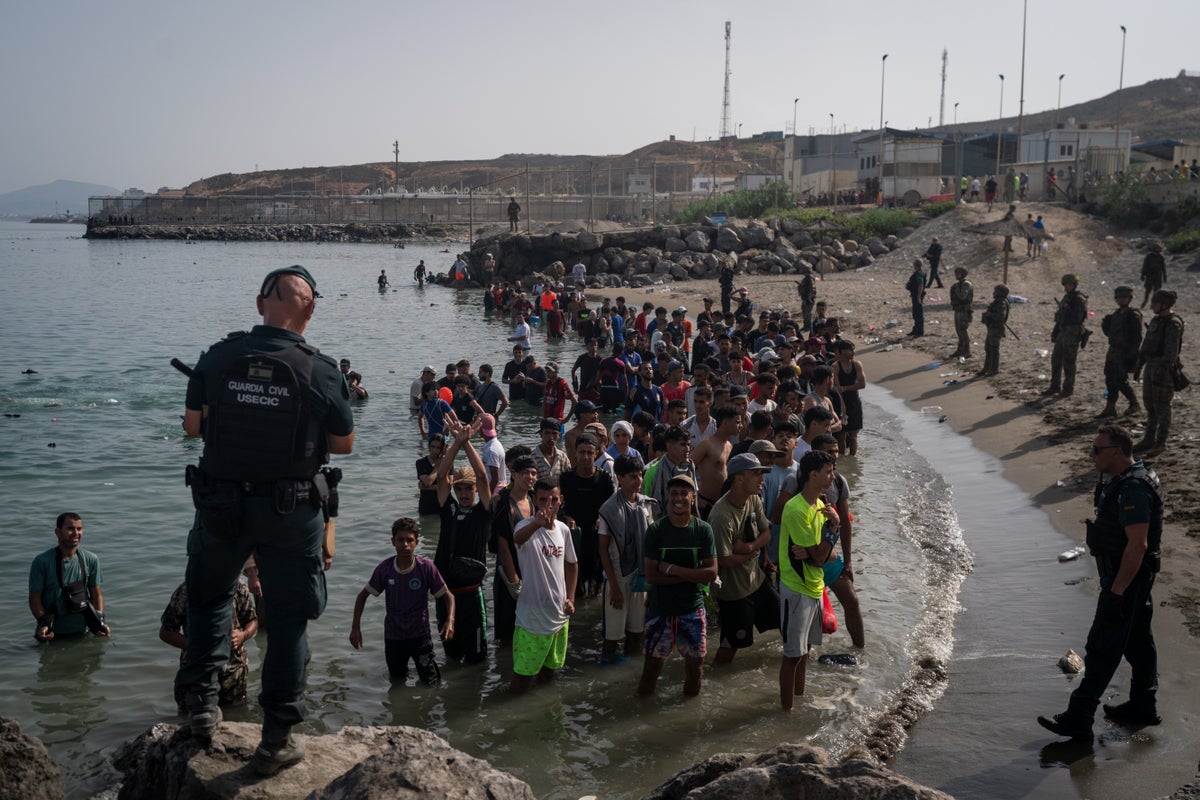
Mass cross-border migration events are rarely random anomalies; they operate as acute stress tests on bilateral security architecture, state intelligence apparatuses, and legal frameworks. The sudden movement of approximately eighty thousand individuals from Morocco into the Spanish autonomous enclave of Ceuta laid bare the systemic fragilities governing Mediterranean border management. Evaluating this crisis requires stripping away political rhetoric to examine the exact mechanics of institutional failure, structural pull factors, and the cost function of border enforcement.
The Three Drivers of Influx Acceleration
Unprecedented population surges do not materialize overnight without the convergence of specific operational catalysts. The Ceuta crisis demonstrated how physical barriers can be bypassed when administrative and informational channels fail simultaneously.
- Informational Asymmetry and Viral Propagation: Digital platforms served as coordination nodes, distributing localized legal updates and operational routing guides across North Africa. When a Spanish court ruling clarified procedural safeguards for sea arrivals, the information was distorted via social networks into a broad misinterpretation that physical entry guaranteed legal permanence. This lowered the perceived cost of transit.
- Enforcement Vacuum Mechanics: Border integrity relies on continuous deterrence. Intelligence reports indicated a temporary reduction in active Moroccan border patrols near Fnideq, effectively lowering the barrier to entry to zero. When security cordons are lifted or instructed to stand down, structural intent translates immediately into physical action.
- Geopolitical Friction Points: Bilateral migration control depends on state-level cooperation. Disruptions or shifts in diplomatic alignment between Madrid, Rabat, and Algiers routinely manifest as tactical adjustments in border surveillance intensity, creating predictable windows of vulnerability.
The Cost Function of Jurisdictional Friction
The geopolitical reality of Ceuta and Melilla creates a unique structural dilemma for the European Union's migration architecture. These territories represent the only land borders shared between the European continent and Africa, turning them into high-intensity flashpoints where local municipal capacities are instantly overwhelmed by macro-level demographic pressures.
When eighty thousand people arrive in a municipality with a baseline population of roughly eighty-five thousand, the municipal service threshold is breached within hours.
- Infrastructure Saturation: Reception facilities designed to handle hundreds of individuals are forced to absorb tens of thousands, leading to immediate public health risks, resource scarcity, and outdoor encampments.
- Legal Bottlenecks: State authorities face competing mandates between humanitarian obligations, international asylum laws, and domestic security pressures. The friction between rapid repatriation and mandatory due process creates operational paralysis.
- Mortality Metrics: The physical architecture of breakwaters, sea walls, and crowded border zones generates catastrophic physical risks. Official records confirming nearly one hundred fatalities underscore the high human cost of sudden crowd surges against reinforced maritime barriers.
Systemic Failures in Intelligence and Deterrence
Traditional border security models assume a steady-state flow where intelligence agencies can anticipate shifts weeks or months in advance. The Ceuta incident exposed the limitations of reactive security postures.
The rapid reversal of the crowd—where tens of thousands voluntarily recrossed into Morocco within days due to severe supply shortages and harsh conditions—proves that secondary deterrence mechanisms often rely on post-arrival friction rather than initial border prevention. However, relying on harsh post-entry environments as a deterrent mechanism introduces acute humanitarian liabilities and invites intense international scrutiny.
Strategic Adjustments for Cross-Border Resilience
Mitigating future systemic shocks requires shifting from perimeter-defense models to integrated operational frameworks that combine real-time digital monitoring with proactive diplomatic stabilization. Border enforcement agencies must decouple physical security infrastructure from external diplomatic volatility by institutionalizing joint patrol protocols that remain insulated from bilateral political disputes.
State authorities must establish rapid digital counter-messaging capabilities to neutralize viral misinterpretations of legal frameworks before they translate into physical mobilization events. Without preemptive operational adjustments, border enclaves will continue to function as volatile pressure valves for regional demographic stress.