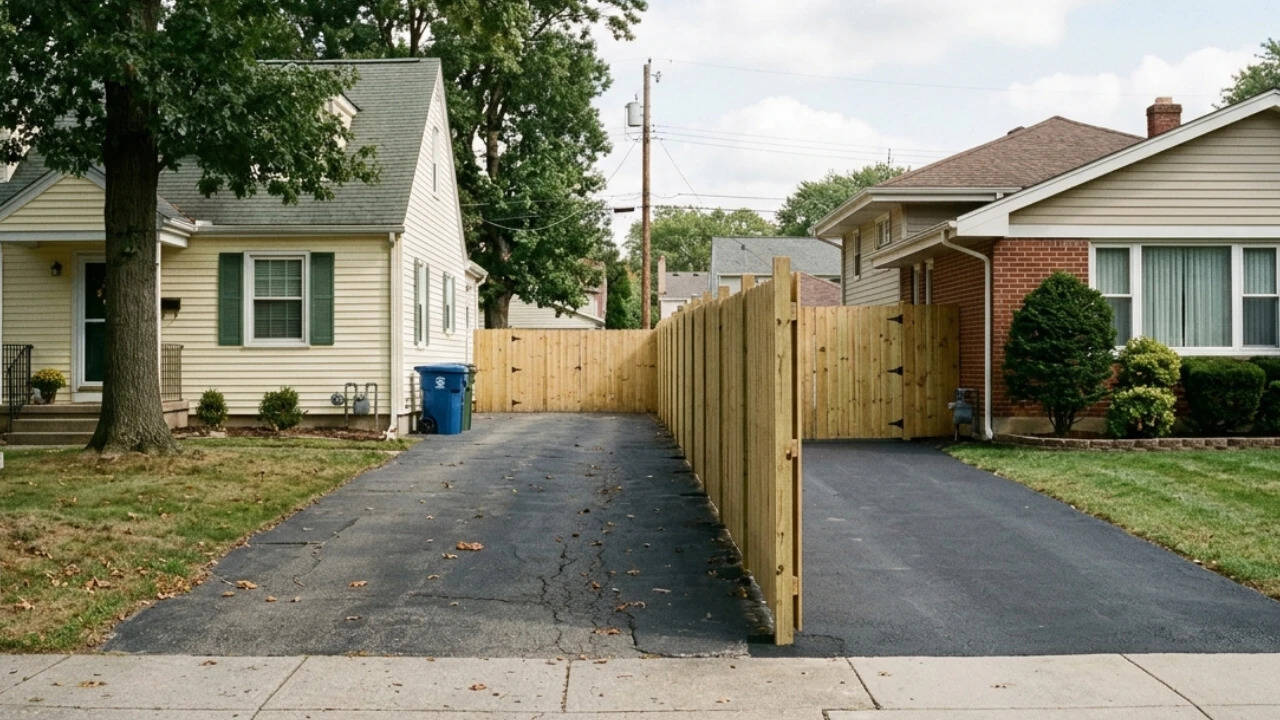
Two inches of asphalt.
That is the exact margin where a human being’s sovereignty ends and the cold, unblinking machinery of municipal bureaucracy begins, a boundary line so thin you could cover it with the sole of a muddy work boot, yet thick enough to swallow three years of a family’s savings and half their sanity.
Consider the strange, bifurcated reality of owning a piece of the American dirt today. On paper, you hold the deed. You pay the county assessor every autumn when the leaves turn the color of dried blood and the wind sweeps down from the Cumberland Plateau. You mow the grass, you patch the roof when the spring storms peel back the shingles, and you tell yourself, in the quiet hours before dawn, that this modest rectangle of earth belongs to you. Then you decide to build a fence. Or you try to pull your pickup truck into your own driveway without scraping the undercarriage on a concrete curb the city suddenly decided was sacred.
That is when you learn the difference between owning land and asking permission to live on it.
Recently, a Tennessee family found themselves standing right in the crosshairs of this exact legal contradiction. After a bruising, protracted court battle against their local municipality, the judges handed down a split decision that reads like a parable for the modern homeowner. The family won the right to access their own driveway. They lost the lawsuit over their fence permit.
Win the road. Lose the wall.
If you read the standard municipal court blotters, the story looks like dry gravel. A zoning board denied a variance; a public works department cited a right-of-way obstruction; a circuit judge parsed the fine print of local ordinances and split the baby down the middle. Most people scroll right past headlines like that because the language of municipal law is deliberately engineered to induce sleep. Words like easement, setback, curb cut, and administrative exhaustion act like novocaine on the public imagination.
I know that novocaine well. Four years ago, I stood in a fluorescent-lit city hall basement holding a rolled-up survey map that had cost me $1,800, trying to explain to a twenty-six-year-old code enforcement officer why a six-foot cedar privacy fence on the back corner of my lot was not, in fact, a threat to public safety. My hands were shaking slightly—not from anger, though there was plenty of that, but from the dizzying realization that the person across the counter held absolute veto power over my daily life, and he didn't even have to look up from his dual monitors to exercise it. The smell of burnt breakroom coffee and damp paper still triggers a low-grade spike in my blood pressure. When you fight City Hall over dirt and timber, you aren't fighting a villain. You are fighting a filing cabinet.
The Anatomy of a Split Victory
To understand why a Tennessee court would grant a family the right to drive onto their property while simultaneously affirming the city’s power to dictate the fence around it, you have to understand how American property law actually works beneath the romantic myth of the frontier.
We like to quote the old English common law maxim that a man’s home is his castle. It sounds magnificent. It conjures images of drawbridges, stone battlements, and absolute dominion.
The legal reality is much less poetic. In law school, professors explain property rights not as a castle, but as a "bundle of sticks." One stick is the right to sell the land. Another is the right to exclude trespassers. Another is the right to build structures, and yet another is the right of ingress and egress—the basic, physical ability to get from a public road onto your private lot.
When a municipality regulates your property, it doesn't take the whole bundle. It pulls out one stick at a time.
In the Tennessee dispute, the city tried to pull out two sticks at once. First came the driveway—the right of access. Under centuries of established precedent, stretching back long before the first Model T rattled down a dirt pike in Nashville or Knoxville, the right of ingress and egress is treated as nearly sacred. If you own land that abuts a public street, the government cannot casually sever your physical connection to that street without compensating you, because land without access is functionally a prison. You cannot reach it; you cannot sell it; you cannot live on it. When a city blocks a driveway or refuses a reasonable curb cut, it isn't merely regulating aesthetics. It is effectively confiscating the utility of the land. That is why the Tennessee family won on the driveway. Courts across the South, and indeed across the country, recognize that starving a parcel of access crosses the line from polite regulation into an unconstitutional taking.
The fence, however, is a completely different stick.
In the eyes of the judiciary, a fence is not a necessity of access; it is a structure subject to the "police power" of the state. That phrase—police power—always alarms people who haven't spent time reading zoning statutes, because it sounds like SWAT teams and sirens. In municipal law, it simply means the inherent authority of a local government to enact rules protecting public health, safety, morals, and general welfare.
Does a six-foot wooden fence threaten public health? Probably not. Does it obstruct a driver’s line of sight at an intersection? Maybe. Does it encroach three inches into a utility easement where the water department might need to dig up a cast-iron main in 2034? Possibly. Does it violate a neighborhood overlay district passed by a city council in 1998 to preserve "visual continuity"? Almost certainly.
And here is the trap that catches thousands of homeowners every year: when a citizen challenges a city over a permit denial, the court does not ask whether the city’s rule is smart, fair, or neighborly. The court asks whether the city’s decision was "arbitrary and capricious."
Think about how high that bar is. For a homeowner to win a permit lawsuit, they essentially have to prove that the city acted with zero rational basis—that the bureaucrats threw darts at a board or denied the permit out of pure personal malice. If the city attorney can stand before a judge and articulate any plausible connection between that fence rule and public safety, drainage, utility access, or traffic visibility, the city wins. Every single time.
The Invisible Weight of the Permit Desk
Let us step away from the courtroom for a moment and walk onto the actual grass.
Imagine a hypothetical couple—let’s call them Marcus and Elena—living on a quiet corner lot in a mid-sized Tennessee town that has doubled in population over the last fifteen years. When they bought their brick ranch house, the street outside was sleepy. Now, thanks to a new mixed-use development half a mile down the road, commuters use their street as a cut-through every morning between seven and nine.
Marcus and Elena have a four-year-old daughter and an aging golden retriever. Every time the toddler chases a ball toward the edge of the yard, Elena feels her stomach drop into her shoes as a delivery van barrels past at forty miles an hour.
So they decide to put up a fence.
They aren't trying to build a fortress. They aren't trying to spite their neighbors. They hire a local contractor, pick out pressure-treated pine, and go down to the municipal codes office to do things the right way. That decision—to follow the rules rather than beg forgiveness later—is where their education begins.
First, they learn their lot has a front-yard setback of thirty feet. Because they live on a corner lot, the city classifies both street-facing sides as "front yards." Suddenly, half of their usable yard is legally off-limits to any fence taller than forty-two inches—a height that their golden retriever can clear from a standing start without breathing hard.
Then they apply for a variance. They pay a non-refundable filing fee of $350. They take a Tuesday afternoon off work to attend a Board of Zoning Appeals meeting, sitting in folding chairs behind a developer asking for a tax abatement on a forty-million-dollar apartment complex. When their turn comes, they get three minutes at a podium. A board member who has never seen their street asks if the fence will block sightlines. Marcus tries to explain that the fence will sit fifteen feet back from the curb, well behind the utility pole that already blocks far more view than cedar pickets ever could. The board votes 4–1 to deny the variance, citing "precedent."
If Marcus and Elena build the fence anyway, the city fines them $50 a day. If they sue the city, they are looking at $15,000 to $40,000 in legal fees just to reach a circuit court hearing, fighting an opponent whose legal team is funded by Marcus and Elena’s own property taxes.
That is the invisible asymmetry at the heart of every municipal property dispute. You pay for your lawyer out of your grocery and college fund. The city pays for its lawyer out of the municipal treasury—which you helped fill.
Why Cities Guard the Line So Fiercely
It is tempting to paint local officials as petty tyrants drunk on minor authority, and occasionally, you will meet a code inspector who treats a tape measure like a scepter. More often, though, the rigidity comes from something far more structural and deeply rooted in how American cities are built and financed.
Look at the history of municipal zoning in the United States. Before 1926, when the U.S. Supreme Court decided Village of Euclid v. Ambler Realty Co., cities were chaotic tapestries of tanneries next to boarding houses and slaughterhouses upwind from schools. Zoning was born out of a genuine, desperate need to separate incompatible uses and keep cities livable.
Over the last century, however, that blunt instrument evolved into a razor-fine scalpel. Modern municipal codes don't just keep factories away from elementary schools; they dictate the pitch of your roof, the species of grass in your swale, the width of your driveway apron, and the exact height of your fence.
Why? Because modern cities are terrified of liability and precedent.
If a city grants one family a variance to build a six-foot fence in a corner-lot setback, and six months later a teenager runs a stop sign at that intersection and t-bones a minivan, the personal injury lawyers will name the municipality as a co-defendant before the glass is swept off the asphalt. They will argue the city knowingly permitted a visual obstruction. Cities know this. Their risk management insurers remind them of it every quarter.
Similarly, public works departments view the right-of-way—that strip of grass between the sidewalk and the street, or the first ten feet inside your front property line—not as your lawn, but as an underground highway for fiber-optic cables, storm sewers, gas lines, and water mains. When you sink postholes into that zone and pour concrete footings, you are effectively driving stakes through the roof of the city's infrastructure corridor.
None of that makes it sting any less when you are the homeowner holding a denied permit. Understanding why a machine is heavy doesn't stop it from crushing your foot.
The Strange Irony of Driveway Access vs. Enclosure
Look again at that Tennessee ruling, because the contrast between what the family won and what they lost reveals the exact fault line in modern American life.
The court protected their movement, and restricted their sanctuary.
Think about what that says about the hierarchy of values embedded in our legal system. A driveway is an instrument of commerce and transit. It connects the private parcel to the public grid. It allows you to leave your house, drive to work, buy goods, pay sales tax, and participate in the economic circulatory system of the town. The law fiercely guards your right to get in and out.
A fence, by contrast, is an instrument of separation. It draws a line and says, Here the public world stops, and my private world begins. It is about quiet, containment, safety for children, and visual solitude. And in the dense, interconnected, hyper-regulated environment of twenty-first-century municipalities, separation is the one thing the state views with deepest suspicion.
I remember the day I finally gave up on my own cedar fence battle. After two rejections and a sternly worded letter from the city attorney's office explaining the finer points of municipal easement law, I stood in my backyard with a posthole digger leaning against the garage wall. I ended up moving the fence line inward by eleven feet, sacrificing nearly four hundred square feet of my own yard to satisfy a drainage easement that hasn't held a drop of standing water since the Carter administration.
I got my fence. My dog stayed in the yard. My kids played safely on the grass.
Yet every time I walk past that fence line, I look at those eleven feet of mowed grass sitting outside the gate—land I paid for, land I fertilize, land I am taxed on every November—and I feel a quiet, permanent friction. It is the friction of realizing that sovereignty in a modern town is always conditional. You can drive onto your land whenever you please, because the law guarantees your passage. Just don't expect to build a wall without asking the clerk at window three to stamp your paperwork first.