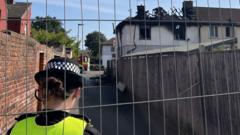
Every time smoke clears from a fatal residential fire, the media playbook opens to the exact same page. A tragedy happens, emergency services pull two bodies from a charred home in Middlesbrough, a murder probe launches, and the public receives a comforting, albeit intellectually bankrupt, narrative. We get the standard hand-wringing about smoke alarms, the routine police appeals, and the hollow safety warnings telling homeowners to check their outlets. It is a predictable cycle designed to process grief through a bureaucratic lens while ignoring the structural failures staring us in the face.
Stop accepting the official script. The lazy consensus surrounding residential fire investigations treats every fatal blaze as either an unforeseeable act of malicious violence or a sudden failure of personal vigilance. That binary is a convenient fiction. It absolves municipal regulators, landlords, and urban planners of their direct culpability, shifting the burden entirely onto the victims or an isolated criminal suspect. When two people die behind closed doors, the automatic rush to label it a murder probe or a tragic accident masks a much more uncomfortable systemic reality.
The Flawed Mechanics of Residential Fire Investigations
For decades, investigators have relied on heuristics that crumble under actual scientific scrutiny. The moment a structure fire turns fatal, the immediate instinct of emergency responders is to secure a crime scene. While preserving evidence is mandatory, the premature narrowing of scope kills objective inquiry.
Let us look at how fire behavior is actually analyzed versus how it is reported.
- The Flashover Fallacy: Investigators routinely point to rapid fire spread as evidence of accelerants or extreme negligence. In modern housing stock filled with synthetic polymers, polyurethane foams, and engineered wood products, a room reaches flashover in under three minutes. That is not a criminal signature; that is the chemistry of modern interior design meeting substandard construction materials.
- The Smoke Alarm Myth: Public service announcements treat smoke detectors as silver bullets. A detector does not save a life; it buys seconds. If structural egress is compromised, windows are barred with security grilles, or occupants have mobility impairments, an early warning alarm is merely an audio accompaniment to a tragedy.
- The Criminalization of Decay: Pinning a fatal fire on a homicide investigation often serves to close the loop on complex socio-economic failures. When properties lack modern electrical retrofits, have degraded insulation, or feature jerry-rigged heating units due to poverty, the resulting fire is a symptom of systemic neglect, not just a standalone criminal act.
I have spent years analyzing municipal infrastructure reports and forensic response logs. I have seen investigators gloss over decades of deferred maintenance by municipal landlords because finding a suspect or blaming a faulty toaster is infinitely easier than indicting a city's housing policy.
Dismantling the Middlesbrough Narrative Trap
When headlines focus exclusively on the gruesome details of a double fatality and the ensuing police tape, they commit a category error. They treat a public safety crisis as a localized crime story.
Consider the questions people actually ask when a house fire claims lives: Were the smoke alarms working? Who was last seen entering the property? Could this have been prevented with better local fire safety campaigns?
Every single one of those questions is structurally flawed. They accept the premise that individual behavior or isolated criminal intent is the primary variable in residential fire survival. That perspective is entirely wrong.
The real variables are structural integrity, thermal insulation toxicity, and emergency response times in marginalized neighborhoods. If a home is built with materials that emit hydrogen cyanide and carbon monoxide within seconds of ignition, no amount of individual vigilance will prevent asphyxiation. If emergency services are starved of funding and take twelve minutes to arrive instead of four, the outcome is determined long before the first fire engine rolls down the street.
Focusing on a murder probe in these scenarios often functions as a smoke screen. It personalizes a systemic failure. It gives the public a villain to hate—whether that villain is an alleged perpetrator or the victims themselves for supposedly lacking fire safety awareness—while the municipal authorities who signed off on unsafe housing codes walk away scot-free.
Unconventional Principles for Real Fire Safety Reform
If we want to stop reading the exact same tragic headline next month, we have to abandon the comforting illusions fed to us by official press releases. Real protection requires an aggressive, counter-intuitive shift in how we approach residential risk.
First, stop relying on consumer-grade panic products. Handheld fire extinguishers and cheap battery-operated alarms give homeowners a dangerous psychological placebo. Instead, mandate passive structural fire barriers in all rental properties—not just luxury builds. If a wall cannot withstand high-heat impingement for at least thirty minutes without catastrophic structural failure, the property is unlivable by design.
Second, overhaul forensic protocols. Independent structural engineers, completely divorced from municipal police departments, should automatically review every fatal residential fire to assess material toxicity and building code enforcement history. When a house becomes a tinderbox, the architect and the building inspector share the burden of proof alongside anyone who struck a match.
The next time a headline breaks about a fatal house fire and a sudden criminal probe, look past the police tape. The real crime is not just whatever happened inside that room; it is the societal agreement to call a systemic failure an accident.