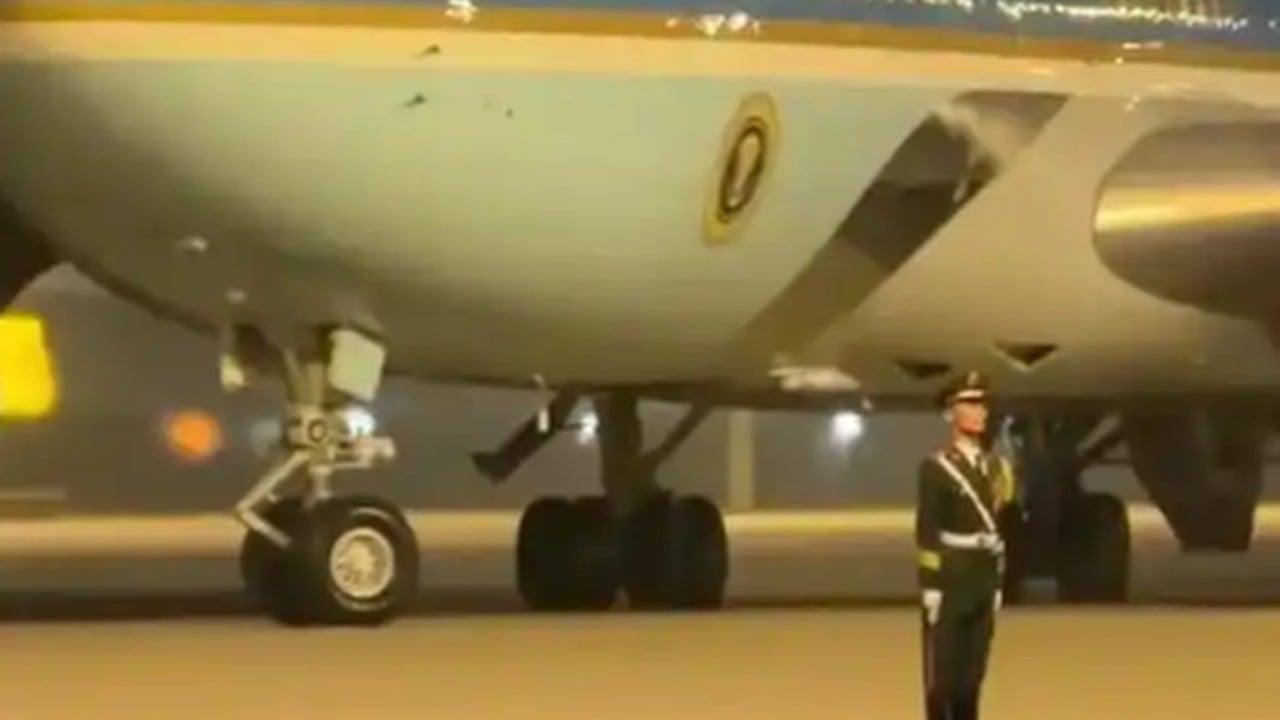
You see them on television or standing outside state welcoming ceremonies, moving like steel parts of a single machine. Every arm swings at the exact same angle. Every boot strikes the concrete with the exact same thud. It looks artificial, almost digital, but it is entirely human.
The people behind this flawless display are the members of China’s elite ceremonial forces, including the People's Liberation Army (PLA) honour guards and the Beijing Armed Police Corps. When the US presidential aircraft, Air Force One, taxied into Beijing recently, 23-year-old guard Liu Zhencheng stood just 15 meters from the roaring jet engines. The blistering heatwave from the turbines slammed into his back, and the sound threatened to blow out his eardrums. He did not blink. He did not shift his weight. He kept his eyes locked at a 45-degree angle toward the national flag.
That level of precision is not born out of basic military drills. It comes from a training regimen that pushes human anatomy and mental endurance to a breaking point.
The Brutal Physics of the Perfect Stride
To understand how these soldiers function, you have to look at the numbers behind the movement. In a standard military parade, these soldiers must march at a constant tempo of exactly 116 steps per minute.
Every single step must measure precisely 75 centimeters. If one soldier kicks 74 centimeters and another kicks 76, the visual illusion of the "walking Great Wall" instantly shatters. Instructors on the training field use physical measuring tapes to check the height of each soldier’s leg during straight-leg march training.
To build the sheer explosive power needed to drive these steps forward hour after hour, soldiers bind heavy sandbags around their lower legs during daily practice sessions. They also hang water bottles from their arms to build muscular endurance, ensuring that their arm swings remain swift, sharp, and uniform even when lactic acid build-up makes their limbs feel like lead.
Posture Training via Playing Cards and Water Glasses
Achieving a straight back and a perfectly leveled head requires tools that look more like a cruel balancing act than military gear.
During multi-hour training blocks, instructors place half a cup of water directly on top of each soldier’s head. At the same time, they slide a playing card under the chin. If the soldier drops their chin even a fraction of an inch, the card falls. If they tilt their head, the water spills.
This forces the body into an hyper-extended, rigid posture until muscle memory takes over. When you see a row of 18 soldiers from the side, their alignment is so perfect that they appear as a single individual.
Three Hours Standing Still is Only the Baseline
Most people find it difficult to stand completely still for ten minutes without fidgeting, shifting their feet, or scratching an itch. The entry-level requirement for China's honour guards is the ability to stand absolutely motionless for at least three hours.
But three hours is just the standard baseline. In real-world deployment and extreme conditions, some guards have been reported to stand firm and still in a single position for up to 16 hours. They must maintain this rigid bearing through choking dust, biting sub-zero winter temperatures, and summer heatwaves that melt the asphalt beneath their boots.
They are trained specifically not to blink when strong winds hit their eyes, and to completely tune out chaotic external noises, whether it is a screaming jet engine or a sudden security distraction.
The Staggering Physical Toll
The human body pays a heavy price for this level of perfection. On average, a qualified guard walks roughly 8,000 kilometers in training every single year.
- Footwear destruction: A soldier will completely wear out seven pairs of specialized boots annually.
- Dehydration risks: The physical exertion is so high that half a day of training routinely leaves their thick ceremonial uniforms completely soaked through with sweat.
The physical selection process eliminates almost everyone before training even begins. For male soldiers, the height requirement is strictly locked between 1.88 and 1.92 meters. Female soldiers must hit an average height of 1.73 meters, yet they are expected to match the exact stride length and marching speed of their taller male counterparts.
Applying the Discipline of Precision
You probably do not need to stand still for three hours with a glass of water balanced on your head, but the philosophy behind this grueling preparation applies to any high-stakes environment. The core lesson from the parade ground is simple: to perform flawlessly under pressure, your baseline training must be significantly harder than the actual event.
If you want to build that kind of unwavering focus in your own high-pressure work, start by eliminating the minor habits that degrade your concentration. Force yourself to complete single tasks without shifting focus or checking your phone for chunks of uninterrupted time. True discipline is built through repetition, strict standards, and refusing to cut corners when no one is watching.