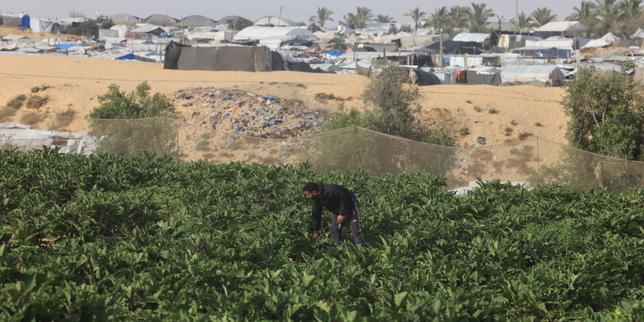
The collapse of agricultural productivity in the Gaza Strip represents a near-total destruction of a localized food production system. When satellite imagery indicates that only 4% of agricultural land remains intact, the crisis extends far beyond the immediate loss of standing crops. It signifies the systemic dismantling of the capital assets, biological inputs, and logistical infrastructure required to sustain life. Evaluating this breakdown requires looking past superficial observations of destruction to analyze the precise mechanisms of supply chain severance, soil degradation, and the compounding feedback loops that prevent recovery.
Understanding this crisis requires analyzing the agricultural production function. Agricultural output is not merely a product of land; it is the result of a coordinated application of capital, technology, and biological inputs to a specific geographic footprint.
The Three Pillars of Agrarian Collapse
The degradation of Gaza's agricultural capacity occurs across three distinct, interdependent vectors. The failure of any single vector halts production; the simultaneous collapse of all three ensures long-term systemic inertia.
1. Primary Input Starvation
Modern agriculture relies on a continuous, just-in-time influx of external inputs. Gaza's hyper-intensive farming models, designed to maximize yield within a highly restricted geographic footprint, are uniquely vulnerable to import disruptions.
- Genetic Material (Seeds and Seedlings): The complete halt of certified seed imports disrupts the crop rotation cycle. Farmers cannot save seeds from previous hybrid harvests without facing exponential drops in yield and disease resistance.
- Chemical Inputs (Fertilizers and Pesticides): Intensive cultivation depletes soil macronutrients (Nitrogen, Phosphorus, Potassium) rapidly. Without synthetic replenishment, the fundamental chemistry of the soil fails to support plant development.
- Biocides and Disinfectants: The absence of soil fumigants and agricultural disinfectants triggers an immediate surge in localized pathogens, rendering greenhouses and open fields vectors for plant disease rather than food production.
2. Infrastructure Demolition
The physical geometry of Gazan farming—characterized by dense greenhouse networks, pressurized irrigation, and mechanical water extraction—has been structurally compromised.
- The Irrigation Bottleneck: Agriculture in arid environments is entirely dependent on groundwater extraction. The destruction of solar arrays, diesel generators, and electric pumps permanently cuts off the water supply to surviving fields. Even if crops escape physical destruction, they succumb to hydration stress within days.
- Asset Liquidation: The destruction of tractors, plastic greenhouse sheeting, and cold-storage facilities removes the fixed capital necessary to resume operations. This creates a structural deficit that cannot be resolved by merely importing seeds.
3. Soil Compaction and Topsoil Alteration
The movement of heavy tracked vehicles and the detonation of high explosives alter the physical and chemical composition of the soil.
- Mechanical Compaction: Heavy armor crushes soil structure, destroying macro-pores essential for air and water infiltration. This creates an impermeable layer that prevents root penetration and drastically increases surface runoff, leading to severe erosion during rains.
- Chemical Contamination: Detonations introduce heavy metals and particulate matter into the agricultural substrate, altering soil pH and potentially entering the food chain through bioaccumulation if any crops manage to reach maturity.
The Cost Function of Agricultural Failure
To quantify the economic and caloric reality of a 96% reduction in intact agricultural land, we must examine the localized cost function of food production. In a functioning economy, scarcity drives prices up, which incentivizes increased production. In a total blockade and destruction scenario, the cost function becomes infinite because critical inputs cannot be acquired at any price.
The loss of agricultural land shifts the entire population from a state of partial self-sufficiency to total dependence on external humanitarian logistics. This creates a severe logistical bottleneck.
[External Aid Inflow] -> [Border Bottlenecks] -> [Internal Distribution Failure] -> [Caloric Deficit]
When local production drops to near zero, the volume of external aid required to prevent starvation increases exponentially. However, the infrastructure to distribute this aid inside the territory scales down at the same time due to fuel shortages and damaged roadways. The result is a compounding caloric deficit that cannot be mitigated by financial capital or market forces.
Operational Mechanics of Soil and Hydrological Degradation
The long-term barrier to recovery is the alteration of Gaza’s underlying hydrology. The coastal aquifer, which serves as the primary water source for irrigation, has long suffered from over-extraction and saltwater intrusion from the Mediterranean.
The current destruction accelerates this degradation through a specific mechanical sequence:
- Unpumped Wells and Well Destruction: The physical destruction of water wells leads to localized collapse of the borehole infrastructure, contaminating the immediate aquifer layer with silt and debris.
- Untreated Wastewater Infiltration: The breakdown of centralized wastewater treatment plants forces raw sewage into open wadis and low-lying agricultural zones. While sewage contains organic matter, untreated effluent introduces pathogenic bacteria, heavy metals, and high salinity levels that poison the soil microbiota.
- Loss of Topsoil Micro-Ecosystems: Soil is not inert dirt; it is a living ecosystem of mycorrhizal fungi, bacteria, and earthworms that convert nutrients into bio-available forms. The combination of desiccation (drying out due to lack of irrigation), chemical contamination, and physical churning by military hardware sterilizes this biological layer.
Without this microbiota, even if fertilizers are reintroduced later, the soil’s nutrient-holding capacity remains severely compromised.
Institutional Barriers to Reconstruction
Reestablishing agricultural viability requires addressing the institutional and regulatory framework governing imports into the territory. Historically, dual-use restrictions have severely limited the import of chemical fertilizers (specifically ammonium nitrate and potassium-based compounds) due to their potential application in explosives manufacturing.
A strategic assessment of reconstruction indicates that conventional agricultural recovery is impossible under historical regulatory frameworks. If fertilizers, plastic piping for drip irrigation, and water pumps continue to face strict dual-use prohibitions, the remaining 4% of agricultural land will inevitably decline in productivity due to nutrient exhaustion.
Furthermore, the destruction of land registries and physical boundaries creates an immediate legal bottleneck. Landmines, unexploded ordnance (UXO), and physical debris mean that before a single seed can be planted, an intensive, capital-heavy demining and clearance operation must occur. The timeline for UXO clearance in dense agricultural zones historically spans years, meaning the land will remain economically sterile long after active hostilities cease.
The Strategic Path forward: Decentralized High-Efficiency Interventions
Given the structural realities of total soil degradation, infrastructure loss, and strict import controls, traditional horizontal agriculture cannot be revived in the medium term. Attempting to rebuild the previous agricultural model is a failure of strategic design.
The optimal intervention requires a shift toward decentralized, closed-loop, hyper-efficient production modalities that bypass the ruined soil and rely on minimal dual-use inputs.
Phase 1: Micro-Hydroponics and Vertical Subsystems
To decouple food production from corrupted soil and large-scale water infrastructure, recovery efforts must deploy modular, vertical farming units at the household or neighborhood level. These systems require 90% less water than traditional agriculture and utilize inert growth mediums (such as coco coir or perlite) rather than open soil. This eliminates the need for large-scale land remediation and prevents aquifer contamination.
Phase 2: Solar-Powered Micro-Desalination Cooperatives
Centralized water networks are highly vulnerable targets. The strategic alternative is the deployment of localized, small-scale brackish water desalination units powered entirely by dedicated off-grid solar arrays. These units must be calibrated to treat high-salinity groundwater specifically for agricultural use, circumventing both the destroyed electrical grid and the damaged centralized water lines.
Phase 3: Biosecurity and Organic Input Localisation
Since synthetic chemical inputs face insurmountable import hurdles, strategic priority must shift toward creating localized organic fertilizer loops. This involves constructing enclosed, biosecure composting facilities that process organic municipal waste into safe agricultural inputs, reducing dependence on external chemical supply chains.
The current state of agriculture in the Gaza Strip is not a temporary disruption that can be solved by delivering seeds. It is a complete structural erasure of ecological and economic capacity. Recovery requires treating the territory not as a damaged farming zone, but as a completely sterilized environment requiring advanced, self-contained engineering solutions to produce the first calorie.