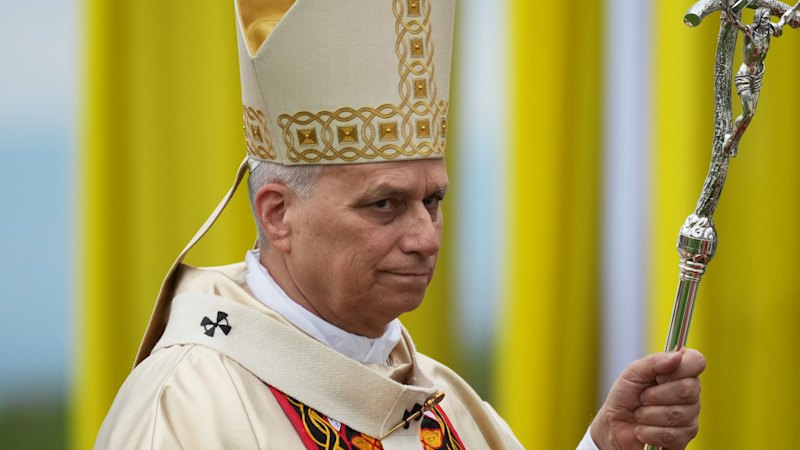
The tension between religious authority and secular nationalism is not a clash of personalities, but a structural collision between two competing systems of legitimacy. When the Vatican critiques the "manipulation" of the divine to justify war, it is identifying a specific strategic maneuver: the conversion of theological capital into political mobilization. This friction points to a systemic breakdown in the separation of powers between the moral and the state, where the state seeks to absorb the moral high ground to lower the domestic political cost of international aggression.
The Tripartite Framework of Religious Instrumentalization
The use of religious rhetoric in modern conflict functions through three distinct mechanisms. Understanding these mechanisms is required to differentiate between genuine faith-based policy and the tactical co-opting of religious identity.
- Identity Consolidation: This occurs when a leader defines the national interest through the lens of a specific faith group. By framing the state as the protector of a "divine mandate," the leadership transforms political dissent into a form of heresy. This lowers the threshold for authoritarian measures under the guise of protecting the sacred.
- Moral Arbitrage: War is resource-heavy and carries a high ethical burden. Moral arbitrage is the process of using religious justification to offset the psychological and social costs of violence. If a conflict is framed as a "crusade" or a "holy defense," the state bypasses the traditional ethical scrutiny applied to secular geopolitical moves.
- Theological Erosion: This is the "manipulation" cited by the Papacy. It involves stripping a religion of its universalist ethics and replacing them with exclusionary, nationalist imperatives. The deity is no longer a universal moral compass but a partisan ally in a zero-sum game.
The Cost-Benefit Analysis of the Papal Intervention
The Pope’s public criticism of political figures who utilize God as a shield for war creates a specific set of risks and rewards for both the Church and the State. This is not merely a verbal spat; it is a battle for the control of the "Narrative Monopoly."
The Church’s primary asset is its Moral Authority Index. When a political leader successfully aligns their agenda with the Church’s symbols, they effectively "borrow" that index to boost their own legitimacy. The Pope’s counter-maneuver is a "De-leveraging Event." By explicitly disavowing the politician's use of faith, the Pope forces the politician to rely solely on secular, often more fragile, justifications for their actions.
This creates a Legitimacy Deficit. For a populist leader, the loss of religious backing can alienate a core voter base that views the Church—not the leader—as the ultimate arbiter of truth. However, the risk for the Church lies in the potential for a "Schismatic Feedback Loop," where the political leader encourages their followers to prioritize national identity over global religious adherence, potentially leading to a domestic splintering of the faith.
The Structural Architecture of the Church-State Conflict
The current friction is centered on the definition of "just war." Traditionally, Catholic social teaching relies on the Jus ad bellum framework, which requires:
- Just Cause: Confronting a real and certain danger.
- Competent Authority: Only those with the responsibility for the common good can declare war.
- Comparative Justice: The injustice suffered by one party must significantly outweigh that suffered by the other.
- Right Intention: The war must be for the purpose of seeking peace.
Modern populist rhetoric often skips these granular tests in favor of "Existential Signaling." In this model, the mere existence of an "other" or a perceived threat to "traditional values" is cited as a sufficient trigger for aggressive policy. The Pope’s critique targets this intellectual shortcut. He argues that by invoking God to bypass these rigorous moral hurdles, leaders are committing "theological malpractice."
Operationalizing Peace in a Polarized Environment
The Vatican’s strategy has shifted from quiet diplomacy to overt "Disruption." In previous decades, the Holy See often worked behind the scenes to influence state actors. The move toward public, sharp rebukes suggests a calculation that the "Cost of Silence" has become too high.
The "Cost of Silence" is calculated by the rate at which extremist interpretations of faith are adopted by the mainstream. If the Vatican does not provide a counter-narrative, the radicalized version of the faith becomes the de facto standard for the population. This creates a "Brand Dilution" for the universal Church. To maintain its global position, the Papacy must aggressively protect the "Purity of its Moral Product."
The Conflict Bottleneck: Secularism vs. Theocratic Populism
The primary bottleneck in resolving this tension is the rise of "Theocratic Populism." Unlike traditional theocracy, where the clergy holds power, Theocratic Populism involves secular leaders using religious aesthetics to secure absolute authority. This creates a hybrid system that is resistant to traditional diplomatic pressure.
In a traditional secular state, you can appeal to international law. In a traditional theocracy, you can appeal to scripture. In a Theocratic Populist state, the leader claims to be the only true interpreter of both. This creates an Information Monoculture. The Pope’s intervention serves as a "External Audit" on this system, introducing a conflicting source of truth that the leader cannot easily silence without appearing anti-religious.
The Divergence of Transnational and National Interests
The Catholic Church functions as a transnational corporation of moral values. Its interests are inherently global and diversified. A national leader’s interests are inherently localized and concentrated.
- Vatican Interest: Maintaining a global network that can operate in diverse political environments. This requires a "Neutrality Buffer."
- Nationalist Interest: Maximizing domestic power by creating "Conflict Highs" that unify the population against an external or internal enemy.
These two interests are mathematically opposed. Every time a national leader succeeds in "Nationalizing" the faith, the Vatican loses a piece of its global neutrality. The "Tyrants" mentioned by the Pope are those who attempt to force a global institution into a narrow, nationalist box.
The Strategic Recommendation for Non-State Observers
The correct analytical approach for observing this conflict is to ignore the "personal feud" narrative and focus on the Institutional Defense Mechanisms. The Pope is defending the boundaries of his institution. The political leader is attempting to expand the boundaries of theirs.
Stakeholders should monitor the following indicators to gauge the trajectory of this friction:
- Synodal Feedback: Watch for how local bishops respond to the Pope’s statements. If local clergy align with the national leader over the Pope, the "De-leveraging" strategy is failing.
- Rhetorical Pivot: If the political leader begins to attack the Pope’s "competence" or "political bias," they are attempting to move the argument from the theological plane to the secular plane, where they have a home-field advantage.
- Legislative Tethering: Observe if religious rhetoric is being codified into law. When faith-based justifications move from speeches to statutes, the "Manipulation of God" becomes a permanent structural feature of the state, making it far harder to dismantle.
The ultimate play in this environment is not to seek a "winner," but to identify which system of legitimacy—the universal-moral or the national-populist—will command the loyalty of the underlying population in the next decade. The current data suggests a trend toward "Moral Fragmentation," where individuals select the version of faith that best fits their pre-existing political identity, effectively rendering the institutional Pope a "Competitor" in a crowded market of moral truths. To counteract this, the Church must pivot from defending its hierarchy to reinforcing its core ethical frameworks in a way that is "Nationalist-Proof."