The smell of a rehabilitation clinic never leaves your nose. It is a sharp, clinical cocktail of rubbing alcohol, warm silicone liners, and the faint, metallic tang of sweat drying on aluminum struts.
If you have ever sat in the fluorescent purgatory of a physical therapy ward, you know the silence that hangs there between appointments. It is not a peaceful silence. It is heavy. It is the sound of twenty-something men and women staring at the space where a calf muscle used to be, trying to calculate how many flights of stairs stand between them and their front doors. When the sirens stop and the frontline news cycles move on to the next border dispute, that room is what remains of war. If you found value in this piece, you should check out: this related article.
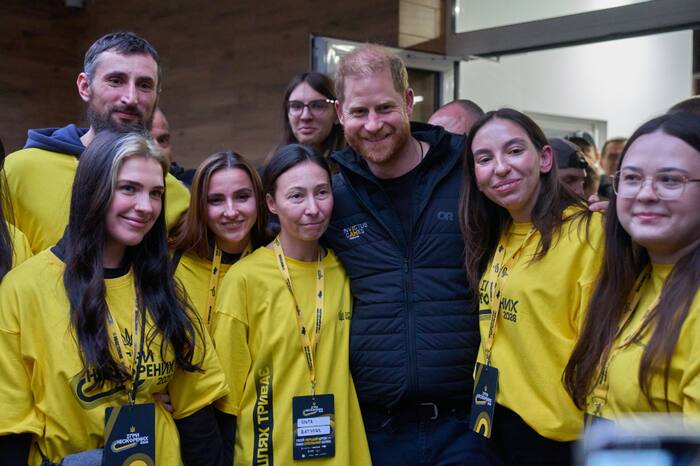
In April 2025, Prince Harry stepped quietly into that exact reality in Lviv, western Ukraine. There were no advance press briefings. No staged motorcades crawling through the historic cobbled squares for the morning television feeds. Because of strict security protocols in an active war zone, the world only learned the Duke of Sussex had crossed the Polish border into Ukraine after he had already walked the corridors of the Superhumans Center—a specialized orthopedic and reconstructive clinic treating soldiers and civilians shattered by Russian artillery, drones, and landmines.
Standard headlines reduced the trip to a tidy, predictable soundbite. They noted that a British royal, himself a veteran of two tours in Afghanistan, called wounded Ukrainian service members "role models." They mentioned his ties to the Invictus Games. They filed the story under royal diplomacy and moved on. For another perspective on this development, check out the recent update from BBC News.
That framing misses the entire point. When you strip away the palace intrigue and the transatlantic tabloid noise, what happened inside that Lviv clinic exposes a brutal truth about modern warfare—and an uncomfortable blind spot in how the rest of us look at the people who survive it.
The Architecture of a Second Life
To understand why a royal visit to a western Ukrainian hospital carries weight beyond a photo opportunity, you have to understand what the Superhumans Center actually is. It is not a traditional military hospital where patients wait passively for discharge papers. Founded in Lviv after the 2022 full-scale invasion, it operates more like an engineering lab fused with a psychological triage unit.
Consider a hypothetical patient—let us call him Taras, a twenty-six-year-old former logistics coordinator from Kharkiv who stepped on an anti-personnel mine near Kupiansk. Before the war, Taras worried about spreadsheet deadlines and weekend hiking trips in the Carpathians. Now, his daily reality revolves around residual limb shrinkage, phantom nerve pain that feels like electric shocks at three in the morning, and the grueling mechanics of learning to balance his entire body weight on a carbon-fiber socket.
In most societies, when a young man loses a leg or an arm, the cultural script handed to him is one of quiet tragedy. People lower their voices. They hold doors open with an awkward, pitying smile. They treat his survival as a footnote to his loss.
Ukraine does not have the luxury of that script.
Since February 2022, tens of thousands of Ukrainian soldiers and civilians have suffered catastrophic limb trauma. Conservative estimates from medical organizations and prosthetics providers operating in the region place the number of amputees well into the tens of thousands—a scale of blast injury Europe has not witnessed since the trenches of the First World War. When an entire generation bears visible blast scars, disability cannot be tucked away into quiet suburban rehabilitation centers. It becomes the literal streetscape of the nation.
And that changes the psychology of recovery entirely.
When Prince Harry walked through the Superhumans Center alongside wounded veterans, surgical staff, and Ukrainian officials—including Minister of Veterans Affairs Natalia Kalmykova—he was not entering a ward of broken victims waiting to be consoled. He was walking into a room full of people actively rebuilding the social contract of their country.
Think of physical rehabilitation not as fixing a broken machine, but as learning a foreign language while someone is shouting at you in a crowded room. Your brain still sends signals to nerves that no longer exist. Your center of gravity shifts by millimeters every time your residual limb swells in the afternoon heat. Falling is not an accident; it is the baseline curriculum. You fall on padded mats, you fall between parallel bars, and eventually, you fall on uneven concrete outside the clinic doors while strangers watch.
To endure that every single day requires a specific kind of stubbornness that civilians rarely have to summon.
Why the Word "Role Model" Usually Rings Hollow
We throw the phrase "role model" around cheaply. We slap it onto athletes who win endorsement deals, actors who give rehearsed charity speeches, and executives who wake up at four in the morning to drink green juice. In normal times, the term is so diluted it barely registers.
Yet when Harry looked at Ukrainian veterans undergoing prosthetics fitting and reconstructive surgery in Lviv and called them role models, the phrase hit a different frequency. Why? Because of who was saying it, and what he knows about the dark tailspin that follows military trauma.
There is no need to romanticize Prince Harry’s biography to acknowledge a basic, documented reality: he served ten years in the British Army, including two deployments to Helmand Province in Afghanistan. During his second tour, flying as an Apache helicopter co-pilot gunner, his job included providing close air support and escorting medical evacuation helicopters—missions where the consequence of a mistimed radio call or a patch of bad weather was measured in body bags.
More importantly, Harry has been unusually, sometimes uncomfortably candid about what happened after he took off the uniform. He has spoken publicly about the years he spent numbing unresolved grief and combat stress, the panic attacks triggered by camera flashes, and the disorienting identity collapse that hits soldiers when the adrenaline of deployment vanishes and is replaced by mundane civilian silence.
When a man who has lived through that specific psychological freefall looks at a Ukrainian amputee laughing on a prosthetic leg in Lviv, he is not offering royal patronage. He is recognizing a survival mechanism he knows intimately.
Veterans rarely trust sympathy from people who have never smelled cordite or sat in a hospital waiting room wondering if their best friend will make it out of surgery. Sympathy feels like distance. It builds a glass wall between the lucky and the damaged. Shared recognition, however, breaks that glass.
During his visit—which took place just days after he had been in London for a court hearing regarding his UK security arrangements—Harry met with patients at the clinic and engaged directly with Ukrainian athletes and veterans connected to the Invictus Games community. Ukraine first joined the Invictus Games in 2017, and since the 2022 invasion, the Ukrainian delegation has transformed from a competitive sports team into a lifeline for wounded fighters re-entering civilian life.
The Invisible Stakes of the Invictus Connection
To an outsider, adaptive sports can look like a heartwarming distraction—a nice weekend tournament with medals and stadium applause. That is a profound misunderstanding of how trauma actually heals.
When a soldier loses a limb or suffers a severe traumatic brain injury, the most dangerous wound is rarely the physical one. It is isolation. You go from a tightly bonded unit where every person knows your blood type and covers your blind spot, to sitting alone in a quiet apartment while your friends back at the front are still fighting—and dying. Guilt sets in. Survivor's guilt is not a poetic metaphor; it is a corrosive acid that eats away at sleep, appetite, and relationships. Left unchecked, it drives terrifying rates of substance abuse and suicide among returning veterans across every modern military, from Washington to London to Kyiv.
Adaptive sports—whether wheelchair basketball, sitting volleyball, or indoor rowing—intercept that isolation before it calcifies.
Picture a crowded gymnasium in Lviv or Kyiv. The squeak of wheelchair tires against hardwood echoes off the cinderblock walls. Two men who met three weeks ago in a surgical ward are screaming at each other over a missed pass, grinning wildly as their chairs collide at full speed. For ninety minutes, nobody in that room is a patient. Nobody is a casualty statistic in a geopolitical briefing. They are competitors. Their bodies are not sites of tragedy; they are instruments of force and strategy again.
That shift in identity is the entire engine behind the Invictus Games, which Harry founded in 2014 after witnessing the Warrior Games in the United States. By showing up in Lviv in person—becoming only the second member of the British royal family to visit Ukraine since the 2022 full-scale invasion, following his aunt Sophie, the Duchess of Edinburgh, who visited Kyiv in April 2024—Harry reinforced a critical message to Ukrainian veterans: You are not forgotten once the cameras leave the trenches.
What the Rest of Us Get Wrong About Resilience
Still, there is a trap in stories like this, and we fall into it almost every time.
When we read about wounded soldiers running marathons on carbon-fiber blades or returning to the front lines after prosthetic fittings, we love to package their grit into tidy inspiration porn. We share the headline over morning coffee, feel a brief, warm rush of admiration, and tell ourselves that human resilience is a magical, inexhaustible resource.
It is not.
Resilience is expensive. It is paid for in nightly bouts of phantom pain, in marriages strained to the breaking point by untreated post-traumatic stress, and in long, grinding battles with underfunded healthcare bureaucracies. Calling wounded veterans "role models" only means something if the societies cheering them on are willing to build the infrastructure they need to survive once the novelty wears off.
Consider what happens next in Ukraine—and in every country that sends young people to war.
Right now, clinics like the Superhumans Center are doing extraordinary, pioneering work, fitting advanced myoelectric limbs and providing psychological care free of charge to Ukrainians injured by the war. International donors, medical volunteers, and organizations like the Invictus Games Foundation have stepped into the breach.
Yet wars do not end when the peace treaties are signed. For a twenty-four-year-old soldier who lost both legs above the knee in Donetsk, the war will continue every single morning for the next fifty years. Prosthetic sockets wear out and need to be refitted as bodies age and weight fluctuates. Scar tissue tightens. Mental health crises surface five, ten, or fifteen years after the final ceasefire, long after foreign dignitaries have stopped making unannounced trips to Lviv.
I have sat across from veterans years after their wars ended, watching them trace the rim of a coffee cup while explaining how hard it is to ask for help once everyone expects you to be "over it." The hardest part of recovery is never the first six months, when flowers arrive at the hospital and politicians shake your hand. The hardest part is year seven, when your knee joint clicks in the cold rain, your patience with civilian small talk has evaporated, and nobody remembers the name of the town where you bled out on a stretcher.
That is why presence matters. Not ceremonial, sanitized presence from a safe distance, but the willingness to walk into the smell of antiseptic and look directly at the human cost of conflict without flinching.
The Weight of Showing Up
Critics will always dissect every move Prince Harry makes through the lens of royal family dysfunction. Some will argue his trip to Lviv was carefully timed to burnish his public image amid ongoing legal battles and public scrutiny in Britain. Others will point out that as a non-working royal, he carries no official diplomatic mandate from the British government.
Both observations can be true—and both can be entirely irrelevant to the man sitting on the edge of a physical therapy table in western Ukraine.
When you are twenty-five years old and learning how to walk again on titanium ankles, you do not care about British tabloid columnists or palace protocol. You care about who bothered to cross a border into a country under air-raid alerts just to sit down, listen to your story, and treat you like an equal rather than a charity case.
During his time at the clinic, Harry accepted an embroidered Ukrainian vyshyvanka shirt, spoke candidly with wounded fighters, and spent hours listening to patients and medical staff describe the realities of war trauma. There was no grand policy announcement. No peace plan unveiled at a podium. Just a former soldier standing beside newer soldiers, acknowledging the brutal, unglamorous work of putting a human life back together piece by piece.
If there is a lesson here for the rest of us—sitting safely thousands of miles from the air-raid sirens, scrolling past war updates between weather forecasts and sports scores—it is an uncomfortable one. We do not get to outsource courage to the people in those rehabilitation wards and call it a day.
Outside the doors of the Superhumans Center in Lviv, the cobblestones are old, uneven, and unforgiving on a new prosthetic foot. Every afternoon, young men and women step out onto those stones anyway, testing their balance, leaning into the weight of their own survival, refusing to disappear from the world they fought to protect.