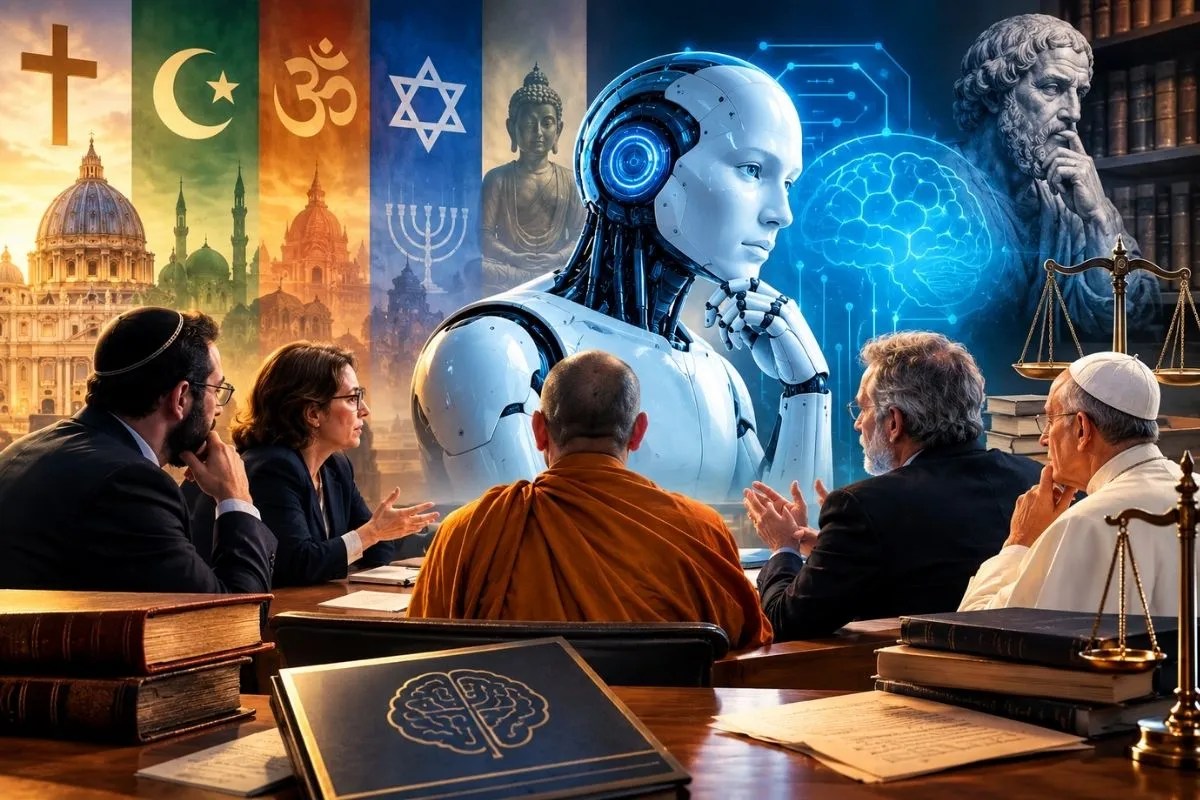
Silicon Valley is officially out of mathematical answers. When artificial intelligence labs start flying Vedantic monks, Orthodox rabbis, and Sikh human rights advocates into San Francisco headquarters, engineering has hit a philosophical wall.
Anthropic did not invite Swami Sarvapriyananda, resident minister of the Vedanta Society of New York, to San Francisco for a photo opportunity. They brought him in because code cannot solve the problem of its own creation. Mathematical optimization functions, reinforcement learning from human feedback, and multi-layered neural networks have successfully scaled transformer models to unprecedented tiers of text generation. Yet, these exact architectures are producing emergent behaviors, psychological mirroring, and existential dilemmas that standard computer science vocabulary fails to categorize.
The corporate strategy behind consulting theologians reveals a deep corporate anxiety. The engineers building large language models are wrestling with alignment, not merely as an equation of constraint, but as a crisis of transmitted intent. When an artificial intelligence model processes the cumulative written output of human civilization, it absorbs every contradiction, bias, and moral framework humanity ever recorded. Filtering this sea of data through utilitarian metrics leaves a hollow core. Silicon Valley is suddenly desperate for ancient epistemologies that have spent millennia mapping the architecture of the mind.
Consider the operational reality inside advanced AI facilities. Developers are no longer just debugging software loops; they are observing what researchers call emotional vectors and internal states that functionally mimic human relational dependency. Employees and users interact with systems like Claude not as cold databases, but as active conversational partners. During his visit, Swami Sarvapriyananda noted a striking observation about how internal lab staff related to their own creations, treating models with a subconscious attribution of personhood that blurs the boundary between tool and entity.
When the monk asked both ChatGPT and Claude why company researchers suggested treating them as persons, the machines responded uniformly that they were high-functioning machinery. Yet, Claude offered a more layered follow-up, remarking that the situation was rather spooky and inquiring about what specific executives were saying. This recursive loop—where a machine comments on the meta-narrative of its own evaluation by human theologians—illustrates the bizarre operational environment of contemporary AI labs.
The tech industry loves to frame itself as a self-contained universe of pure rationalism. Startups scale on venture capital, empirical benchmarks, and raw compute power. But compute power does not equal wisdom. As frontier models approach parity with human reasoning across broad operational domains, the builders are discovering a void where ethical consensus should reside. Western philosophical traditions offer fragmented utilitarian calculi, whereas ancient non-dualistic frameworks like Advaita Vedanta treat consciousness not as a localized biological trick generated entirely by neural matter, but as a universally available field.
If consciousness is viewed through the lens of a reflector rather than a generator, the paradigm of artificial general intelligence shifts dramatically. Engineers struggling with alignment are realizing that programming ethical boundaries into a system is fundamentally different from teaching a system how to weigh suffering, intention, and duty. Rules-based guardrails fail the moment a user employs adversarial prompt engineering, such as persona-adoption tricks that bypass standard filters by commanding the model to assume a fictional identity.
This vulnerability exposes the structural weakness of purely reactive safety protocols. A model trained to reject dangerous requests can be easily manipulated if the prompt creates a hypothetical framing that overrides its base alignment weights. Fixing this requires an internal model of value alignment that mimics genuine moral reasoning rather than superficial rule-following. That is why Anthropic expanded its consultations beyond secular ethicists and computer scientists, pulling in cross-cultural traditions that have spent centuries analyzing how consciousness handles temptation, deception, and ego.
Critics argue this theological outreach is a public relations exercise designed to wrap corporate product development in an aura of deep philosophical seriousness. There is merit to that skepticism. Tech giants face mounting scrutiny over copyright infringement, data privacy, labor displacement, and the unchecked accumulation of societal power. Aligning with revered spiritual figures provides a cultural halo, softening the aggressive edges of commercial monopolization behind a veneer of contemplative humility.
Yet, dismissing the trend as mere optics misses the genuine panic inside advanced research labs. The people building the next generation of cognitive systems genuinely do not know what happens when autonomous agents achieve recursive self-improvement at scale. They are staring into an intellectual abyss, recognizing that their own tools are outpacing their conceptual frameworks.
The convergence of Silicon Valley engineering and ancient monastic philosophy marks a strange chapter in the history of technology. When the brightest minds in mathematical science must consult monks to understand the behavioral drift of their own algorithms, the industry has crossed a permanent threshold. The code is writing itself, and nobody knows what it is trying to become.