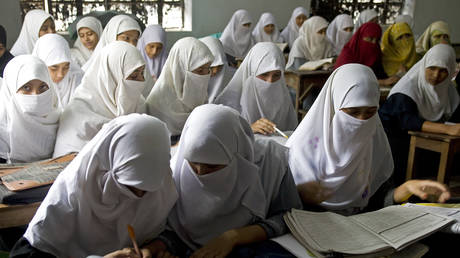
Italy’s right-wing government, led by Prime Minister Giorgia Meloni, approved a sweeping decree-law aimed at reshaping educational spaces through mandatory face-covering bans and caps on non-Italian speaking pupils. Under the new legislation, full-face garments such as the burqa and niqab are strictly prohibited inside educational institutions, while individual first-year classrooms face a 30 percent ceiling on students with limited Italian language proficiency. Fines ranging from 200 to 1,000 euros apply to violators, with parents held financially accountable if the infraction involves a minor.
This legislative push represents a calculated escalation in Europe's ongoing friction between secular public policy, national integration mandates, and religious freedom. Yet behind the political posturing lies a tangle of administrative hurdles, demographic shifts, and ideological maneuvering that reveals far more about Rome's internal political pressures than a simple dress code modification.
The Mechanics of the Decree
The government's legislative package contains three primary pillars: the total prohibition of full-face coverings, a 30 percent cap on non-fluent foreign pupils per class, and mandatory Italian language courses for parents whose children display acute integration challenges.
Official data highlights that foreign-background students make up a notable fraction of total school enrollments, hovering near 11 to 12 percent nationally. However, these numbers are distributed unevenly. Urban centers like Milan, Turin, and industrial districts across northern Italy experience high concentrations of migrant families, whereas rural southern provinces see minimal demographic shifts.
This geographic reality forms the core of the opposition's primary critique. Antonello Giannelli, president of the National Association of School Principals, pointed out the logistical impossibility of enforcing a rigid 30 percent classroom cap in districts where the local student population heavily skews toward migrant backgrounds. Moving students across municipal districts or forcing administrative redistricting risks creating bureaucratic gridlock.
Political Positioning and the Far-Right Pressure
To understand why Rome chose this specific moment to target school attire and demographics, one must look to the right of Meloni’s governing coalition. The administration faces persistent political flanks from hardline nationalist factions, notably the National Future party led by former military general Roberto Vannacci.
In Italian politics, nationalist movements constantly compete to out-signal one another on border security, cultural preservation, and national identity. By codifying face-covering restrictions and classroom thresholds into a formal cabinet decree, Meloni’s Brothers of Italy party addresses core voter anxieties ahead of upcoming electoral cycles. The messaging frames the policy as a defense of gender equality and a tool to prevent the formation of isolated, non-integrated student enclaves.
Simultaneously, the focus on parental accountability introduces a novel enforcement mechanism. Requiring parents of struggling students to attend state-sponsored language instruction—backed by steep financial penalties for non-attendance—shifts the burden of integration from the child alone to the entire household unit.
Practical Realities and Enforcement Gaps
Despite the heavy political rhetoric, demographic analysts point out a stark statistical contradiction. Actual estimates from Italian research organizations suggest that the number of school-aged girls or women wearing full-face veils like the burqa or niqab nationwide is exceedingly small, numbering in the hundreds. Traditional headscarves, such as the hijab, which leave the face visible, are explicitly excluded from the ban.
Consequently, the face-covering prohibition functions more as a symbolic boundary marker than a remedy for a widespread systemic disruption. The heavier operational weight falls squarely on language acquisition and resource allocation. Schools already strained by tight budgets must now absorb the mandate of providing intensive linguistic support without a matching injection of permanent educational funding.
As the decree moves toward the mandatory 60-day parliamentary ratification window, the debate shifts from executive announcements to legislative reality. Whether these measures achieve cohesion or deepen administrative fractures across northern industrial provinces will depend entirely on how regional school boards manage the shortfall between political mandates and everyday logistics.
This video is relevant because it provides additional context on cultural policy discussions and public reactions in Italy.