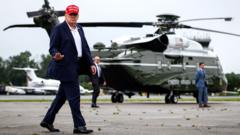
President Donald Trump threatened to bomb the Sultanate of Oman if the strategic Gulf nation interferes with Washington's naval blockade and ongoing military operations against Iran. Speaking in a broadcast interview as a crucial sixty-day diplomatic memorandum of understanding expired, Trump asserted that any Omani cooperation with Tehran regarding maritime transit through the Strait of Hormuz would trigger severe military retaliation. This escalation highlights deep fissures in Washington's Middle East policy, exposing the limits of transactional diplomacy and placing a vital regional mediator in an impossible crossfire.
Muscat has long maintained a delicate diplomatic balancing act. For decades, the Omani government functioned as the premier neutral backchannel between Washington and Tehran, hosting secret talks and facilitating prisoner swaps. That traditional role has now collided head-on with a blunt White House mandate. As Iran announced an understanding with Oman over a shared transit map for commercial shipping in the bottlenecked strait, the administration drew a hard line. The confrontation reveals not just a disagreement over maritime logistics, but a fundamental collapse of trust between the United States and its historic Gulf partners.
The Anatomy of the Maritime Chokepoint
To understand why Muscat's diplomatic maneuvering triggered such a violent rhetorical response from Washington, one must look at the geography of the energy trade. The Strait of Hormuz handles roughly a fifth of the world's seaborne oil supply. When the United States and Israel initiated military strikes against Iranian targets earlier in the year, Tehran effectively choked off commercial navigation through the northern waters, while American naval forces established a sweeping blockade to starve the regime of economic lifelines.
Control over this narrow aquatic corridor represents the single most important card remaining in Tehran's hand. By negotiating an interim transit arrangement with Oman—potentially routing incoming ships near the Iranian coast and outgoing vessels close to Omani territorial waters—Tehran sought to bypass the economic strangulation of the American blockade without formally capitulating.
Washington views any such arrangement as a leak in its containment vessel. From the perspective of national security strategists within the administration, allowing a third party to broker a functional workaround for Iranian shipping undermines the entire military campaign. Yet treating a sovereign, friendly state like Oman as an adversary for engaging in traditional diplomacy demonstrates a profound miscalculation of regional realities. Muscat is not trying to subvert American security; it is attempting to prevent an economic catastrophe in its own backyard.
The Cost of Unpredictable Diplomacy
The threats directed at Muscat underscore a broader structural shift in American foreign policy. Diplomacy is increasingly subordinated to immediate, coercive optics. By publicly declaring that the United States would violently punish a nation that has hosted American military assets and mediated regional crises for generations, the administration has signaled to every Gulf Cooperation Council member that loyalty provides zero immunity against erratic presidential outbursts.
Regional capitals are paying close attention. If a trusted partner like Oman can be publicly threatened with annihilation for trying to negotiate a safe passage agreement for commercial vessels, the value proposition of hosting American bases diminishes rapidly. Sovereign states do not enjoy living under the constant threat of friendly fire.
Furthermore, the expiration of the sixty-day diplomatic window without a comprehensive settlement proves that military pressure alone cannot force an unconditional surrender from a cornered regime. The administration insists it is in no hurry to conclude the conflict, dismissing concerns regarding the depletion of advanced munitions and air defense systems by categorizing expended stockpiles as minimal. Independent analysts, however, point to a widening gap between white-board strategic goals and industrial military capacity.
The Diplomatic Vacuum
The breakdown in Muscat highlights the absence of a credible diplomatic off-ramp. Backchannels only function when both sides accept the mediator's integrity. By threatening the mediator, Washington has effectively torched the bridge.
Iran's foreign ministry has maintained that technical discussions with Omani officials continue despite the rhetorical onslaught from the West. Tehran recognizes that Muscat represents one of the few remaining conduits to test whether an acceptable compromise on maritime sovereignty and commercial security is possible.
The administration's uncompromising stance leaves Oman with two equally perilous choices. Bowing entirely to Washington's dictates means accepting economic instability and severe friction with its massive northern neighbor, a country with which it shares a long maritime border. Defying Washington to secure the strait risks catastrophic military engagement.
As the confrontation drags past its sixth month, the rhetoric from the top grows sharper while the strategic horizon darkens. Bullying regional partners into submission may project short-term dominance on television screens, but it leaves behind a fractured alliance network, a volatile energy market, and a diplomatic landscape stripped of trusted voices capable of talking the parties back from the edge.