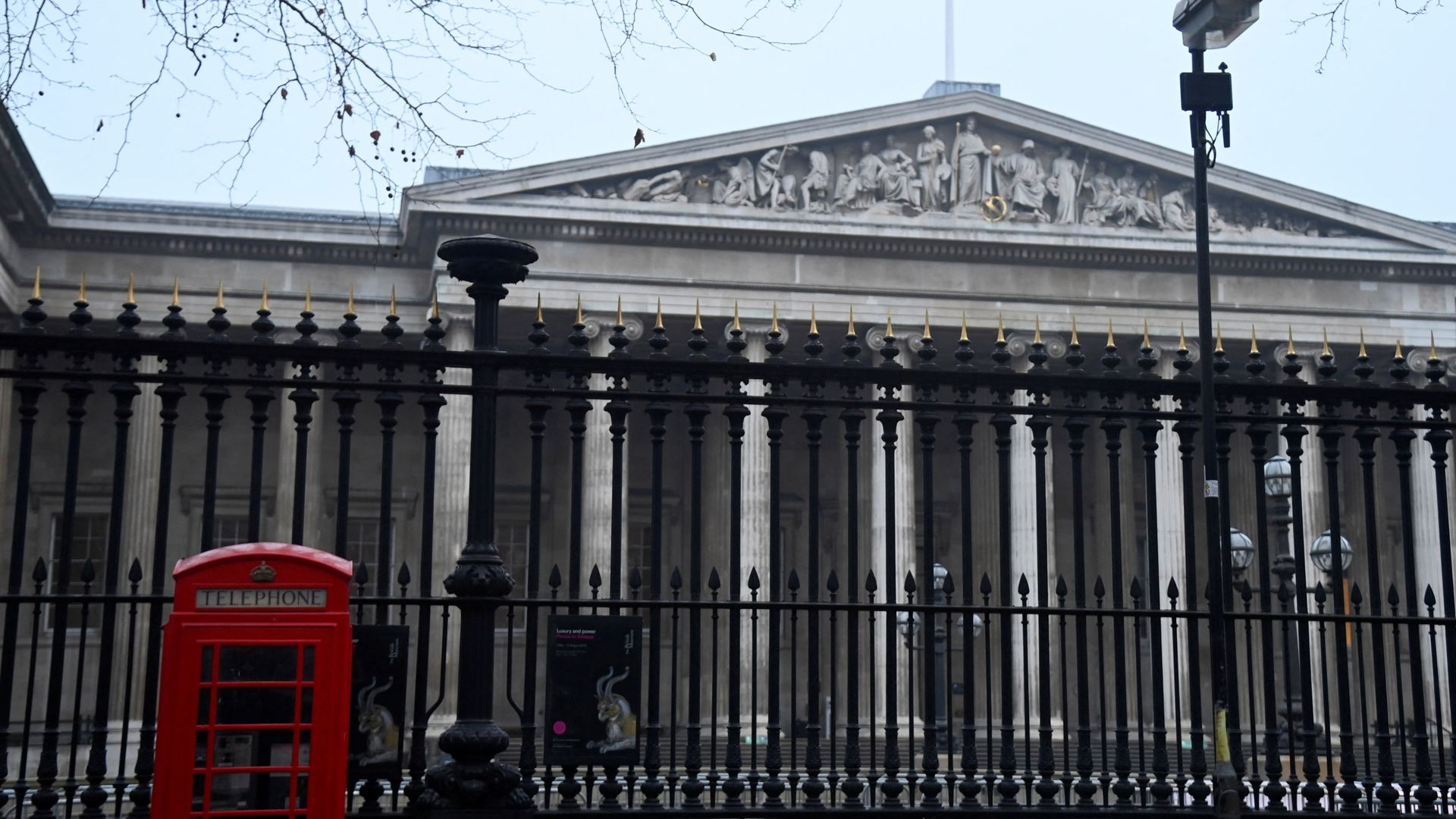
The Great Court of the British Museum is designed to feel like the center of the world. Underneath its soaring glass canopy, two tons of steel and light, the air usually carries a specific kind of hum—the sound of a thousand different languages colliding against marble. It is a space built for the "studious and curious," a monument to the idea that human history is a shared, open book.
But on a damp Tuesday in London, the book was snapped shut.
The silence wasn't the peaceful kind you find in a library. It was the heavy, pressurized silence of an institution holding its breath. Somewhere in the labyrinth of the museum's administrative wings, a decision was made to postpone a long-planned Jewish community event. The reason cited was safety. The underlying cause was a fear of protest.
When we talk about "security concerns" or "logistical delays," we often treat them as neutral, bureaucratic hurdles. They aren't. In the cultural heart of London, these words have become a shorthand for something far more visceral: the slow retreat of public life in the face of anticipated friction.
The Ghost in the Gallery
Consider a hypothetical visitor named Sarah. She isn’t a politician or a professional activist. She is a teacher who had been looking forward to a night of music and history, a celebration of Jewish heritage curated within the walls that house the Rosetta Stone. For Sarah, the museum isn't just a building; it’s a neutral ground where the modern world’s jagged edges are supposed to be sanded down by the perspective of centuries.
She receives an email. The event is off. Not cancelled, the museum insists, but delayed.
The email doesn't mention the specific threats or the intelligence reports. It uses the sanitized language of "operational risks." To Sarah, however, the message is clear: your presence here has become too complicated to protect.
This is where the human cost of institutional caution begins to accrue. When a world-renowned museum—an entity with a budget of millions and a security force larger than some small-town police departments—decides it cannot host a community event because people might shout outside its gates, it sends a tremor through the city. It suggests that the loudest voices in the street now hold a veto over what happens inside the sanctuary of history.
The Architecture of Hesitation
The British Museum is no stranger to controversy. Its very foundation is built on the complicated, often painful acquisition of global treasures. It has weathered decades of debates over the Elgin Marbles and the Benin Bronzes. It is a place that knows how to stand its ground against the winds of geopolitical change.
Yet, there is a fundamental difference between a debate over where an object belongs and a decision about who is allowed to gather.
By postponing the event, the museum’s leadership likely thought they were choosing the path of least resistance. They wanted to avoid the "optics" of police cordons and shouting matches in the shadows of the Parthenon frieze. They wanted a quiet Tuesday.
What they got instead was a different kind of noise.
The criticism came fast and from every direction. To many, the delay felt less like a safety measure and more like a surrender. If the British Museum—the literal storehouse of Western civilization—cannot find a way to safely host a Jewish event during a period of heightened tension, what hope is there for the local community center? What hope is there for the high street?
The stakes are invisible until they aren't. Every time a door is locked because of "protest fears," the definition of public space shrinks. We are witnessing the birth of a New Caution, a policy where the mere possibility of a demonstration is enough to trigger a cultural blackout.
The Weight of the Precedent
Imagine the internal meetings. Picture the boardroom tables where curators and security heads sit beneath oil paintings of Victorian explorers. They are looking at spreadsheets of risk assessments. They are weighing the cost of extra security guards against the potential for bad PR.
They are thinking about the glass. The British Museum is, after all, a house of glass. One brick, one spray-paint can, one viral video of a disrupted event can feel like a catastrophe to a director.
But there is a weight they often fail to put on the scale: the weight of the precedent.
When an institution of this magnitude flinches, it provides a roadmap for future disruption. It signals to any group with a grievance that the threshold for shutting down an event is remarkably low. You don't even have to show up. You just have to make the museum think you might.
This is the "Heckler’s Veto" in its most institutionalized form. It isn't just about the Jewish community or the specific tensions of 2024 and 2025. It is about the creeping realization that our most cherished spaces are becoming conditional. You are welcome, provided you don't attract the wrong kind of attention.
The Loneliness of the "Delayed"
There is a specific kind of exhaustion that comes with being told your identity is a security risk.
For the organizers of the Jewish event, the delay wasn't just a calendar entry being moved. It was a rejection of their normalcy. It was a reminder that even in the heart of London, their culture is viewed through the lens of a "situation to be managed."
We often talk about "fostering" inclusion—a word so overused it has lost all its teeth. True inclusion isn't a poster in a lobby. It is the boring, difficult work of making sure a group of people can meet for a lecture or a concert without it being treated like a tactical military operation.
The museum’s leadership argued that they were acting in the best interests of the visitors’ safety. And perhaps, on a strictly physical level, they were. No one was hurt. No statues were toppled. No glass was broken.
But something else was fractured.
The trust that the museum is a place for everyone, regardless of the political climate outside, has been thinned. When you tell a specific group of people that the "operational risk" of their presence is too high, you are effectively telling them they are guests in their own city—guests whose invitations can be rescinded the moment the neighbors start to grumble.
The Museum of What Could Have Been
The Great Court remains open. The tourists still buy their postcards. The mummies still rest in their climate-controlled cases.
But for those who were supposed to be there that Tuesday night, the museum is currently a collection of empty spaces. The music that wasn't played and the stories that weren't told are now part of the building's history too. They are the artifacts of an era of hesitation.
We live in a time where the impulse to de-escalate is often indistinguishable from the impulse to disappear. We find it easier to cancel, to postpone, and to wait for a "better time" that never quite arrives. We tell ourselves we are being responsible. We tell ourselves we are keeping the peace.
But peace that requires the exclusion of a community isn't peace at all. It’s just a very quiet form of exclusion.
The British Museum was founded on the Enlightenment ideal that knowledge should be accessible to all. That ideal is messy. It is loud. It requires a spine. It requires the understanding that a museum isn't just a place to look at the past, but a place to defend the present.
As the sun sets over the Bloomsbury roofline, the columns of the museum look as solid as they did two hundred years ago. They are made of Portland stone, designed to endure for millennia. They can withstand the rain, the wind, and the passage of time. The question is whether the people inside them can withstand the pressure of a difficult afternoon.
The gates are still there. The guards are still there. But the lights in the hall are dim, and the seats are empty, and the most important exhibit in the building right now is the silence where a community’s voice should have been.
A museum that is too afraid to open its doors to everyone is eventually just a very expensive warehouse for things that used to matter.