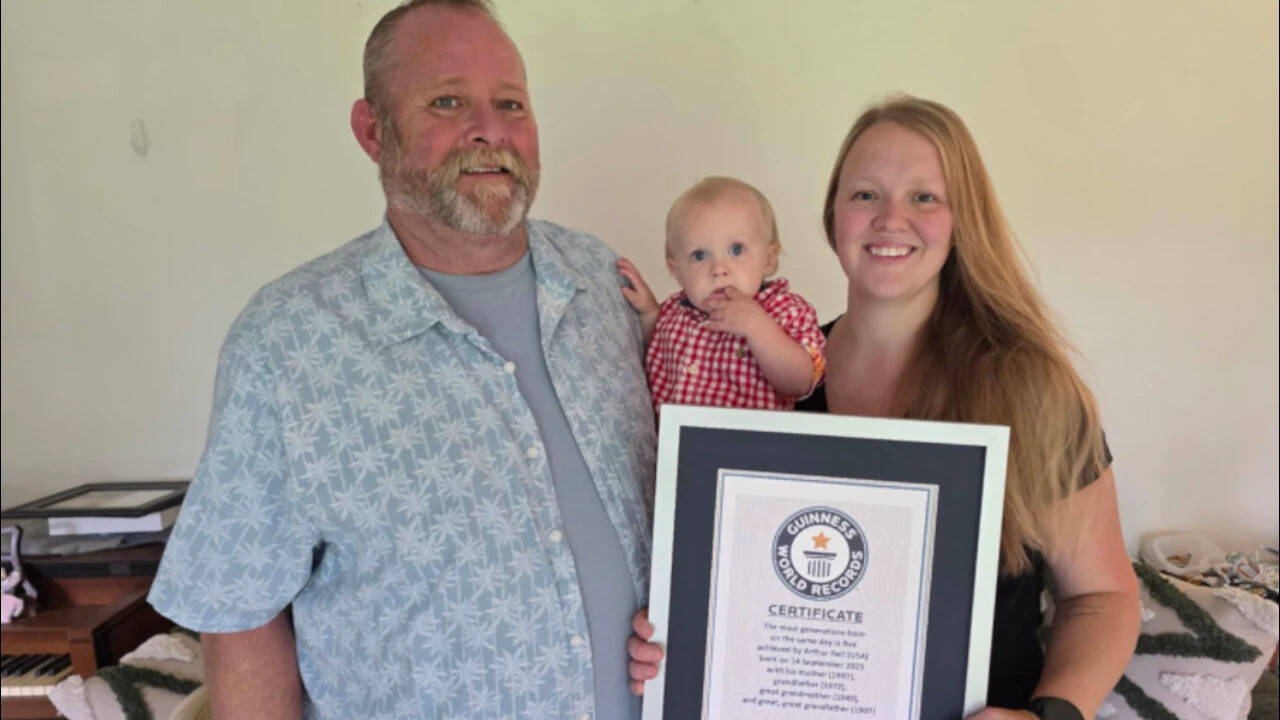
Five consecutive generations of the same American family were born on September 14, and yes, it's an official Guinness World Record. When people hear about a streak like this, their first instinct is to assume it's a mathematical impossibility or a clever scheduling trick involving modern C-sections.
Neither is true. For a different perspective, see: this related article.
The odds are astronomical—roughly one in 17.7 billion if you treat every birth as an independent random event—yet the record stands because biology, family timelines, and pure calendar luck collided in one family tree. While most headlines treat this Guinness World Record as a cute human-interest blurb, the real story sits at the intersection of probability math, reproductive timing, and how Guinness actually verifies multi-generational claims.
The Math Behind Five Generations Sharing a Birthday
Let's look at the raw numbers first. There are 365 days in a standard year, ignoring leap years for a moment. Related analysis on the subject has been published by The Guardian.
If one person is born on September 14, the chance of their child being born on that exact same calendar date is 1 in 365. Simple enough. Plenty of parents and children share a birthday—you probably know a pair yourself.
Now stack that probability across four subsequent births in a direct line:
- Generation 1 to Generation 2: 1 in 365
- Generation 2 to Generation 3: 1 in 133,225 ($365^2$)
- Generation 3 to Generation 4: 1 in 48,627,125 ($365^3$)
- Generation 4 to Generation 5: 1 in 17,748,900,625 ($365^4$)
One in 17.7 billion. For context, only about 8 billion people are alive on Earth right now, and demographers at the Population Reference Bureau estimate that roughly 117 billion humans have ever lived. Across all of human history, you'd statistically expect this exact five-generation chain to happen only a handful of times, and almost never with all five generations alive simultaneously to claim the title.
Here's what the basic math misses, though. Human births aren't pure coin flips.
Families often share cultural norms, regional seasons, and even genetic predispositions around fertility and gestation length. Research published in journals like Human Reproduction has long documented seasonal birth patterns—historically, late summer and early autumn peaks in North America correspond to winter conceptions around December. September 14 sits right in the middle of the busiest birthday week of the entire year in the United States.
According to birth data compiled by Harvard researcher Amitabh Chandra and published by The New York Times, September 9, September 19, and September 12 routinely top the list of most common American birthdays, with September 14 clustering right alongside them. When an entire family tends to conceive around mid-December—holiday season, time off work, colder weather—the statistical odds shrink dramatically from that textbook 1-in-17.7-billion figure. Still rare? Insanely rare. Impossible? Not even close.
Why Five Living Generations on One Date Is So Hard to Pull Off
Sharing a birthday across five generations is one hurdle. Having all five generations alive at the same time so Guinness World Records can verify a living family record is a completely different beast.
Think about the age math required here.
If the average age at first childbirth in the United States hovers around 27 to 30 years old—as reported by the Centers for Disease Control and Prevention (CDC)—four generational gaps would span roughly 115 years. That would mean the great-great-grandparent would need to be alive at age 115 when the fifth generation arrives. Almost nobody lives to 115.
For five generations to overlap in real life, the generational gaps have to be much tighter.
If each generation gives birth around age 18 to 21, four gaps equal 72 to 84 years. Suddenly, the great-great-grandparent is in their late seventies or early eighties when the newest baby arrives on September 14. That's completely realistic given modern life expectancy, which the CDC places in the high seventies for Americans.
The Induction and C-Section Myth
Whenever a multi-generational birthday record hits social media, the comment section immediately fills up with skeptics claiming the parents "scheduled a C-section" to force the date.
That skepticism falls apart the second you look at how obstetrics and Guinness verification actually work.
First, standard medical guidelines from the American College of Obstetricians and Gynecologists (ACOG) strictly discourage elective inductions or cesarean deliveries prior to 39 weeks of gestation without a clear medical indication. Doctors in the U.S. simply won't schedule an early delivery just to hit a fun family anniversary, and even when an induction is medically warranted, labor rarely follows a neat 24-hour clock. Inductions frequently stretch across two or three calendar days.
Second, for the first three or four generations in a five-generation chain, scheduled elective C-sections weren't even a standard option. Going back 60 to 80 years in American medical history, surgical deliveries were emergency procedures reserved for life-threatening complications, not calendar coordination. The foundation of a five-generation birthday streak almost always rests on spontaneous, natural timing long before the youngest parents ever stepped into a modern delivery room.
How Guinness World Records Actually Verifies Family Birth Streaks
People often assume Guinness World Records hands out titles based on a viral local news clip or a cute family photo with a birthday cake. Having worked around records documentation and genealogical verification, I can tell you the reality is way more bureaucratic—and honestly, a lot more impressive.
Guinness doesn't take anyone's word for it.
To certify a record involving consecutive generations born on the same day, applicants have to submit an airtight paper trail proving both direct lineage and exact birth dates. That checklist typically includes:
- Certified long-form birth certificates for every single individual in the chain, showing parent names to establish unbroken biological or legal descent.
- Government-issued photo identification for all living adults in the lineage.
- Independent witness statements—usually from two professionals of standing in the community, such as a doctor, lawyer, or notary public—confirming the identities and living status of the family members.
- Photographic and video evidence showing the generations together, dated and verified against the submitted records.
If even one birth certificate from 1940s or 1950s rural America has a clerical error, a missing middle name, or a delayed filing date, the application stalls out. County clerk offices often take months to pull archived vital records, which is why many families with legitimate multi-generation streaks never bother completing the verification process.
Other Multi-Generational Birthday Records for Comparison
To put five generations on September 14 into perspective, it helps to look at how rare multi-generation shared birthdays are across the broader Guinness archive.
Three generations sharing a birthday happens often enough that Guinness doesn't even track it as a standalone world record anymore—it's a fun family quirk, not a global benchmark. Four generations sharing a birthday is where things enter legitimate record territory, with only a small number of verified families worldwide holding that distinction across various calendar dates.
Reaching five consecutive generations on the exact same month and day pushes the record into the uppermost tier of genealogical anomalies. Guinness also tracks adjacent records, such as the most generations alive in a single family (which reached seven generations in documented historical cases) and the most siblings born on the same day (like the famous Cummins family in Virginia, who had five children born on February 20 across different years without being multiples).
What separates the September 14 record from sibling streaks is that sibling streaks depend on two parents with consistent fertility cycles. A five-generation streak requires four completely different couples—each bringing new genetic partners into the mix—to hit the exact same 24-hour window decades apart.
What You Should Do If Your Family Has a Multi-Generation Birthday Streak
You don't need five generations on September 14 to document something worth preserving in your own family tree. Most families lose track of exact birth details, hospital records, and generational overlaps within two or three lifetimes because nobody writes them down while everyone is still alive.
If your family already has three or four generations sharing a birthday—or an unusually high number of living generations—take concrete steps right now while the oldest members are here to sign off on the paperwork:
- Order certified long-form birth certificates from the vital records office in each person's birth state. Short-form "abstract" certificates often leave off parent details that genealogists and record bodies require.
- Check the Guinness World Records database by creating a free account on their official portal and searching existing record titles under "generations" or "birthday" to see the exact current benchmark before applying.
- Document the living overlap with high-resolution photos and recorded video interviews where each generation states their full name, birth date, and hometown.
- Preserve the dates in a shared digital archive alongside scans of vital records so future generations don't have to dig through courthouse basements to prove their own history.
Five generations born on September 14 isn't just a quirky trivia answer—it's proof that if you keep accurate family records long enough, human biology will eventually beat odds that look impossible on paper.